




21st-century warfare is also war of ideas, technology and adaptability, says Defence Minister Rajnath Singh
STC NEWS MONITORING DESK
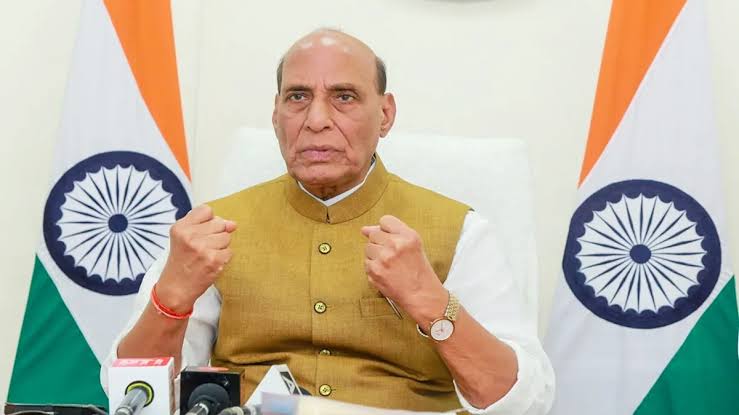
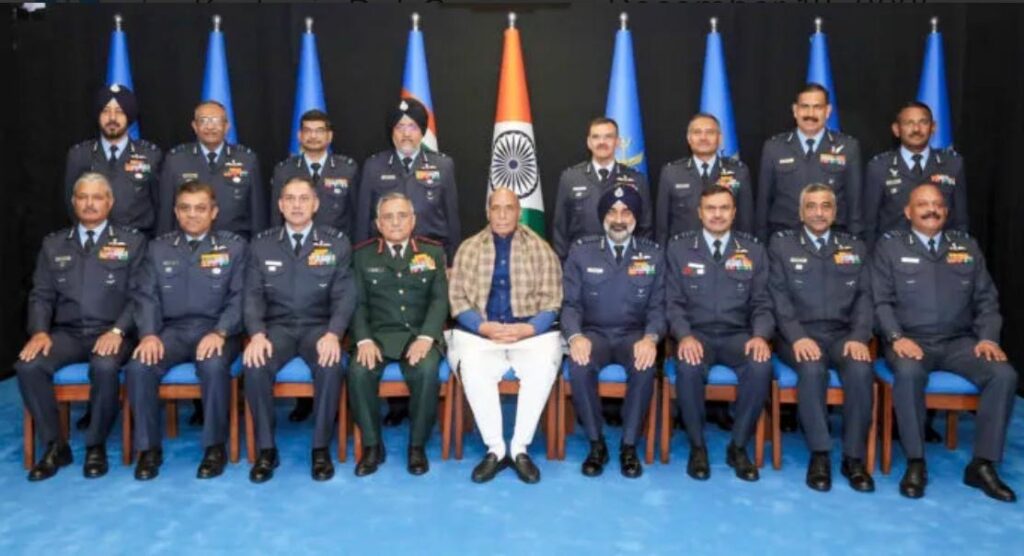
NEW DELHI, DECEMBER 18 (STC): Defence Minister Rajnath Singh in his address at the Air Force Commanders’ Conclave here today has underlined that “21st-century warfare is not just a war of weapons”, but also a “war of ideas, technology and adaptability”. At the same time, he has urged air force commanders to draw lessons from the decisive military action during Operation Sindoor and stay prepared to deal with every future challenge.
“21st century warfare is not just a war of weapons. It is a war of ideas, technology and adaptability. Cyber warfare, Artificial intelligence, unmanned aerial vehicles, satellite-based surveillance and space-enabled capabilities are fundamentally changing the future of warfare,” He said.
“Precision-guided weapons, real-time intelligence and data-driven decision making are no longer optional, they have become basic requirements for success in modern conflicts. Those nations which master the trinity of technology, strategic vision and adaptability will move towards global leadership,” he added.
He praised the courage, speed and precision with which the Indian Air Force (IAF) destroyed terror camps during Operation Sindoor and effectively handled the “irresponsible reaction” from Pakistan after the Indian strikes, the defence ministry said.
“India’s high-impact, short-duration operational capability was demonstrated by the armed forces during Operation Sindoor,” Singh said, as he described the IAF as a technologically-advanced, operationally-agile, strategically-confident and future-oriented force, which safeguards national interests amid the constantly-evolving global order.
Underscoring the importance of thoroughly understanding the “enemy’s offensive and defensive capabilities” to maintain a decisive advantage, the defence minister urged the commanders to draw lessons from Operation Sindoor and stay vigilant and ready to deal with every future challenge.
Highlighting people’s trust in the armed forces, especially the air-defence capability, Singh said, “Usually, when the enemy attacks, people hide. But when the Pakistani forces tried to target Indian installations, the people of India remained calm and continued with their daily routines. This is a proof of the trust of every Indian in our operational preparedness.”
Reflecting on the changing nature of warfare, Singh said the Russia-Ukraine conflict, the Israel-Hamas war, the Balakot air strikes and Operation Sindoor have proved that air power has emerged as a decisive force in today’s times.
Air power is not just a tactical asset, but a strategic instrument, and speed, surprise and the shock effect are its inherent characteristics, he asserted.
“Air power gives any leadership the capability to deliver a clear strategic message to the adversary that every step will be taken to uphold national interests. Through speed, reach and precision, air power has become an effective tool for aligning the nation’s objectives with military means,” Singh said.
Commending the performance of India’s air-defence system and other equipment, effectively used during Operation Sindoor, the senior Bharatiya Janata Party (BJP) leader reiterated the commitment of the government, led by Prime Minister Narendra Modi, to further strengthening India’s security apparatus.
The conclave was attended by Chief of Defence Staff General Anil Chauhan, IAF chief Air Chief Marshal A P Singh and other senior IAF commanders.
Singh also lauded the IAF for its humanitarian assistance and disaster-relief efforts, both domestically and internationally.
“Whether at home or abroad, the IAF has consistently provided critical support during natural calamities. Many of the missions were executed in extremely challenging situations which has increased the trust of the people in our air warriors,” he said.
(Straight Talk Communications I Inputs from Agencies)