


I’m A Concerned Citizen
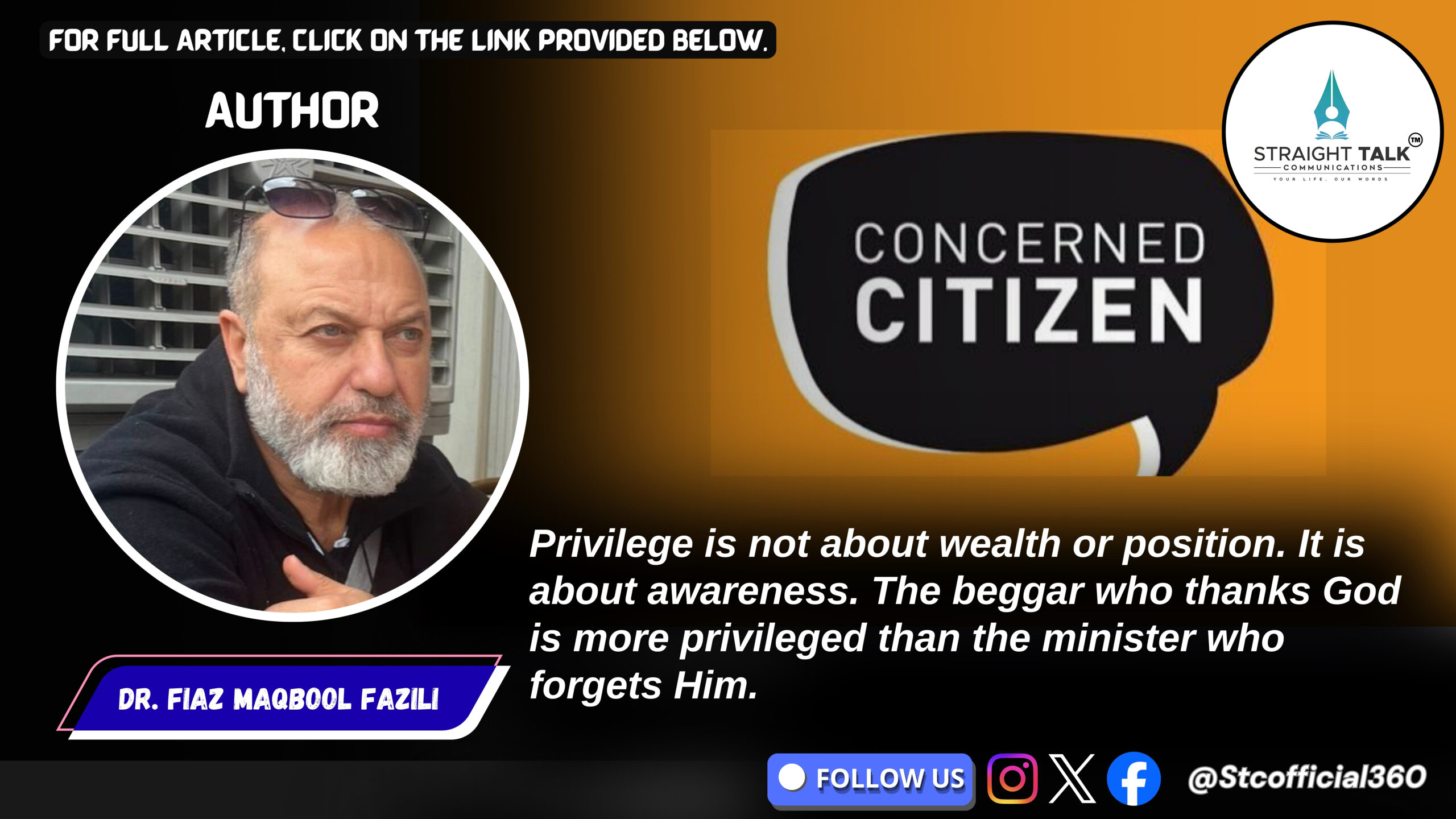
Privilege is not about wealth or position. It is about awareness. The beggar who thanks God is more privileged than the minister who forgets Him.
Dr. Fiaz Maqbool Fazili
There are moments when silence becomes heavier than noise; when the crowd within the mind grows louder than the one outside. In those moments, I often find myself arguing with an invisible voice — the one that questions, that mourns, that reminds me of truths I would rather forget. It whispers that I, like many others, am privileged. Not in the material sense alone, but in the deeper sense of having awareness, access, and choice — the privilege of knowing what is right and still hesitating to act on it. The privilege of having a conscience that keeps burning while so many have smothered theirs to comfort.
Yet, what do we do with this privilege? Most of us live fenced between awareness and apathy, knowledge and inaction. We raise our voices when convenient, fall silent when truth becomes uncomfortable, and call ourselves victims when in fact we are complicit. That voice inside me does not let me rest. It asks: what right do I have to lament about the decay of society if I contribute nothing to its revival except occasional outrage or poetic sighs?
I am a citizen who has seen the change of seasons in Kashmir — not just of weather, but of morality, civility, and compassion. Once, our people valued humility, the dignity of work, the honesty of trade, and the warmth of community life. Today, those values seem like old coins no longer in circulation. We trade respect for influence, faith for fear, friendship for benefit, and intellect for convenience. The collective conscience has become an archive of lost ideals. The voice in my mind cries, not because it is angry, but because it still remembers what we were capable of being.
It tells me that privilege is not a sin, but waste is. We are privileged to have education, but we misuse it to manipulate, not to enlighten. We are privileged with health, yet we live recklessly. We are privileged with access to knowledge, yet we allow ignorance to rule our homes and institutions. We are privileged with social media, but we use it for slander, not for solidarity. We live in a land blessed with beauty, but we destroy it with indifference. We have faith, but not the patience or purity it demands. And when consequences strike, we call them destiny — as if God Himself is responsible for our neglect.
I have walked through the corridors of hospitals, schools, courts, and offices — and everywhere, the same fatigue echoes. Not physical fatigue, but moral exhaustion. People have stopped believing in goodness because it no longer seems profitable. Even service has become a currency. The tragedy is not just corruption in money, but corruption of the soul. We have learned to justify our wrongs so artfully that we no longer recognize them as wrong. The voice inside me mocks me: “You too are part of this system, Dr. Fazili — do not exclude yourself from the disease you diagnose.”
That voice is not wrong. I am privileged to be educated, to have a profession, to have seen both the world’s refinement and its hypocrisy. But what is that privilege worth if I cannot use it to awaken even one sleeping conscience around me? Every time I write, speak, or protest, it feels like throwing pebbles into a dark well, waiting for an echo that never returns. Yet, silence would be worse. Because silence is consent, and I refuse to consent to decay.
There was a time when being a “concerned citizen” meant something. It meant you carried the burden of others’ pain as if it were your own. It meant you stood by truth even when it isolated you. Today, to be concerned is to be mocked. To be ethical is to be called naïve. To speak up is to be labeled troublesome. And so, most retreat into comfort zones, convincing themselves that they can’t change the world. But change never required everyone — it only required the few who refused to go numb.
I often think of the old man I once saw at the foot of the Jhelum, washing his clothes in the murky water while whispering prayers. His back was bent, his clothes tattered, yet his dignity was intact. He didn’t complain, he didn’t beg. I looked at him and thought: he is poor, but maybe richer in peace than many of us who own everything except contentment. That day, the voice inside me said, “You see privilege differently now — it is not what you have, but what you still value.”
Our tragedy lies not in scarcity but in blindness. We see our possessions, but not our blessings. We see our struggles, but not our opportunities. We see others’ faults, but not our hypocrisy. We pray, but without meaning. We read, but without reflection. We live, but without gratitude. We complain that the world has become cruel, yet we forget that cruelty thrives on the silence of the good.
I have written many times about ethics, faith, social decay, and civic responsibility. But lately, I realize all of these are merely different names for one illness — the loss of humility. When man forgets his smallness before God, he becomes a monster to his fellow beings. The voice inside me often repeats the verse: “Do not walk on the earth with arrogance, for you can neither pierce the earth nor reach the mountains in height.” (Qur’an 17:37). But arrogance is now our second skin — intellectual, financial, political, even spiritual arrogance. We flaunt status, not service. We build mosques but destroy brotherhood. We worship rituals, not values.
Still, I am not hopeless. Because that inner voice, though painful, is also a mercy. It reminds me that conscience, however wounded, is not dead. It speaks in the darkness, urging me to stay human in an age of hardness. It tells me that reform begins not in assemblies or slogans but in the silent revolution within a single heart. Each act of honesty, each moment of restraint, each refusal to exploit — these are small rebellions against the culture of decay.
When I see young volunteers cleaning our lakes, students standing up for animal rights, or doctors treating the poor without fee, I feel the same voice smile for a change. These are signs that the flame still flickers, that goodness has not gone extinct — only overshadowed. What we need is to listen more to that inner voice and less to the noise of the crowd.
The truth about the voice inside my mind is that it is not mine alone. It belongs to every citizen who still feels uneasy in the face of injustice, who still blushes at wrongdoing, who still believes that character matters more than comfort. We are all privileged to still feel — because feeling is the last proof that our hearts are alive.
In the end, privilege is not about wealth or position. It is about awareness. The beggar who thanks God is more privileged than the minister who forgets Him. The student who studies by candlelight is more privileged than the one who cheats under chandeliers. The citizen who cares, even silently, is more privileged than the one who thrives in indifference.
The voice inside my mind will not be silenced. It may tremble, it may break, but it will not lie. For truth is not a sermon — it is a wound that refuses to heal until society heals with it. And until that happens, I will continue to write, to speak, and to remind — because I still believe, against all odds, that one conscience can awaken another.
Contact number: 9149727567
(Dr. Fiaz Maqbool Fazili is a medico, a concerned citizen who voices concerns on social and moral life can be reached at drgiazfazili@gmail.com)