


The ‘Why’ That Refuses to Die
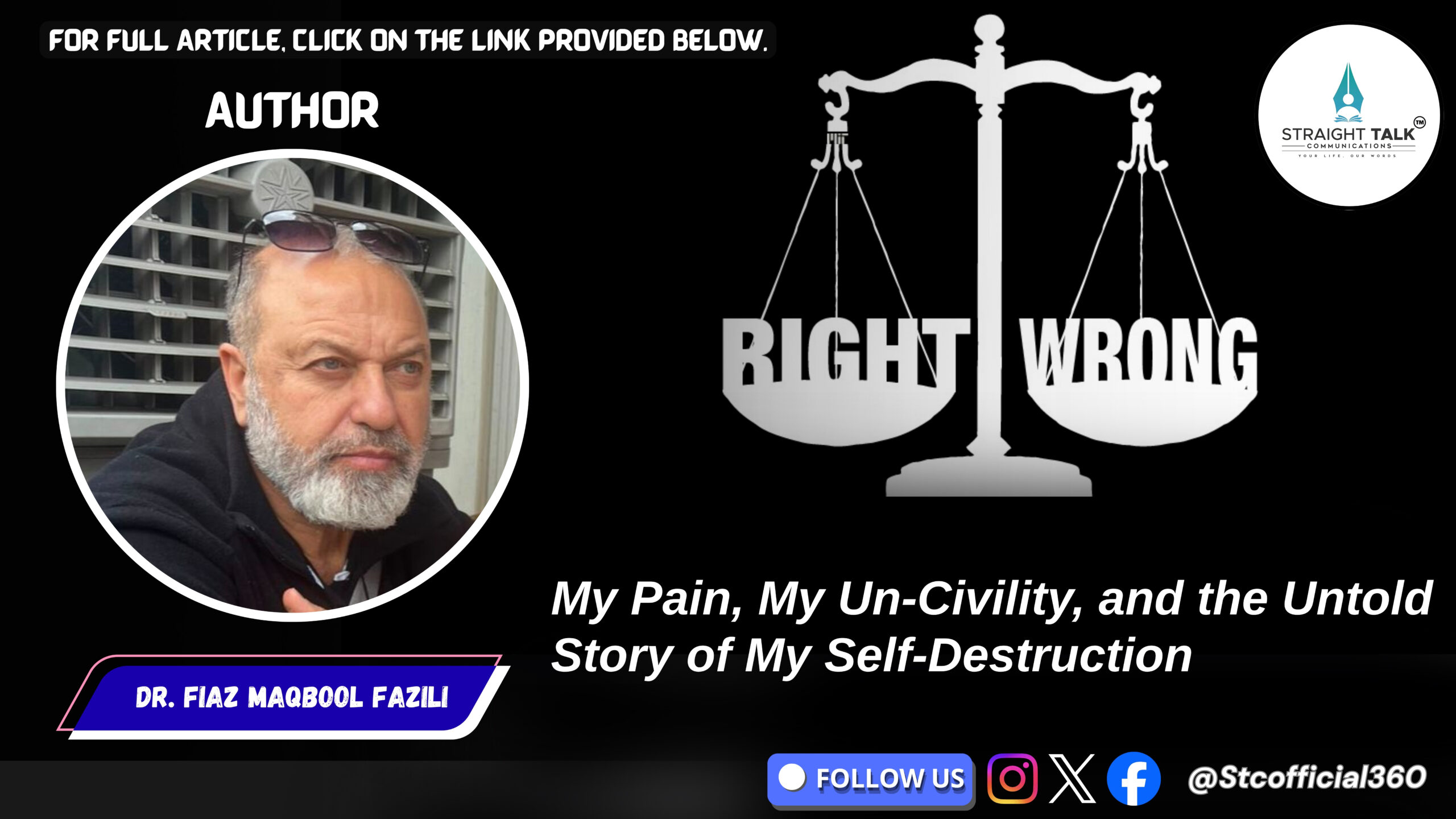
My Pain, My Un-Civility, and the Untold Story of My Self-Destruction
Dr. Fiaz Maqbool Fazili
There are certain questions that haunt me from many years yet answer themselves through silence. Why has our moral compass rusted? Why has civility become a rarity and arrogance a social fashion? Why have ethics and professionalism been reduced to slogans rather than lived virtues? Somewhere along the road, we stopped listening to conscience and started worshipping convenience. Our downfall did not arrive overnight—it was self-engineered, born of pride, greed, misplaced priorities, routes and ignorance disguised as intellect. Each unanswered “why” points inward, reminding us that the decay of society begins with the decay within ourselves.
Of all the names bestowed upon this land, none rings with such poignant, tragic irony today as “Firdous” – Paradise. It was not a mere label but a testament to a reality, a divine endorsement of a valley cradled by snow-clad peaks, adorned with shimmering lakes, and breathing through vast, ancient forests. We, the inheritors of this “Firdous”, were not just its residents; we were its custodians, woven into its very ecological and spiritual fabric. Yet, the untold story of our time is not one of external conquest, but a profound, sustained, and heartbreaking act of self-destruction. We have, with a relentless hand, taken a masterpiece of nature and are methodically erasing it, and in the process, erasing ourselves.
Look around, not with the eyes of a tourist seeking a faded postcard, but with the stark clarity of a resident. The forests that once stood as silent, sentinel guardians, regulating our climate, holding our soil, and housing our biodiversity, have been cut down mercilessly. The symphony of birds that once defined our dawns has faded; the flora and fauna that were the living jewels of this paradise are now ghosts, remembered only in the stories of our elders. Our glaciers, the frozen reservoirs of our lifeblood, are in retreat, weeping icy tears for a future they see all too clearly. The very water that gives us life has been betrayed. Our lakes and rivers, once revered, are now choked, polluted, and shrinking, their banks violated by the concrete arrogance of encroachment.
We have built with a foolish defiance, ignoring the ancient wisdom of the land. We constructed homes and markets in the natural pathways of floods, and now, with every small downpour, a collective anxiety grips us. The looming flood is no longer an act of God, but a predictable consequence of our own folly. Our cities, particularly Srinagar, are a portrait of chaos. Illegal constructions sprout like unchecked weeds. Traffic is a daily nightmare of frustration, a monument to poor planning and worse disobedience of commuters. The great chowks of Hyderpora, Jehangir Chowk, and Karan Nagar are not intersections but colossal chokes, where time, fuel, and patience evaporate into the polluted air. Pedestrian ways, meant for the citizen, are occupied by hawkers, forcing a perilous dance with traffic. Bridges, engineered for movement, have been usurped as bus stops, defeating their very purpose.
But this physical decay is merely the symptom of a far deeper, more insidious sickness of the soul. What have we done to ourselves, to our fellow citizens? We have fed our people poison. From the rotten meat in our markets to the adulterated food in our shops, from the chemical-laced fruit to the bakery and spurious medicines in our pharmacies, we have commodified health and betrayed trust. The very sustenance of life has been turned into a potential weapon of profit. This moral bankruptcy extends beyond the marketplace into the most sacred of our social rituals. Our marriages have become garish displays of imported cultures, a hollow performance of wealth that has stripped the occasion of its authentic joy and community spirit. Even our funerals, moments of profound grief and final respect, are increasingly becoming platforms for public display, where the number, type of attendees matters more than the sincerity of the prayer.
Our two pillars of civilizational progress—health and education—are running compromised processes. In hospitals, the quality of care is often dictated not by need but by connection. In schools and universities, we have lost the sacred respect for merit. The relentless pursuit of shortcuts has corrupted the minds of our youth even before they can fully form. We have produced a generation that is often taught that what you know is less important than who you know. We have lost our ethical compass, and in doing so, we have lost our voice.” The very people we entrusted to be our voices of concern, our conscience, now often speak in whispers, compromised by the very systems they were meant to change”, many Senior citizens share this viewpoint.
The most painful evidence of this inner decay is the specter of drug addiction that haunts our youth. It is a quiet, insidious genocide, robbing our future of its vitality and hope. Stories of immorality and a complete loss of ethical boundaries in public and private life shatter the very foundation of what we once proudly called Kashmiriyat—a centuries-old tradition of tolerance, community co-existence, and integrity. What is pure left in this wounded paradise? Even corruption, it seems, is now done in an “honest” way, brazenly, without a hint of shame, as if it were a legitimate tax for existence.
As a columnist, one is left with a profound sense of despair. We write, we warn, we alert, we plead. Yet, the most common comment I receive is a devastating allegory: “You are selling mirrors in a city of the blind and distributing combs in a city of the bald.” The implication is crushing—that our words are useless, that the people are incapable of seeing the truth or have no need for the solutions offered. It forces a moment of agonizing introspection: Should I stop writing about what disturbs my surroundings? Is this relentless highlighting of our failures a futile exercise?
The answer, however, is not silence. The problem is not that the city is blind or bald. The problem is a deep-seated denial, a collective preference for comfortable lies over uncomfortable truths. The question is not whether we should speak, but what we should speak about, and to whom. We need to change our preferences, our corridors, and the doors we are knocking on.
Knocking on the doors of apathetic institutions and corrupt corridors of power has yielded little. Perhaps the door we must knock is different or on most fervently is the door of our own conscience. The change must begin at the most fundamental level—within our families, our homes, and our own choices. Do we choose the adulterated product because it is cheaper, or do we stand for purity even at a cost? Do we seek a shortcut for our child’s admission, or do we instill in them the value of hard-earned merit? Do we remain silent when a flood channel is encroached, or do we find the courage to object?
The lament of the poet, “Khazir suchta hai Dal kinarey” The Buck Stops Where, starting from me first, (Khazir is searching on the banks of the Dal), is not just a line of verse. It is the cry of every conscious Kashmiri soul searching for the remnants of that lost paradise. We are all “Khazir’s “, searching for a reflection of our former glory in the polluted waters of our present. The search will be in vain if we only look to the government, the authorities, or some external saviour. The redemption of our “Firdous”, begins with a million individual acts of integrity, responsibility, and love. It begins when we stop being spectators to our own demise and become gardeners of our own paradise, however small our patch may be. The choice is stark: to continue this spiral of self-destruction, or to finally, humbly, begin the long and difficult work of self-correction. The mirror is being held up; it is time for us to open our eyes and look.
(Author is a concerned citizen can be reached at drfiazfazili@gmail.com)