





SUNDAY BYTES: Zero Tolerance for Negligence to Restore Safety and Trust in Healthcare
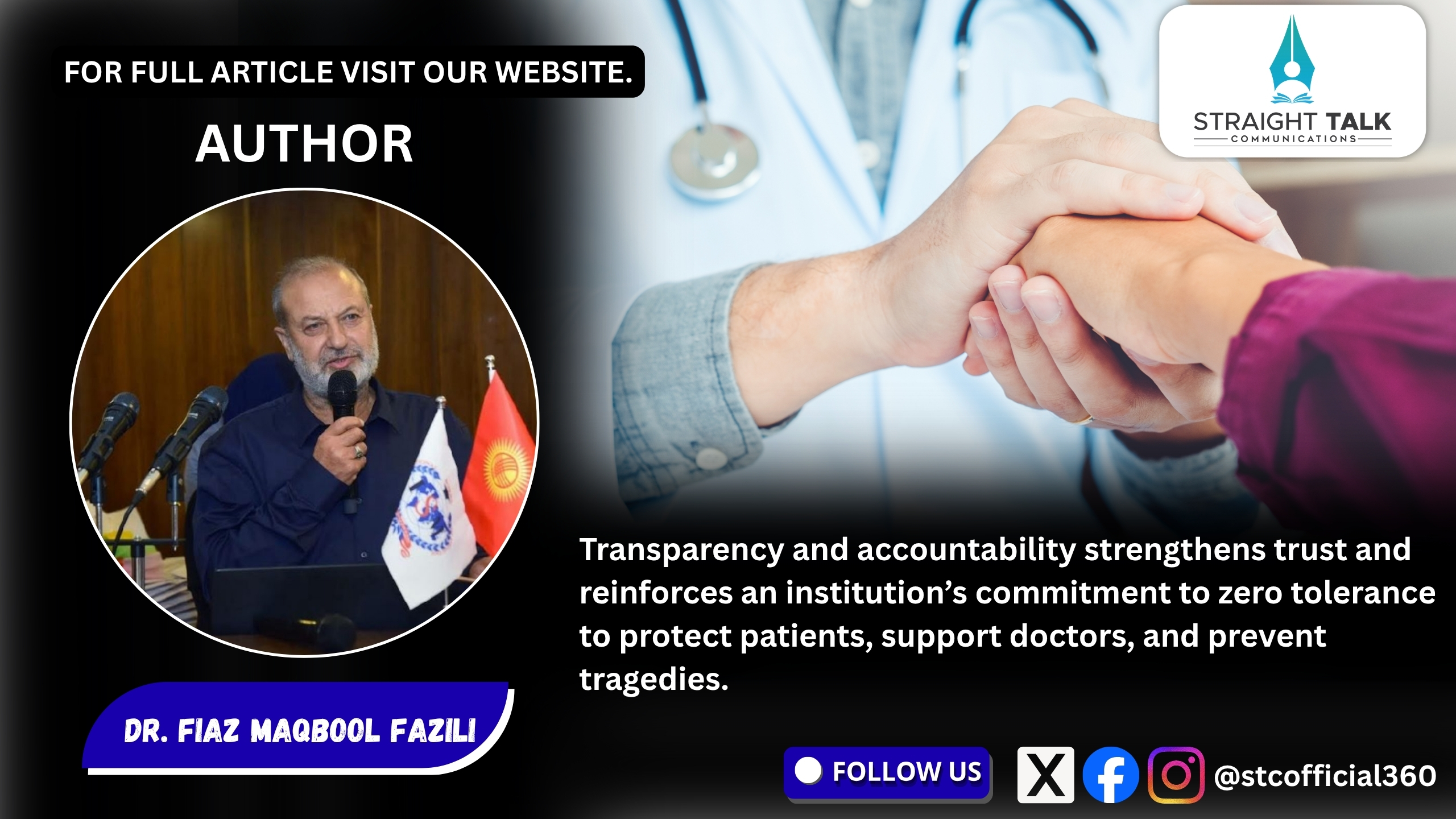
Transparency and accountability strengthens trust and reinforces an institution’s commitment to zero tolerance to protect patients, support doctors, and prevent tragedies.
Dr. Fiaz Maqbool Fazili
Why must transparency become the new pillar of healthcare? This question always baffles me. Nothing wounds the human spirit more deeply than the loss of a child like little Ahmad. No parent should ever have to stand beside the stillness of a young life extinguished too early. And yet, when tragedy occurs in a hospital—where hope ought to live—its impact reverberates far beyond a family’s grief.
Unarguably, hospitals treat thousand’s every day with diligence and compassion. Yet it takes only one patient—one slip through the cracks—for the entire system to be declared negligent and uncaring. The heartbreaking story of “Justice for Ahmad” has once again ignited debates about medical negligence and safety system in hospitals. But beneath every headline is a deeper truth: most adverse events are rooted not in malice or incompetence but in systemic failures. Overwork, staff shortage, chaotic environments, absence of safety protocols, communication issues, accountability mechanisms and inadequate resources form the perfect breeding ground for error. Human beings—even the most skilled—cannot perform flawlessly under impossible circumstances.
Errors in medicine are known since times immemorial, the USA, with all its sophistication, loses an estimated 250,000 lives annually to preventable medical error. Nearly 5.2 million errors were recorded in India in 2020. These staggering numbers show that negligence is rarely a single act by a single person but a chain of vulnerabilities within the system. In any high risk -high reliability industry—aviation, nuclear energy, oil rigs—catastrophic events trigger rigorous root-cause analyses. Medicine, too, must cultivate this culture through Peer review, clinical audit, confidential case discussions, FPPE (Focused Professional Practice Evaluation) and OPPE (Ongoing Professional Practice Evaluation) credentialing and privileging process. Both are systems used in healthcare for evaluating the performance of individual practitioner’s evaluations, and senior supervision (often lacking or delayed) is essential to improving standards. These processes must encourage evidence-based protocols, safety check lists, quality, accountability with honesty. Gross and repeated negligence, of course, must invite strict disciplinary action. Kashmir is fortunate to have seasoned experts—senior clinicians, former principals, former directors, Quality and Patient safety experts —who can guide such reforms. We must embrace this opportunity for collective change.
Criminal liability for medical negligence exists under multiple laws—including tort law, the IPC (with Section 304-A addressing death by negligence), the Indian Contracts Act, and the Consumer Protection Act—yet legal action remains rare. Many families stay silent, believing negligence is too difficult to prove, fearing powerful lobbies, or lacking the resources to pursue justice. Some resign themselves to fate, while others settle disputes quietly out of court. Recent Supreme Court rulings that make prosecution harder have made things harder to prove and pushed timely justice further.
In Kashmir, numerous inquiries into alleged negligence have been ordered in recent years, yet their findings are seldom made public. After initial uproar, investigations fade into silence—fuelling speculation, mistrust, and frustration. This silence is compounded by a troubling lack of transparency. Allegations then shift to social media, often amplified with unverified or exaggerated claims, creating confusion long before facts are established.
Medical negligence itself is widely misunderstood, partly because it is not properly taught in MBBS programmes. Critical areas such as ethics, morality, communication skills, and behavioural science are also neglected. Negligence is not simply a poor outcome; it is a breach of duty that falls below accepted professional standards with errors of omission or commission. But systemic safeguards remain weak: J&K has no central registry of negligence cases, privileging processes to assess a doctor’s competence are inconsistent, and informed consent practices are often inadequate.
Understanding the Medical negligence law is therefore essential. It clarifies patient rights, helps families identify genuine lapses in care, and offers a path to seek justice based on evidence(documentation) rather than emotion. Without widespread legal awareness, transparent institutions, and stronger accountability mechanisms, neither patient safety nor public trust in the healthcare system can improve.
High-risk(dependency) areas—ICUs, CCUs,PICU,NICU Interventional bays, Emergency departments, Labour rooms, OTs -are particularly vulnerable. Yet Kashmir’s medical history shows few examples of institutions or any practitioners being held accountable for clear cases of negligence. This absence widens the gap between patients and providers. While most doctors remain dedicated and ethical, a few cases of misconduct tarnish the entire profession.
Michael Millenson reminds us of that system array, confusion and lack of empathy—not incompetence—cause most medical mistakes. Poorly designed systems lack the safeguards needed to protect human imperfection. The government must help hospitals implement strong Quality and Patient Safety (QPS) systems. Only then can we hope to match the safety standards of aviation or nuclear sectors.
With the current leadership and management, there is a reasonable expectation that conflicts of interest will not influence inquiry panels, that institutional insiders will not—consciously or unconsciously—shield colleagues, and that standardized inquiry procedures will be strictly followed. Each institution must commit to disclosing unbiased inquiry findings and recommendations to the public. In the absence of official information, social media becomes an uncontrolled courtroom, shaped by rumour and emotion rather than science. Caregivers face public humiliation before any formal verdict. Fear of backlash—media sensationalism, politicisation—drives institutions into limbo. This secrecy erodes accountability: when reports vanish into drawers, the system learns nothing. Errors recur, trust erodes, and caregivers begin practicing defensively.
The way forward is building a systemic culture of safety and accountability; Transparency is not a luxury; it is the foundation of trust. If healthcare workers expect respect, society expects honesty. As announced by SKIMS admin a welcome step of a time bound inquiry in keeping with the spirit of zero tolerance for negligence, we hope the family receives complete and timely justice in little Ahmad’s case. The path forward requires a culture rooted in safety, transparency, and accountability. Trust in healthcare cannot be restored without openness. As the public expects honesty from institutions, systemic reforms are essential. Independent inquiry panels—comprising clinical auditors, legal experts, quality professionals, and public representatives—must replace insider-only committees to ensure credibility. Inquiry findings should be shared publicly in a responsible manner, revealing systemic issues and corrective steps without violating patient privacy or targeting individuals. A uniform, UT-wide inquiry protocol with clear timelines and documentation standards is vital. Public engagement through verified, accessible information—such as press briefings and summary dashboards—can prevent rumours and build confidence. Long-pending legal reforms must include establishing an independent medical safety authority. Hospitals must also strengthen internal self-regulation through audits, skills validation, privilege reviews, morbidity-mortality meetings, and continuous training. Above all, healthcare must embrace a culture where reporting errors leads to improvement, not punishment. Negligence should be penalised—but honesty should be protected.
Major takeaway is “Justice for Ahmad” is not just the cry of one grieving family—it is society’s demand for safer, more honest, more accountable healthcare. Pending final conclusion of inquiry committee findings, we do appreciate the SKIMS administration for acting promptly on the first complaint and attaching the involved staff to ensure an unbiased inquiry. Now, the public expects the final inquiry findings to be shared transparently. While official clarifications are acknowledged, the everyday realities faced by people in different hospitals cannot be overlooked. Most doctors are dedicated, but a noticeable section demonstrates behaviour that leaves attendants feeling dismissed or disrespected. As I have stated earlier: If negligence is established on factual grounds, proportionate action must follow. Transparency and accountability strengthens trust and reinforces an institution’s commitment to zero tolerance to establish the healthcare system to protect patients, support doctors, and prevent future tragedies. Hospitals must remain places of healing—not institutions burdened with unanswered questions. Safety begins with truth. Justice begins with honesty. Trust begins with transparency. Only by committing to these principles can we build a healthcare system worthy of the people it serves.
(STRAIGHT TALK EXCLUSIVE. The author is a Certified Clinical auditor, Healthcare policy analyst and reforms National and international expert on policy planning and reforms, can be reached at drfiazfazili@gmail.com)