


STC TRIBUTE: My Journalism Lessons From Gutsy Sofi
Sajjad Bazaz
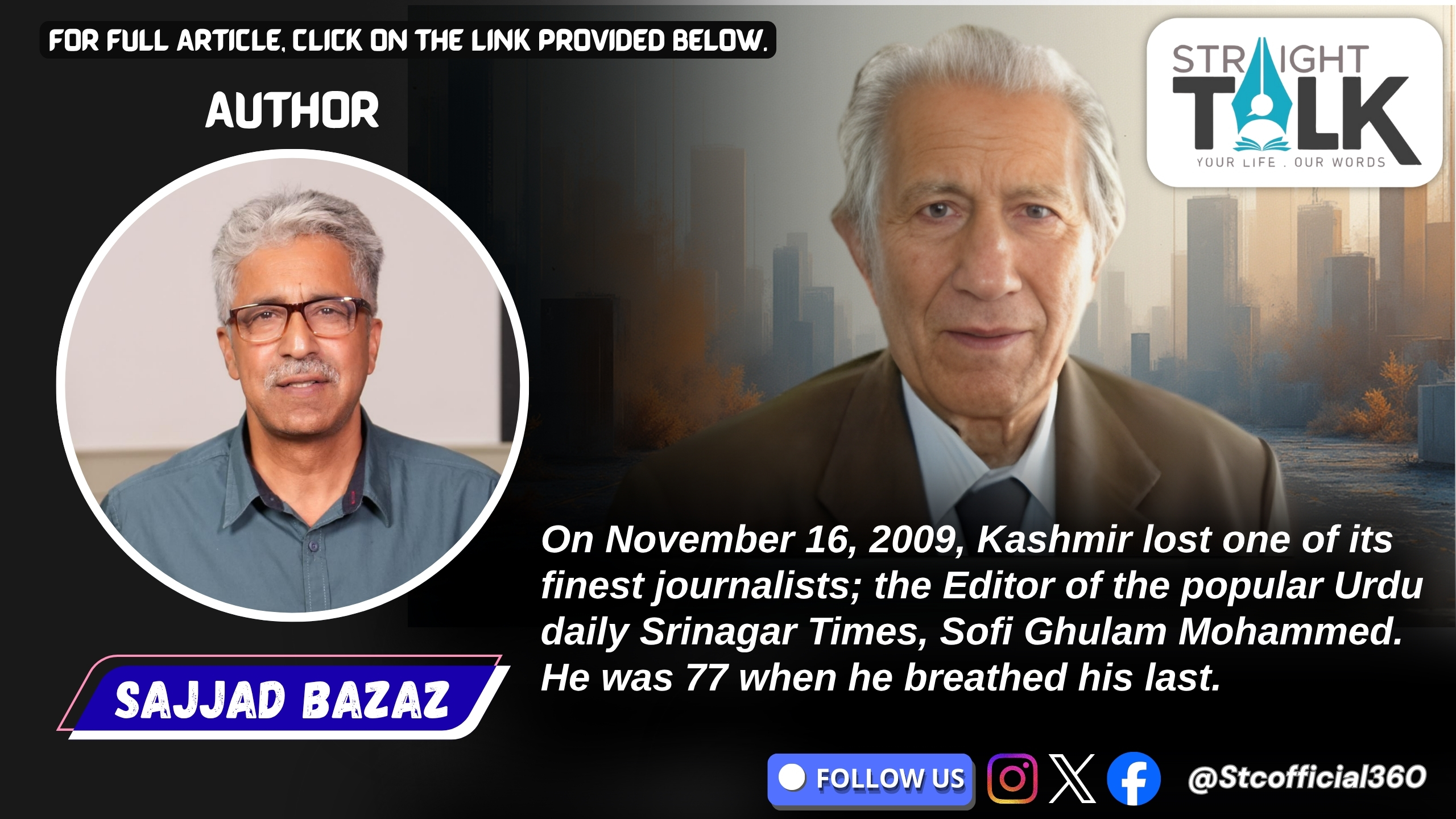
On November 16, 2009, Kashmir lost one of its finest journalists; the Editor of the popular Urdu daily Srinagar Times, Sofi Ghulam Mohammed. He was 77 when he breathed his last. One of the pioneers in Journalism, particularly Urdu Journalism, Sofi enjoyed an illustrious career as a journalist since 1960 when he joined Congress mouthpiece ‘Khidmat’. Later on, he started his own daily newspaper – Srinagar Times – in 1969. During his 50 years of career, he authored several books including ‘Loosmet Tarakh’ and ‘Sheeshi-Te-Sangistan’ both of which won Cultural Academy Awards. In 2002 he was nominated to the state Legislative Council.
Today, on his 16th death anniversary, I am reminded of a few brief meetings with him, whom I found to be a gutsy journalist. I met him for the first time in 1986 when I was pursuing my post graduation in Mass Communication and Journalism in Kashmir University. Some political developments at the national level attracted me to pen down some thoughts with an intention to get them published under my own name in Srinagar Times. It was a big dream that time to get a byline in newspapers.
Basically, Rajiv Gandhi’s performance in the middle of his term in office as Prime Minister of India was best summed up as “good intentions, some progress, frequently weak implementation, and poor politics.” Two major scandals, the “Spy” and the “Bofors” affairs, had tarnished his reputation. In January 1985, he confirmed in Parliament the involvement of top government officials, their assistants, and businessmen in “a wide-ranging espionage network.” The Spy scandal had remained a lingering embarrassment to Prime Minister Rajiv Gandhi’s administration.
In 1986, India purchased US$1.3 billion worth of artillery pieces from the Swedish manufacturer A.B. Bofors, and months later a Swedish radio report remarked that Bofors had won the “biggest” export order by bribing Indian politicians and defense personnel. The revelation caught the attention immediately because of the allegations that somehow Rajiv Gandhi and his friends were connected with the deal. Despite relentless attacks and criticisms in the media as well as protests and resignations from cabinet members, Rajiv Gandhi adamantly denied any role in the affair.
With this background, I wrote an article, precisely an opinion piece, ‘Rajiv Gandhi Ka Jahaz Khatray Mein’ (Rajiv Gandhi’s aeroplane in danger) and approached the Srinagar Times office to publish it. A frontline staff member in the office took me to the Editor’s room where I saw Sofi Ghulam Mohammad for the first time face to face and he was busy writing something. After introducing myself, I handed over my article for publication. While having a look (at a glance) at the article, he smiled and suggested me to write regularly for the newspaper and even suggested that I join as a sub-editor after completing post graduation. Precisely, his response was encouraging. I left his office with all satisfaction and fervently hoped that the article would be published soon.
For about 10 days I was eagerly looking for my article in the newspaper, but it didn’t find a space. In the meantime, on a few occasions, I approached Sofi sahib to know the fate of my opinion piece and every time he assured me that the article would definitely be published and that too ‘within couple of days’. But that didn’t happen. After a week or so, I once again approached him about the status of my article. This time, he made me sit comfortably in his office and offered me a cup of tea. Even though I was glad to enjoy the tea with the editor of a leading newspaper, at the same time I was curious to know about the fate of my write-up. The curiosity ended soon when Sofi sahib categorically told me that the article would not be published. “Most of the revenue comes to us from government advertisements, and no newspaper can afford to lose this support. I appreciate the content of your write-up, but the political situation demands not to publish it,” said Sofi sahib and simultaneously gave me some topics to write about. His blunt ‘no’ did disappoint me, but the way he advised me to write on certain socio-economic topics was a huge encouragement to me. Later on, I wrote on the topics which he suggested and after submitting for publication, he used to publish them in the very next issue.
Second time, I met him at a private function in October-November 2002. He had a close shave with death when on the evening of September 17, 2002 he was fired upon by an unidentified gunman in his office chamber. He had sustained a bullet injury in his hand and was still nursing his injury. The attack on Sofi sahib was condemned worldwide and the World Association of Newspapers and the World Editors Forum, which represent 18,000 publications in 100 countries, had expressed their serious concern at the attack and had even called upon the then union Home Minister, L. K. Advani to ensure that everything possible was done to bring the attackers to justice and to ensure the safety of journalists in Jammu and Kashmir.
Coming back to the interaction with Sofi sahib on the occasion, I told him that he was lucky to escape the bid on his life. He reacted sharply and said, “If I am alive today, it is because of the grace of God. The person who tried to shoot me was basically lucky because I tried to overpower him. I think he was luckier.” Sofi Sahib had jumped over a small table to grab the assailant. During the scuffle, the gun shot hit him in his right hand, he elaborated.
I asked him about his analysis of the prevailing situation. He blamed ‘all forces’ and not any particular side. He summed up by saying: “There are so many vested interests here for which all the stakeholders have to take the responsibility for the turmoil.”
When I asked him the way out to come out of the turmoil, he, like other commentators, said that he firmly believed that this stalemate cannot be solved by the gun. He advocated peace and advised me to ‘please write it on my behalf’ that ‘unless and until there is peace, there is no solution to the end of human sufferings in Kashmir’. For this, he suggested that all commentators while writing on Kashmir should mobilize the warring sides to step forward to talk about peace. ‘When a house is on fire, you have to extinguish the fire rather than seeing why it occurred. That is my opinion,’ he concluded the discussion on the Kashmir situation at that time.
And what he said holds true even today – unless peace prevails, no problem can be solved.
Precisely, I would say that during my brief meetings with him, I found him straightforward in his approach, particularly in his profession. He always referred to his newspaper as a family newspaper. May Allah grant him highest place in Heaven and give courage to all to contribute to promote and achieve peace.
(Sajjad Bazaz is Editor-In-Chief at Straight Talk Communications)