
DATELINE: International Men’s Day – The Day We Briefly Admit Men Are Human
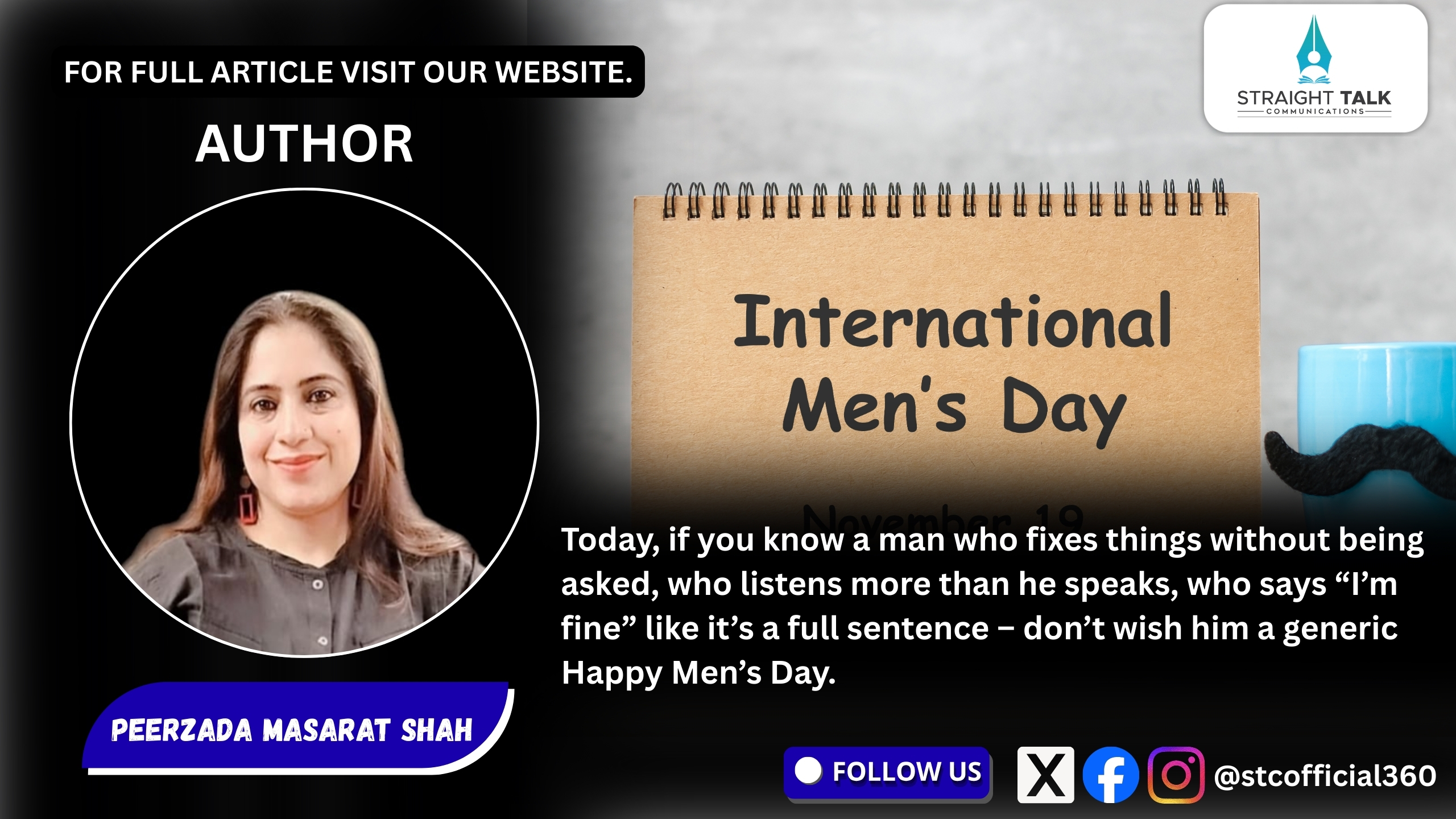
Today, if you know a man who fixes things without being asked, who listens more than he speaks, who says “I’m fine” like it’s a full sentence – don’t wish him a generic Happy Men’s Day.
Peerzada Masarat Shah
November 19 passes quietly in most calendars, like a polite cough in a library. While International Women’s Day triggers global campaigns, corporate color schemes, and TED-level enthusiasm, International Men’s Day slips by with the enthusiasm normally reserved for World Plumbing Day. Yet beneath the jokes lies a crisis measured in body bags and silent screams.
The Numbers Don’t Lie
- World Health Organization (2024): Men die by suicide at 3.9 times the rate of women in high-income countries; globally the ratio is roughly 2:1, translating to ~75% of all suicides being male.
- United States: CDC 2023 data – suicide is the 2nd leading cause of death for men aged 10–34 and 4th for men 35–54.
- United Kingdom: Three-quarters of registered suicides (4,907 out of 6,069 in 2023) were men (Samaritans).
- Australia: Men accounted for 75.5% of suicide deaths in 2023 (Australian Bureau of Statistics).
- India: National Crime Records Bureau 2022 – 118,979 men vs 45,026 women died by suicide; male rate 28.5 per 100,000 vs female 11.1.
- South Korea: The only OECD country where women outlive men by more than six years, largely because Korean men have the developed world’s highest suicide rate (39.4 per 100,000 vs 16.9 for women, 2023).
These are not anomalies; they are the statistical echo of a single sentence repeated from childhood: “Man up.”
A Short, Unlikely History
The modern International Men’s Day was relaunched on 19 November 1999 by Dr Jerome Teelucksingh, a history lecturer at the University of the West Indies in Trinidad and Tobago. He picked the date for two deeply unpretentious reasons: it was his father’s birthday and the anniversary of Trinidad’s football team qualifying for the 1990 World Cup – two moments when ordinary men allowed themselves visible joy.
In 2007 an Indian judge’s clerk and women’s rights activist named Uma Challa began organising IMD events in Hyderabad. Facing ridicule (“Men have 364 days already”), she persisted, co-founding the Save Indian Family Foundation and turning the day into a platform for discussing false dowry cases, biased family courts, and male suicide. By 2009 India had become one of the most active celebrants of a day almost no one else noticed.
Today more than 90 countries mark 19 November in some form, from Kazakhstan to Jamaica, though media coverage remains roughly 1/50th of what 8 March receives.
Six Official Objectives (Rarely Quoted Without Eye-rolling)
- To promote positive male role models – not rock stars and athletes, but “ordinary blokes who live decent and honest lives”.
- To celebrate men’s contributions to society, family, and childcare.
- To focus on men’s health and wellbeing – physical, mental, spiritual.
- To highlight discrimination against men in social services, attitudes, and law.
- To improve gender relations and promote gender equality (yes, really).
- To create a safer, better world where men and boys can reach their full potential.
How the Day Actually Looks Around the World
- Barbados: Free prostate-cancer screenings and father–son cricket matches.
- South Africa: “Men’s Parliament” sessions where politicians sit and listen to ordinary men speak about mental health.
- Norway: Trade unions run workshops titled “It’s okay to ask for help – even if you can assemble IKEA furniture blindfolded”.
- India: Helplines report a spike in calls from men on 19–20 November – the only two days some feel “allowed” to ring.
- Australia: The Australian Men’s Health Forum persuades worksites to run “R U OK mate?” check-ins that aren’t met with “Yeah nah yeah sweet as”.
The Silence That Kills
In 2022 a 28-year-old software engineer in Bengaluru hanged himself two weeks after his wife filed a dowry-harassment case. The suicide note read: “I have no one to talk to. Everyone will say I am weak.” His story is one of thousands that surface only when the worst has already happened.
In the UK, the construction industry – 96% male – has a suicide rate 3.7 times the national average. The charitable response? A sticker campaign that reads “It’s okay not to be okay” placed next to circular saws.
A Day Is Not Enough – But It’s a Start
International Men’s Day will never have the budget, the hashtags, or the corporate branding of its March counterpart. That is partly the point. Men have been told for generations that they neither need nor deserve special attention.
Yet every year on 19 November, a few more workplace posters go up, a few more fathers get asked “How are you, really?”, and a few more boys hear – perhaps for the first time – that tears do not make them less of a man.
So today, if you know a man who fixes things without being asked, who listens more than he speaks, who says “I’m fine” like it’s a full sentence – don’t wish him a generic Happy Men’s Day.
Just ask, properly: “Are you okay?”
And then shut up and listen.
Because the strongest thing a man can do is still, paradoxically, the hardest: admit he’s human.
Happy International Men’s Day.
See you next November – or, preferably, sometime much sooner.
(Straight Talk Communications Exclusive)