


Healthcare Leadership: The Will, The Way and The System
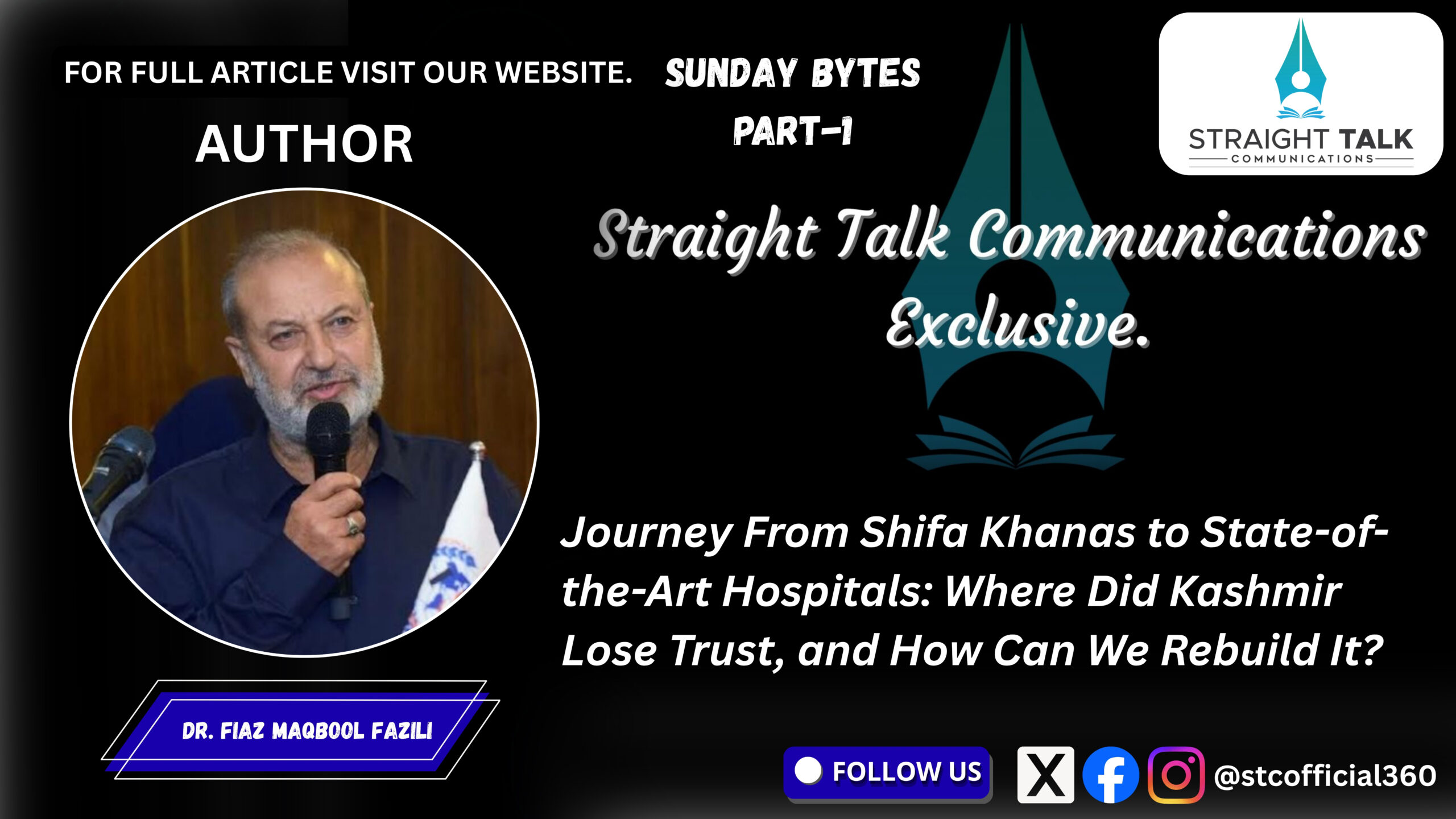
Journey From Shifa Khanas to State-of-the-Art Hospitals: Where Did Kashmir Lose Trust, and How Can We Rebuild It?
Dr. Fiaz Maqbool Fazili
The Way — a clear plan or path the brain can believe in. My take is very similar but slightly different. In Built for Freedom™️, I call it Vision + System. Vision gives you energy, just like Berkman’s will. But I believe what ultimately creates unstoppable belief is not just a plan, but a system — a structured framework that keeps working when emotions waver or circumstances change. A plan can feel fragile. A system compounds. Once you’ve built a system you trust — whether it’s collecting your third rent check or stacking covered call ETF income — your brain doesn’t just stop here.
Visionary leadership is the cornerstone of a modern, patient-centric healthcare system. Directors and Principals must go beyond clinical excellence and embrace strategic and operational planning that strengthens structure, streamlines process, and thereby delivers the outcomes our society deserves. From my childhood days as a Biscoe boy, I remember the familiar path to State Hospital. Frequent throat infections and sports injuries made those visits routine. At the gate, Asad stood with his stick—managing the flow of attendants with a calm authority that reassured even the anxious. He would guide us to my late uncle, a senior Surgeon whose quiet competence symbolised everything we believed a healer should be. Our next stop was the Shifa Khana—an expression that, for us, belonged to “Hedwun Hospital- the shifa Khana ”, a space where pain softened because trust was intact.
Today, I often find myself—and thousands of others—hesitating to take a loved one to these same state-administered hospitals. This aims at gap analysis from the pen of an expert on improvement of healthcare standards, how did our healthcare institutions that once evoked confidence become places with many approach without that trust comfort, or confidence? What caused this profound shift from Shifa Khana to a system struggling to inspire basic trust?
The story of healing in Kashmir is centuries old, woven into a culture where compassion and competence formed the backbone of care. The traditional Hakims or Medical practitioners, operating from modest Shifa Khanas, embodied a sacred covenant of trust. His practice was not merely medicinal but deeply relational. Diagnosis requires not only knowledge but intuition, empathy, and faith. Treatment was rooted in a dialogue between healer and patient—something that felt divine at times. That bond, once unshakeable, is now fractured.
To be sure, Kashmir’s health services have come a long way in infrastructure and technology. The skyline is dotted with imposing multi-storey super speciality hospitals. Advanced diagnostic or therapeutic machines once unimaginable—MRI scanners, CT suites, laparoscopic theatres—are now commonplace. Our hospitals carry titles like Super Specialty, Advanced Institute, Tertiary care referral and State-of-the-Art. But the most critical ingredient of healthcare—the patient’s faith in the system—has weakened drastically. The question that haunts us is not one of resources alone, but of leadership, governance, and vision.
The decline is not sudden. It is a gradual erosion, accelerated by decades of conflict, resource constraints, and systemic lethargy. But the most significant cause, though rarely spoken aloud, is a failure of visionary leadership. Key positions in our health ecosystem have too often been filled on the basis of seniority, political comfort, routine rotation or even favourite’s rather than capacity, clarity, leadership traits or foresight. Administrators have managed the present but did they prepare a visionary strategic or operational, short- or long-term policy planning for the future. As Kashmir’s population expanded and chronic diseases grew exponentially, hopes also moved high but the hospitals continued operating on outdated master plans drawn for a different era.
On gap analysis we found there has been inadequacies or lack of serious push to develop peripheries- District hospitals, subdistrict ,satellite hospitals, maternity and child care hospitals strengthen primary care, or distribute specialties strategically across districts. Instead, referral centres like SMHS and SKIMS became overburdened monoliths (recognised by none other than Chief Minister Mr. Omar Abdullah on annual day of slims on 5th December)—expected to serve functions far beyond their designed capacity. The result is predictable: crowding, chaos, burnout, and distrust.
Leadership failure cascades downward into planning and management. Procurement systems remain archaic, reliant on paperwork rather than digital, data-driven forecasting. Essential supplies run out with alarming frequency, forcing families into stressful searches for critical consumables even during emergencies. Staffing patterns on the right person at the right place are skewed—specialists are posted where they are least needed, often due to political influence, while essential units suffer chronic shortages.
Yet these operational failures are merely symptoms of a deeper crisis: a breakdown of management. Committees mandated to oversee infection control, quality audits, bio-medical waste, EBM QPS protocols and patient welfare exist only on paper. Accountability mechanisms rarely activate. Preventable patient harm yields no serious scrutiny; unhygienic wards invite no reprimand; delayed equipment repair elicits no urgency. In this culture of impunity, negligence perpetuates neglect.
Despite this grim picture, Kashmir is not devoid of talent, dedication, or possibility. Our doctors and nurses remain among the most capable and committed anywhere. Many leaders(Directors, Principals, Medical superintendents, HODS, CMo,BMO s etc within the resource allocation system genuinely try to push reforms, often against heavy odds. There have been significant expansions in tertiary-care infrastructure, improvements in emergency services, and successful procurements in recent years. All these gains matter and form the foundation on which improvement can grow.
But the challenge is structural: the system evolves slower than the needs of the people. A visionary leader knows that hospitals grow not merely through walls and machines but through human capital and process excellence. Yet our priorities have not met vision. We invest crores in buildings but little in nurturing the workforce’s morale, skills, ethics and above all patient journey(satisfaction). Thus, we see a peculiar contradiction: a gleaming cardiology block next to an overflowing general ward, a modern dialysis machine lying unused for months, or a new building celebrated at inauguration but left without functional heating during Chillai Kalan, forcing patients to shiver under thin blankets. This neglect corrodes the frontline relationship between doctor and patient. Today’s Kashmiri doctor is a tragic figure—highly skilled yet chronically overworked, burnt out, forced to treat patient loads that would overwhelm any system. Supplies are limited, investigations delayed, and the sheer volume of cases leaves little time for counselling or communication. Patients perceive hurried consultations as apathy or arrogance. Doctors, exhausted and demoralized, appear defensive or distant. And in that narrow, fragile space of misunderstanding, suspicion begins to grow. In the Shifa Khana, the healer had time; now time itself is a luxury.
Public frustration is amplified by the visible gaps: long queues, lost reports, unhygienic washrooms, non-functional taps, and overcrowded waiting spaces.
Meanwhile, leadership is frequently seen hyped at ribbon-cutting ceremonies, seminars, and conferences—unarguably important in their own right to foster updates with CME’s and research but often disconnected from the people’s lived experience. When basic human needs remain unmet, a growing sense of institutional indifference emerges.
This loss of trust pushes families toward private /corporate hospitals, despite the enormous financial burdens they impose. The public system, created as a safety net, becomes a last resort. And that is the greatest indictment of all.
Yet rebuilding trust is not impossible. It begins with redefining leadership—moving from administrators who manage files to genuine leaders who manage missions. We need individuals who walk the wards at night, listen to young doctors, empower nursing staff, enforce discipline, serve with an empathetic team spirit team and ensure transparency. Strategic planning must shift from firefighting to forward-looking. Tools like SWOT analysis, Lean Six Sigma, Gemba walks (late night surprise checks) and value-stream mapping can help align processes with patient needs and elevate performance to global standards. Visionary leadership is the cornerstone of a modern, patient-centric healthcare system. Directors and Principals must go beyond clinical excellence and embrace strategic and operational planning that strengthens structure, streamlines process, and thereby delivers the outcomes our society deserves. Institutions rise when leaders possess clarity of purpose, data-driven decision-making, ethical governance, and the courage to reform outdated systems. Many past administrators were outstanding clinicians, but their leadership impact remained limited to their specialties. Healthcare today demands leaders who can design systems, build motivated teams, enforce standards, and leave behind a legacy that elevates institutions to the next level. With true vision and governance, the failures we see today will not be repeated tomorrow.
The upcoming search for the next generation of Principals, Directors, and CEOs in our healthcare institutions is a defining opportunity. These roles must not be ceremonial. They demand strategic clarity, operational intelligence, financial stewardship, and an ethical commitment to staff and patients. The right leader can transform culture, instill accountability, and inspire excellence.
The name Shifa Khana may no longer be used, but its spirit need not die. Modern medicine cannot replicate Hakim’s intimacy, but it can uphold his compassion. What Kashmir needs today is not just state-of-the-art hospitals but state-of-the-heart leadership. Because the ultimate diagnosis we must make is of a system in distress—and the ultimate cure we must offer is restored faith.
EDITOR’s NOTE: Part 2-Healthcare Leadership at SKIMS: Who Led, How, and What We Learned- to be concluded
(STRAIGHT TALK COMMUNICATIONS. The author is a clinical auditor healthcare policy analyst and with expertise in healthcare quality advocates for patient rights and compassionate care writes from the rare vantage of both healer and patient. Contact: drfiazfazili@gmail.com).