


ALL ABOUT SKIMS: Revisiting Golden Era and Glorious Past – (Part I)
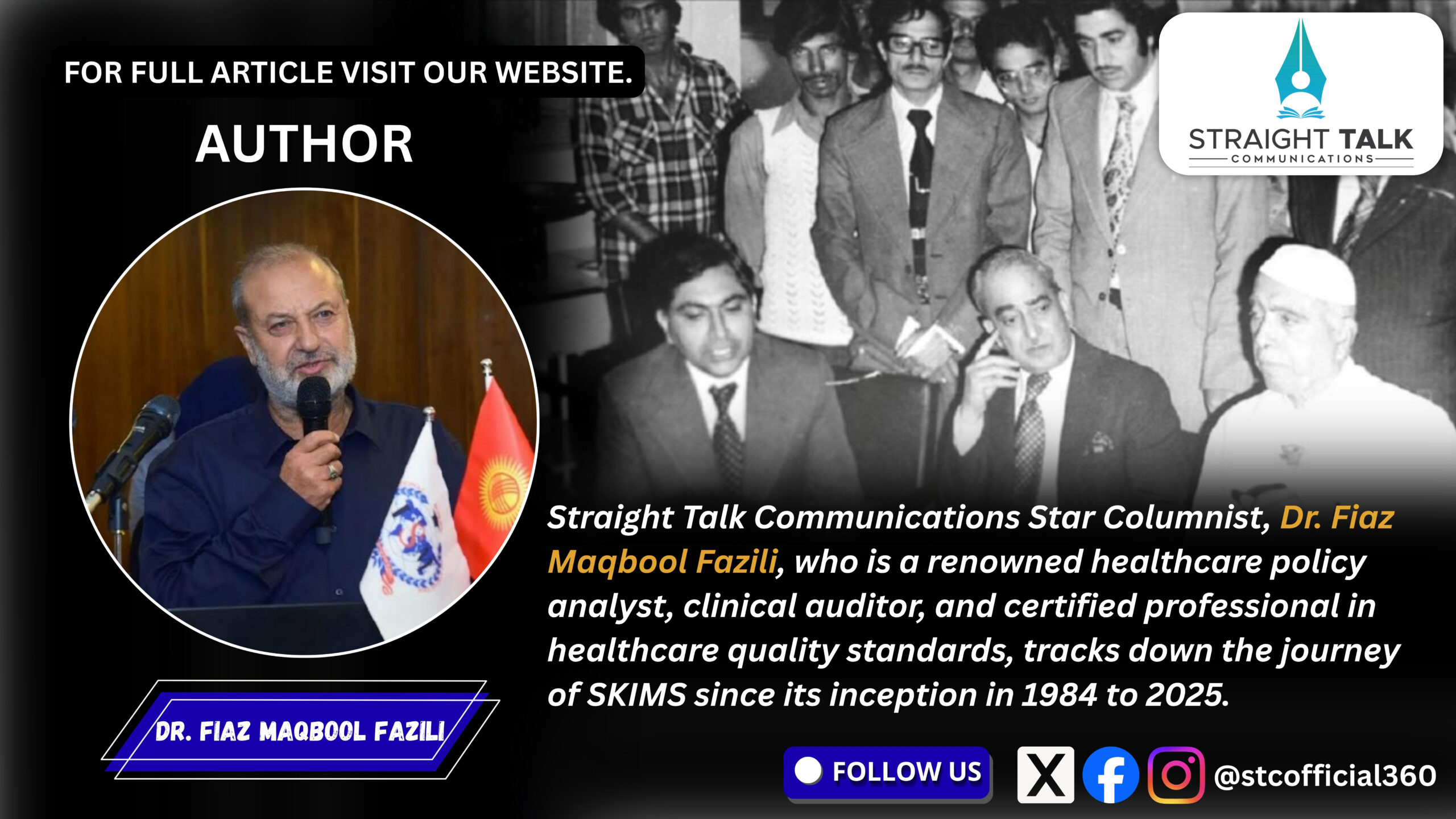
Straight Talk Communications Star Columnist, Dr. Fiaz Maqbool Fazili, who is a renowned healthcare policy analyst, clinical auditor, and certified professional in healthcare quality standards, tracks down the journey of SKIMS since its inception in 1984 to 2025.
“Medicine is not a trade; it is a calling where the physician not only thinks with his head but also with his heart.” — Prof. Mohandas.
Sher-i-Kashmir Institute of Medical Sciences (SKIMS) was never intended to be merely a hospital complex rising from the plains of Soura. It was conceived as a moral and professional promise to the people of Kashmir—that geography, environmental, or economic hardship would not determine the quality of healthcare they received. At its heart, SKIMS was imagined as an institution of high-class service, blending scientific excellence with ethical conduct, discipline with compassion, and empathy with humility. This commitment was not ornamental; it was the soul of the SKIMS idea.
The dream behind SKIMS emerged from a painful reality. For decades, serious illness in Kashmir meant long journeys to distant cities, unbearable expenses, separation from family, and uncertain outcomes. SKIMS was envisioned to reverse this injustice. It promised that world-class tertiary care could be delivered within Kashmir itself, by professionals trained to global standards. Excellence was to be measured not merely in machines or titles, but in the dignity, safety, and compassion with which patients were treated. Beyond politics, Late Sheikh Mohammad Abdullah imagined an institution that would become Kashmir’s medical conscience, translated into reality through iconic project planning by Dr. Nagpal. Like a seed planted with care, SKIMS grew from an idea into an imposing institution—one that once commanded national respect and international repute.
From the outset, the vision of SKIMS was institutional, not architectural. Buildings can rise anywhere; cultures cannot. SKIMS aspired to cultivate a culture where standards were non-negotiable, systems mattered more than individuals, and ethics guided every decision. It sought parity with institutions like AIIMS and PGI Chandigarh—not through imitation, but by internalising the principles that sustain great medical centres: merit, accountability, academic freedom, professional excellence, and respect for patients. This vision translated into an early institutional ethos remembered with pride as the “Golden Era.”
Faculty or staff recruitment prioritised competence—not merely qualifications, but the capacity to contribute through academic and research excellence. Doctors trained in leading centres across India, the UK, the US, and elsewhere returned home with professional discipline: structured rounds, rigorous academics, adherence to protocols, and ethical clarity. High-class service meant punctual care, seriousness in diagnosis, empathy in interaction, and refusal to compromise standards under pressure. SKIMS’ mission was clearly three-dimensional: patient care, academics, and research—each reinforcing the other.
Patient-centred care was the visible face of this mission. Patients from remote districts—and even outside Jammu and Kashmir—sought treatment at SKIMS with confidence. Complex neurosurgery, cardiac care, oncology, nephrology, gastroenterology, critical care, and advanced diagnostics were delivered with competence that inspired trust. High-class service meant more than clinical success; it meant dignity in illness, communication with families, and treating patients as humans, not case numbers.
Technology followed purpose. Advanced imaging, minimally invasive procedures, and modern diagnostics were not luxuries but instruments of equity—ensuring Kashmiris received care comparable to leading centres elsewhere.
Education formed the backbone of the mission. SKIMS was envisioned as a demanding academic environment where postgraduate training was rigorous and uncompromising. Teaching was central. Consultants were mentors; residents were trained to think critically, paramedics were Good paramedics and nurses are defined by professional competence matched with empathy—delivering skilled, timely care while preserving dignity, compassion, and trust in every patient interaction question safely, and resolve professionally. High-class service in education meant producing ethical, competent, globally relevant doctors or paramedics who could serve anywhere yet chose to serve at home.
High class quality research, often neglected in peripheral institutions, was integral to the SKIMS idea. Kashmir’s unique epidemiology, environmental factors, and psychosocial stresses offered opportunities for context-specific research, including mountain medicine, conflict-related mental health, and regional disease patterns. High-class service extended to generating knowledge relevant to local needs rather than importing external guidelines.
For a significant period, structure, process, and outcomes aligned to make SKIMS a national and or international reference point. Administrative systems respected clinical autonomy. Academic processes were largely transparent. Outcomes earned credibility. Patients trusted the institution; young doctors aspired to train there; foreign-trained professionals returned willingly. This alignment flowed from a shared commitment to high-class service as a value system.
The glorious era of SKIMS—the 1980s and 1990s—was defined by rigorous training and professional grooming. Any alumni could walk into international hospitals with confidence and unquestioned competence. “SKIMS-trained” became a global benchmark, often opening doors worldwide. More than three decades later, an honest question remains: does SKIMS still command the same reputation?
Patient dissatisfaction today cannot be ignored. Patient care is teamwork backed by clinical best practice protocols; when cohesion fails to translate into patient experience, dissatisfaction grows. Whether due to system failures, intra -organisational disarray, communication gaps, trust deficits, or attitude mismatches, the outcome is erosion of confidence. Patients and attendants operate in an “expectation zone” shaped by fear, stress, and grief. When frontline staff—the visible face of any institution—are unsupported or overburdened, even competent care feels inadequate.
What has gradually been lost is the institutional insistence that excellence is a daily discipline—and with it, patient trust. High-class service requires time, training, support, talent nurturing, and stable leadership. When clinicians are overburdened, academic space erodes, and systems weaken, service quality inevitably suffers. SKIMS did not falter for lack of talent or legacy, but due to erosion of structures that protected merit, accountability, discipline, strategic visionary policy plans and ultimately executive autonomy. Decline advances quietly through diluted standards, blurred responsibility, misplaced priorities, resource misallocation and mission drift. This is not a moral indictment of individuals, but evidence that excellence cannot rest on personal sacrifice alone; it demands resilient systems.
Yet, the dream of SKIMS is far from dead. It remains the valley’s only comprehensive tertiary-care institute, delivering unmatched sub-specialty services. It is staffed by highly trained professionals—doctors, nurses, and paramedics—working under trying circumstances. Technology continues to upgrade, and many faculty retain strong national and international reputations.
Institutions carry memory in their DNA. SKIMS alumni across India and abroad testify to what it once consistently produced. Infrastructure, though strained, still exists. Patient load, though overwhelming, reflects continued public faith. Most importantly, the idea of SKIMS as a centre of high-class service still resonates deeply in Kashmir’s collective consciousness.
Reclaiming the original promise requires institutional courage, not nostalgia. High-class service must again become the organising principle—restoring autonomy, protecting clinical judgment, investing in faculty development and retention, rebuilding research culture, restoring patient trust as tertiary care status and aligning administration with clinical priorities. Staff support, empathy, and wellbeing are not luxuries; they are prerequisites for safe, ethical care. A culture that exploits dedication in the name of sacrifice ultimately undermines service.
Remembering what SKIMS was meant to be is not sentimentality; it is articulation of professional benchmarks using clear performance indicators and gap analysis. Kashmir deserves institutions that reflect its resilience and intellect. Patients deserve care that is competent, compassionate, affordable, and dignified. Young doctors deserve environments that inspire excellence rather than exhaustion.
SKIMS was a dream anchored in vision, guided by mission, and animated by high-class service. That commitment once made it a symbol of what was possible even in adversity. Renewing it is not merely an institutional task—it is a moral imperative. Visionary leadership is pivotal. SKIMS needs leaders who understand they are custodians of a public trust, not occupants of a posting—leaders who value systems over symbolism and substance over slogans. Excellence flourishes where standards are clear, expectations fair, and accountability universal. Healthcare leadership at SKIMS—who led, how, and what we learned—will be examined in subsequent writings.
(To be concluded)