


SUNDAY BYTES: Srinagar’s Traffic Crisis Cannot Be Solved Without Citizens Changing Behaviour
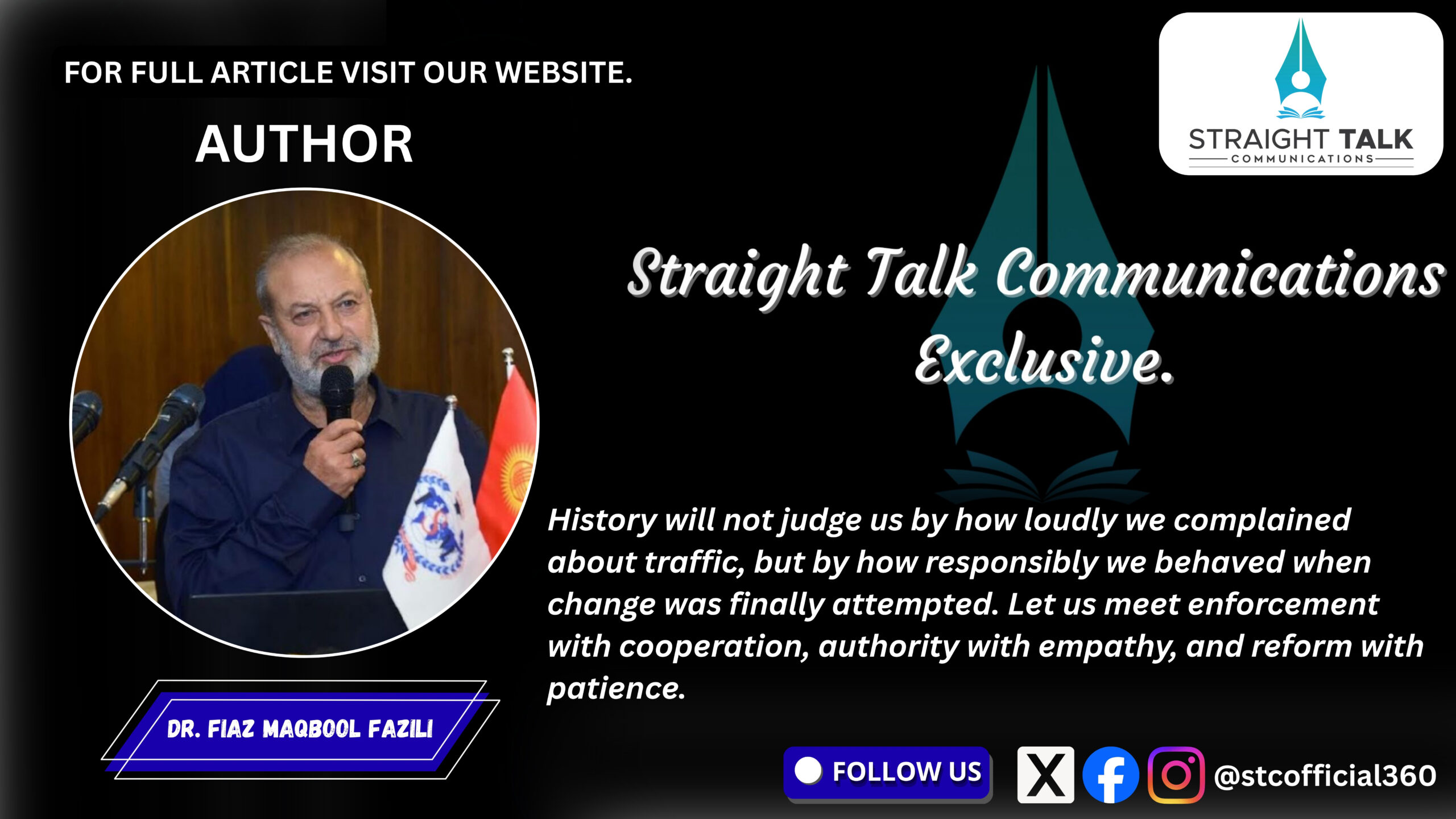
History will not judge us by how loudly we complained about traffic, but by how responsibly we behaved when change was finally attempted. Let us meet enforcement with cooperation, authority with empathy, and reform with patience.
Dr. Fiaz Maqbool Fazili
Who among us is not troubled by the daily traffic woes of Srinagar? Who has not felt the frustration simmer while stuck at a choke point, watching precious minutes,—and patience—evaporate amid honking horns, illegal parking, Vip movement and erratic driving? Traffic congestion has become so normalized in our city that we have almost resigned ourselves to it as fate rather than failure. Yet, every once in a while, a shift in leadership rekindles hope that things need not remain this way.
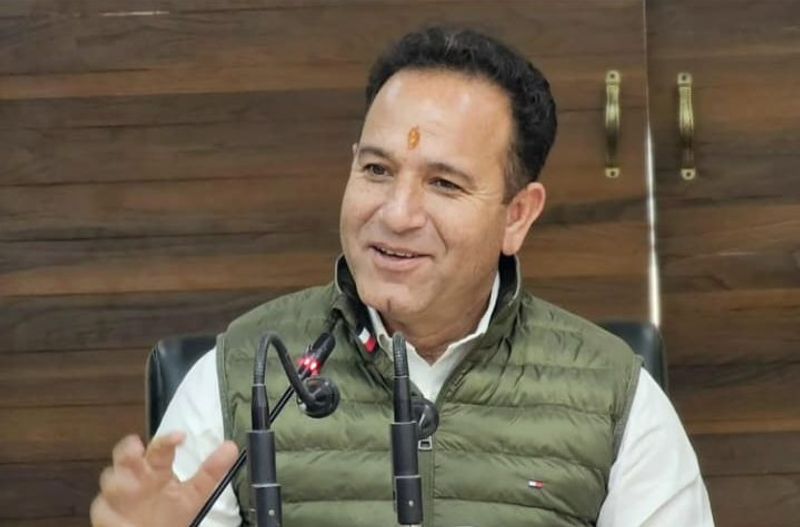
Such a moment arrived when SSP Traffic Srinagar City, Mr. Aijaz Ahmed Bhat, took charge. Hope, however, is a fragile thing. It survives not merely on intent, but on action—and on cooperation. Over the past weeks, what has stood out is not just policy pronouncements from the traffic department, but visible, on-ground engagement that signals seriousness of purpose. For a city long starved of sustained enforcement and coordinated planning, this matters.
A first interaction, a shared realisation, my first interaction with SSP Mr. Aijaz Bhat was during a meeting at the Divisional Commissioner’s office, where a group of concerned citizens—professionals, civil society members, various stakeholders, and City managers —had gathered to discuss everyday issues that afflict ordinary people, leaving aside VIP-centric narratives. Traffic congestion dominated the discussion, as it inevitably does Mrs. Naseema Lanker is a retired Indian Administrative Service (IAS) officer from the Jammu & Kashmir cadre who held significant posts, including being the first woman Divisional Commissioner of Kashmir identified some traffic bottle necks which needed urgent attention. During that meeting, while discussing “on Pareto Principle — the vital few “ but high-impact steps that are doable even within constraints. At the end of meeting I handed over a brief action plan note outlining what truly bothers the common citizen to SSP Aijaz sahib and Mrs. Nuzhat Qureshi Dy Comr. SMC about illegal parking, unchecked encroachments, absence of parking infrastructure, urgent need to decongest city’s s two big Chokes of city (Jehangir chowk and Hyderpora chowk )and a culture of impunity on roads. Also, I highlighted illegal parking and roadside encroachments around GMC Srinagar, I did not expect instant results. Yet, within days, I saw action—roads cleared, movement eased, and a message sent that no area is too sensitive, no violation too entrenched to be ignored. The real test, however, lay ahead.
From office rooms to open roads what followed was not a perfunctory acknowledgment, but something far more meaningful ownership. Since then, I have repeatedly seen the SSP and his team not behind desks, but on the roads. That is where credibility is earned. Jehangir Chowk- “The Hardest Knot”, anyone familiar with Srinagar knows that Jehangir Chowk is not just a traffic junction; it is a nerve centre. It connects major offices, channels traffic across the Jhelum, and bears the daily burden of buses, e-rickshaws, private vehicles, hawkers, and pedestrians—all competing for space in an area with no structural parking and decades of unplanned use.
To attempt decongestion here in Srinagar city is to invite resistance, criticism, cries and inconvenience. Yet, just a week ago, I witnessed SSP Mr. Aijaz Bhat and SMC team undertaking what many would consider the most difficult task—attempting removal of encroachments and enforcement of road discipline at Jehangir Chowk.
Let us be honest,traffic habits do not change overnight. Old habits die hard. Erratic driving, casual violations, unauthorised parking and the sense that “rules are for others” are deeply ingrained. But change must start somewhere—and it often starts with consistent enforcement backed by visible leadership.
“Roads Are Not for Business,” recent statements and actions by the Traffic Police Srinagar City attracted particular appreciation from netizens. The clear warning issued to car dealers illegally displaying vehicles on roads, and to shopkeepers—especially in Lal Chowk and Amira Kadal—against all-day roadside parking, addresses a long-standing distortion of public space.
The SSP’s words were unambiguous: “Roads are meant for smooth movement of traffic, not for running businesses.” This is not anti-trader, anti-shopkeeper, or anti-business. It is pro-citizen. Customers stopping briefly to shop is one thing; shopkeepers occupying road space for entire days is another. The distinction matters—and it has finally been articulated with clarity and courage.
A city moves smoothly only when conscience moves first,and civil societies are real civil. Similarly, addressing concerns around challans, the SSP clarified due process, dispelling the myth of arbitrary enforcement based solely on mobile photographs. Transparency builds trust, and trust is essential if enforcement is to succeed.
Beyond enforcement traffic discipline is a shared responsibility. That said, let us not indulge in the illusion that traffic decongestion is solely the responsibility of the traffic police. It is not. It never was. Traffic is a systems problem—intersecting town planning failures, inadequate parking infrastructure, weak public transport, non-visionary town planning, and citizen behaviour. Enforcement can buy time and restore order, but sustainable improvement requires horizontal and vertical coordination.
The SMC team has been central to decongestion efforts—clearing encroachments, regulating hawkers, redesigning footpaths, and enforcing civic measures that support traffic management. Under Commissioner Fazlul Haseeb (IAS), who also heads Srinagar Smart City Limited, the focus since June 2025 has been on improving service delivery, advancing urban projects, strengthening cleanliness drives, and tackling legacy issues such as the Achan dumping site.
Likewise, urban planning bodies must acknowledge the glaring gap: the absence of structured and multi-level parking facilities in high-density commercial zones. This is not a traffic problem alone; it is a planning deficit decade in the making.Such infrastructure will take time. There is no shortcut. But pending those long-term solutions, what we do have is the immediate power of cooperation.
A humble appeal to the people and commuters for cooperation, the SSP said that citizens, especially youth, have been coming forward with feedback. “The public here is sensitive and cooperative. Many young people approach us with suggestions, and we consider their advice seriously. We try to implement the practical ones,” he said. This is where my appeal too —to citizens, traders, shopkeepers, transporters, taxi drivers, bus owners, and commuters—becomes earnest and personal. If you truly want traffic improvement…If you genuinely desire decongestion of Srinagar…If you are tired of complaining yet unwilling to change habits—pause.
No traffic plan can succeed if we continue to park “just for five minutes,” block lanes for convenience, race through signals, or treat footpaths as extensions of shops. No officer, however sincere, can succeed without public buy-in.Support this effort. Even when it inconveniences you. Especially when it inconveniences you. Change is uncomfortable. Discipline feels harsh when it is new. But cities do not improve by sympathy alone; they improve by shared sacrifice and sustained consistency.
We are often quick and generous with criticism—many of us, including myself, occupy positions of leadership and influence. Yet when it comes to change, our resolve weakens.
We forget a fundamental truth: not all change is improvement, but all improvement demands change. Sadly, when action is required, our ink dries and our fingers turn cold.
Against this familiar inertia stands a rare and commendable example: Team Leader Dig Traffic, Shaikh Junaid, SSP Aijaz Bhat, a supercop on a mission, assisted by versatile Dy SP Mahboob al Haq driven by a clear vision to decongest Srinagar and rescue the city from its chronic traffic misery. His effort is not merely enforcement; it is an invitation to civic maturity.
This is a sincere call to civil society, commuters, shopkeepers, street vendors, and residents alike.Let us do our part and help him succeed. Traffic reform cannot survive on policing alone; it needs public cooperation, behavioural change, and moral responsibility.
Traffic indiscipline, encroachment of footpaths, illegal parking, reckless driving, and disregard for pedestrian rights are not minor civic lapses; they are moral failures. Creating public obstruction is not a minor civic lapse but a moral failing that contradicts the spirit of faith. Islam is lived not only in places of worship but in everyday conduct on streets and footpaths, where respecting others’ right of way tests our Iman. The Prophet saw taught that removing harm from the road is an act of charity; therefore, blocking roads, encroaching on walkways, or parking in ways that endanger lives cannot be justified. Most Kashmiris know this teaching well: easing another’s path is virtuous, while creating obstacles and causing inconvenience to others is sinful.
If we truly desire improvement, we must change our behaviour—our erratic driving habits, casual encroachments, disregard for pedestrians, and indifference to rules meant for collective good. Law enforcement can regulate, but only society can reform itself. If we walk this path together—with sincerity, discipline, and conscience—we may yet witness a new dawn: the sun rising over a smarter, humane, and more liveable Srinagar.
Change begins not on the road, but within us. The traffic department has made a move. The intent is visible. The effort is evident. Now, the question is simple: will we, as a city, respond? History will not judge us by how loudly we complained about traffic, but by how responsibly we behaved when change was finally attempted. Let us not miss this opportunity. Let us meet enforcement with cooperation, authority with empathy, and reform with patience.
Only then can Srinagar’s roads begin to breathe again.
(Author besides being a Medical doctor, is very active in positive perception management of various moral, social and religious issues can be reached at drfiazfazili@gmail.com & twitter @drfiazfazili)