

BY THE WAY: Venezuela and the Triumph of Power Over Principle
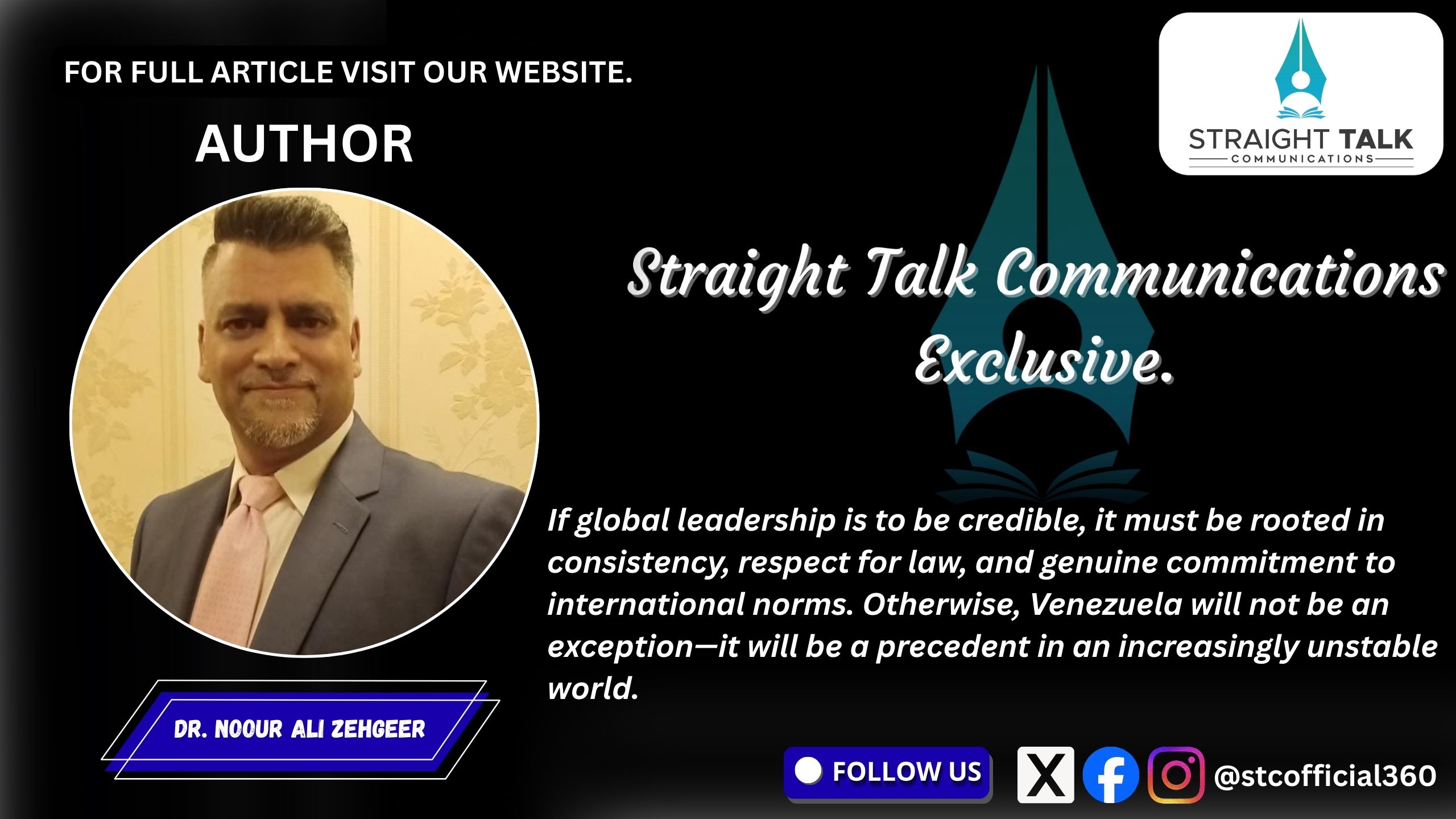
If global leadership is to be credible, it must be rooted in consistency, respect for law, and genuine commitment to international norms. Otherwise, Venezuela will not be an exception—it will be a precedent in an increasingly unstable world.
Dr. Noour Ali Zehgeer
The recent United States military action against Venezuela and the arrest of President Nicolás Maduro have jolted the international conscience, compelling the world to confront a disturbing reality: is the global order still anchored in law and collective norms, or has raw power become the ultimate arbiter of justice?
What transpired in Venezuela is far more than a regional shock confined to Latin America. It represents a dangerous moment in global politics—one that exposes the accelerating decay of international law and the growing normalisation of unilateral force by powerful states. The episode underscores a troubling trend in which might increasingly overrides legitimacy, and sovereignty becomes negotiable when inconvenient to dominant powers.
At its core, the intervention reflects a pattern of unchecked unilateralism. The forcible detention of a sitting president of a sovereign nation and his transfer to another country is not merely an extraordinary diplomatic act—it is a direct challenge to the very foundations of the rules-based international system. Such actions send a chilling message: legal norms apply selectively, and global justice is dictated not by institutions, but by influence and military reach.
There is no denying that Nicolás Maduro’s rule has been deeply contentious. His government has faced persistent allegations of authoritarianism, electoral manipulation, economic mismanagement, and human rights abuses. Venezuela’s once-thriving economy collapsed under his watch, hyperinflation devastated livelihoods, and millions were forced to flee in search of survival. These realities are undeniable and deserve scrutiny.
This unprecedented military intervention sacrifices norms of sovereignty, non-intervention, and legal extradition in favour of immediate assertions of control.
Yet internal governance failures—however severe—do not provide legal or moral justification for foreign military intervention. If domestic instability were accepted as grounds for external force, the principle of sovereignty would collapse entirely. Under such a framework, nearly every nation could become a potential target. International law exists precisely to prevent this slippery slope, ensuring that change arises through lawful, collective mechanisms rather than coercion.
The most glaring contradiction lies in Washington’s self-portrayal. The United States frequently casts itself as a global defender of democracy and human rights. However, its actions often suggest a far less altruistic agenda. Statements indicating that Washington would effectively “manage” Venezuela until a new leadership is installed echo a colonial mindset the modern world claims to have outgrown. Imposed governance—no matter how it is framed—remains a violation of self-determination.
Equally revealing is the economic dimension underlying the crisis. Venezuela possesses one of the largest proven oil reserves in the world, and history offers sobering parallels. From Iraq to Libya and Afghanistan, interventions justified in the name of democracy have often been followed by prolonged instability, fractured societies, and humanitarian disasters. In many cases, strategic resources—not democratic values—have appeared to drive policy decisions.
Remarks suggesting that the costs of intervention could be recovered through Venezuela’s oil revenues remove any ambiguity about motivation. Such logic strips moral rhetoric of credibility and exposes a transactional approach to sovereignty. When military action is framed as an investment to be repaid through resource extraction, the language of liberation rings hollow.
The geopolitical fallout is already visible. Russia and China have denounced the intervention as a direct assault on international norms, while even some traditional U.S. allies—long critical of Maduro—have expressed unease. This growing discomfort reflects fears that such precedents may embolden other powers to act similarly elsewhere, from Eastern Europe to the Asia-Pacific. Once norms are broken by one actor, others will inevitably follow.
Economically, the consequences extend far beyond Venezuela’s borders. Disruptions to oil production or exports risk destabilising global energy markets, driving up prices and disproportionately harming developing economies. Countries like India, heavily reliant on energy imports, have a clear interest in stability rather than escalation. New Delhi’s call for restraint, dialogue, and diplomacy reflects both strategic prudence and ethical responsibility.
History offers ample warning. Iraq and Afghanistan stand as powerful reminders that military force may dismantle regimes, but it rarely builds peace. The United States ultimately withdrew from both conflicts under circumstances widely regarded as costly and destabilising, leaving behind societies still struggling with violence and institutional collapse. War may be swift; rebuilding trust, governance, and social cohesion is not.
The deepest irony of contemporary U.S. foreign policy lies in its widening gap between rhetoric and reality. While proclaiming commitment to peace and international order, it has increasingly relied on sanctions, coercion, and force. This approach weakens multilateral institutions, erodes faith in international law, and accelerates global disorder. When powerful nations disregard rules, they lose the moral authority to demand compliance from others.
The Venezuela crisis should serve as a global warning. It highlights how power politics continues to eclipse legality, ethics, and humanity. The international community must resist the normalisation of unilateral intervention and reaffirm the primacy of dialogue, diplomacy, and collective decision-making.
Venezuela holds the world’s largest proven oil reserves and critical minerals. The U.S. seeks to secure long-term energy and strategic resource. So why Not to Kill Democracy for Fuel?
Another Iraq episode I may say.
Ultimately, the right to choose a nation’s leadership belongs to its people alone. Governments may fall to force, but peace and legitimacy cannot be imposed at gunpoint. If global leadership is to be credible, it must be rooted in consistency, respect for law, and genuine commitment to international norms. Otherwise, Venezuela will not be an exception—it will be a precedent in an increasingly unstable world.
(STRAIGHT TALK COMMUNICATIONS EXCLUSIVE)