



SUNDAY BYTES: Health Alert – When Going to Emergency Department Should Not Be Scary
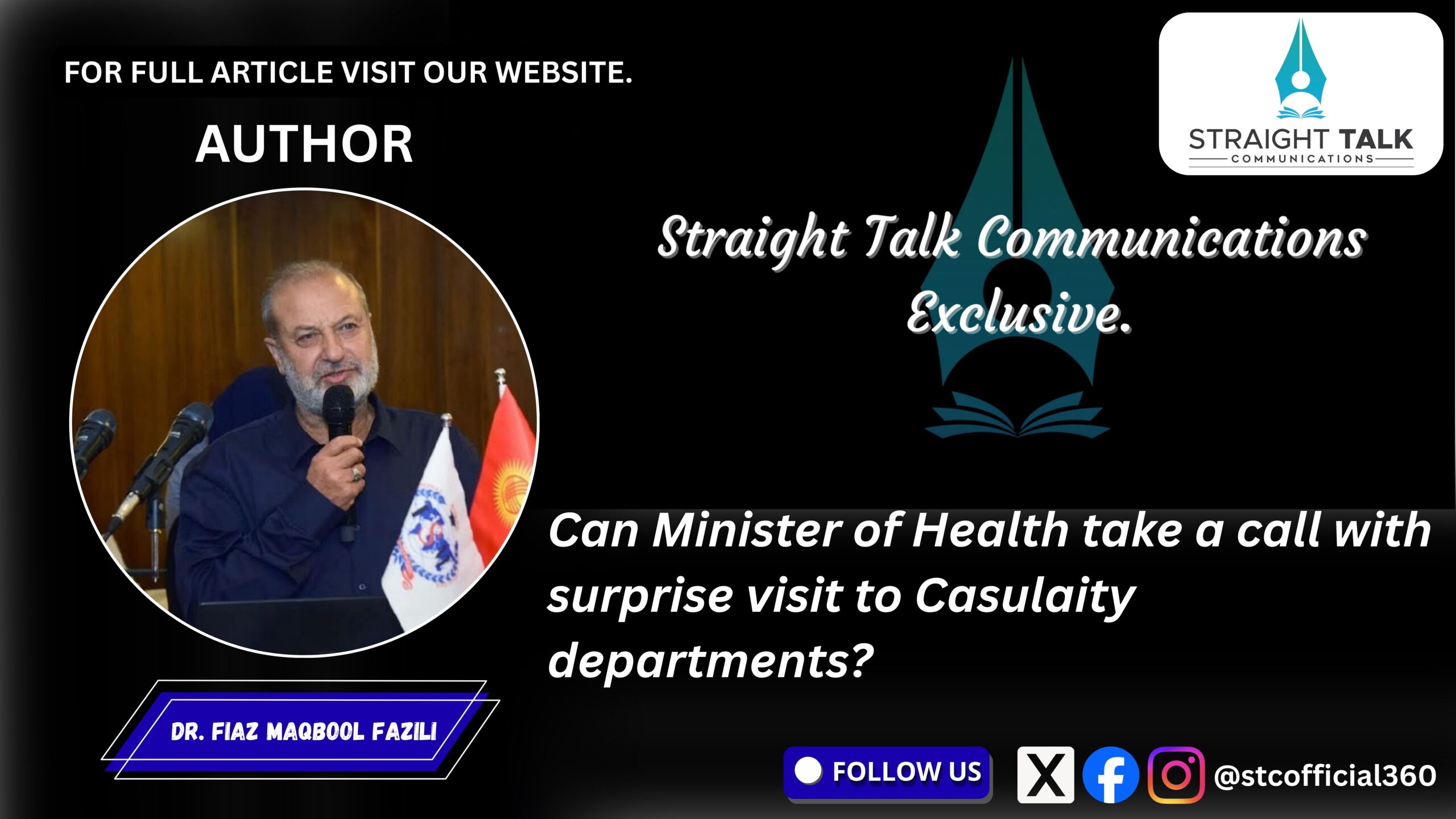
Can Minister of Health take a call with surprise visit to Casulaity departments?
Dr. Fiaz Maqbool Fazili
Emergency departments are not merely hospital entry points; they are the moral barometers of a healthcare system. How a system treats its sickest, most vulnerable patients—often at the worst moments of their lives—reveals whether healthcare is truly organised around patients or merely around constraints, convenience, and damage control. Emergency departments are meant to be sanctuaries of trust—places where fear meets competence, where chaos is rapidly organised into care, and where minutes matter more than excuses. Yet for far too many patients and families, going to the emergency department (ED) has become a frightening gamble rather than a reassuring refuge. The fear is not of illness alone; it is of mismanagement, delay, neglect, and the haunting question: Will I be treated according to my need, or according to chance?
For over twenty-five years, one explanation has been repeated ad nauseam whenever emergency care fails: overcrowding. Overcrowding is real, no doubt. But it has become a convenient shield behind which the absence of systems, discipline, protocols, and accountability hides comfortably. Crowding explains volume; it does not justify chaos. High-volume emergency departments across the world function safely—not because they have fewer patients, but because they have strict triage, standard operating procedures (SOPs), and an uncompromising culture of accountability.
The uncomfortable truth is this: many emergency departments are not scary because patients are sick; they are scary because systems are weak.
The Missing Spine: Triage and Protocols;
At the heart of emergency medicine lies triage—the ethical and clinical sorting of patients according to acuity, not noise, influence, or arrival order. Triage is not a formality; it is a life-saving intervention. Without strict triage, the ED becomes a waiting hall where the sickest may wait the longest, and where urgency is decided by volume, pressure, or persuasion.
Yet in many of our emergency departments, triage either does not exist, is poorly implemented, or is overridden casually. Protocol-driven pathways for common but life-threatening presentations—acute chest pain, stroke, sepsis, trauma, acute abdomen—are either absent or ignored. Instead of right acuity, right time, right place, right treatment by the right person, we witness improvisation masquerading as experience.
Emergency care must move as a continuum: door to doctor, doctor to decision, decision to destination. Any break in this chain costs time—and in emergency medicine, time is tissue, time is brain, time is life.
The Dangerous Comfort of the “Three Ps”
Perhaps no symbol better reflects the erosion of emergency standards than the disturbing normalisation of the so-called three Ps: pantoprazole, paracetamol, and a petril (sedative). This triad, casually administered to a wide range of undifferentiated patients, has crept into the minds of young doctors as a default response rather than a temporary measure.
Sadly a dangerous trend “3-P protocol” — Pantoprazole, Paracetamol, Petril (antianxiety medicine) has become a ritual in causalities — is not medicine; it is mechanical prescribing. It has no place in the evaluation of chest pain or upper abdominal pain, especially in an emergency setting.There is no textbook, no guideline, no evidence-based protocol that authorizes this combination as a default response to undifferentiated chest or epigastric pain. On the contrary, such practice masks symptoms, delays diagnosis, and provides false reassurance—a combination that has likely caused more harm than benefit. Chest pain is cardiac until proven otherwise. Epigastric pain in adults can be cardiac, vascular, or surgical until ruled out. Anti-anxiety medication like Petril further blunt warning signs and cloud clinical assessment. The disturbing question is not why overcrowding exists, but how this unsafe habit has been transmitted, normalized, and internalized among young doctors in emergency departments—without scrutiny, audit, or accountability. The old dictum is still relevant today ,If you don’t know proper CPR don’t do it wrong way – don’t do compressions on stomach .. it can be hazardous. Hospitals should make it mandatory all staff working in ED must have BLS,NALS PALS and Or ACLS, ATLS. Emergency medicine is built on protocols, not shortcuts, on thinking, not reflex prescribing. Until this culture is confronted and corrected, we will continue to confuse treatment with triage—and patients will continue to pay the price.
This is not benign practice. It is diagnostic paralysis disguised as treatment. Symptoms are masked, vital clues erased, and evolving catastrophes lulled into deceptive calm. The cost has been tragic. Young lives—including that of a young medical student whose name is withheld—have been lost. Each such death triggers public outrage, media headlines, and hurried inquiries.
But what follows? Silence. Amnesia. No visible conclusions. No transparent outcomes. No zero-tolerance message. No systemic correction. Until the next death jolts us awake again.
Inquiries Without Consequences; Sentinel events are meant to be alarms, not rituals. An inquiry that does not lead to accountability, reform, or deterrence is not an inquiry—it is an exercise in damage control. When adverse events repeatedly occur and no one is held responsible—not individuals alone, but systems and leadership—the message is clear: negligence carries no cost.
Ironically, the same doctors and paramedics who appear helpless within this system perform with remarkable professionalism when they work outside the region. They follow protocols, respect hierarchies, escalate early, and document meticulously. This exposes the fallacy that competence is lacking. It is not competence—it is culture.So, the uncomfortable question must be asked: What changes when the same professionals’ cross geographical boundaries? The answer lies in systems, supervision, and consequences.
Where Does the Buck Stop?
Emergency departments do not fail spontaneously. They fail because no one is clearly responsible for enforcing standards. Who is accountable for ensuring that triage is functional 24/7? Who audits door-to-doctor times? Who mandates senior involvement for high-risk cases? Who ensures that juniors are supervised, supported, and corrected—not abandoned?
Minutes matter in emergency care. Yet escalation to seniors is often delayed, resisted, or perceived as weakness. A low threshold for calling seniors is not inefficiency; it is safety. In high-functioning systems, senior review is a standard, not a favour.Accountability cannot be episodic or personality-driven. It must be institutional. Clinical governance structures, morbidity and mortality meetings with teeth, regular audits, simulation-based training, and enforceable SOPs are not luxuries—they are non-negotiables.
Trust Is Built, Not Demanded;Patients do not expect miracles. They expect sincerity, structure, and safety. Trust in emergency care is born when a patient knows that their management will not depend on whom they know, whom they call, or whom they plead with. No patient should feel compelled to ring a principal, medical director, or superintendent to secure basic emergency care.
That very impulse—to seek protection through influence—is a damning indictment of system failure.
A functioning emergency department should offer quiet assurance: You will be assessed properly. You will be prioritised fairly. You will be treated according to evidence. Seniors will be involved when required. Decisions will be timely. Destinations will be appropriate.
This is not utopia. This is standard emergency medicine.
From Excuses to Ethics; Overcrowding will persist. Resource constraints may remain. But ethical care does not wait for perfect conditions. Even within limitations, process discipline saves lives. A single trained triage nurse, a clear algorithm, a mandatory senior call policy for red-flag conditions—these cost far less than the price of repeated tragedies.The medical fraternity often laments the absence of accountability. That lament is justified—but incomplete. Accountability is not only imposed from above; it is also upheld from within. Silence in the face of unsafe practices is complicity. Normalising shortcuts corrodes professionalism. Young doctors learn not from lectures, but from what is tolerated.
A Wake-Up Call That Must Not Fade; Every avoidable death in the emergency department is a wake-up call. The tragedy is not that such calls occur, but that they are repeatedly snoozed. We grieve, we rage, we inquire—and then we forget.
Until the next headline. Emergency departments should not inspire fear; they should inspire confidence. The path to that confidence is clear: strict triage, enforced SOPs, senior oversight, transparent accountability, and zero tolerance for negligence. Anything less is not constraint—it is choice.
The question before us is simple, and deeply personal: When I fall sick and walk into an emergency department, can I trust the system without making a phone call? Until that answer is an unequivocal yes, the wake-up call remains unanswered.
(STRAIGHT TALK COMMUNICATIONS EXCLUSIVE. Author is a clinical auditor, expert on improving healthcare standards and quality care can be reached at drfiazfazili@gmail.com