

BUDGET 2026: Development in Jammu & Kashmir must be real, visible, equitable and lived
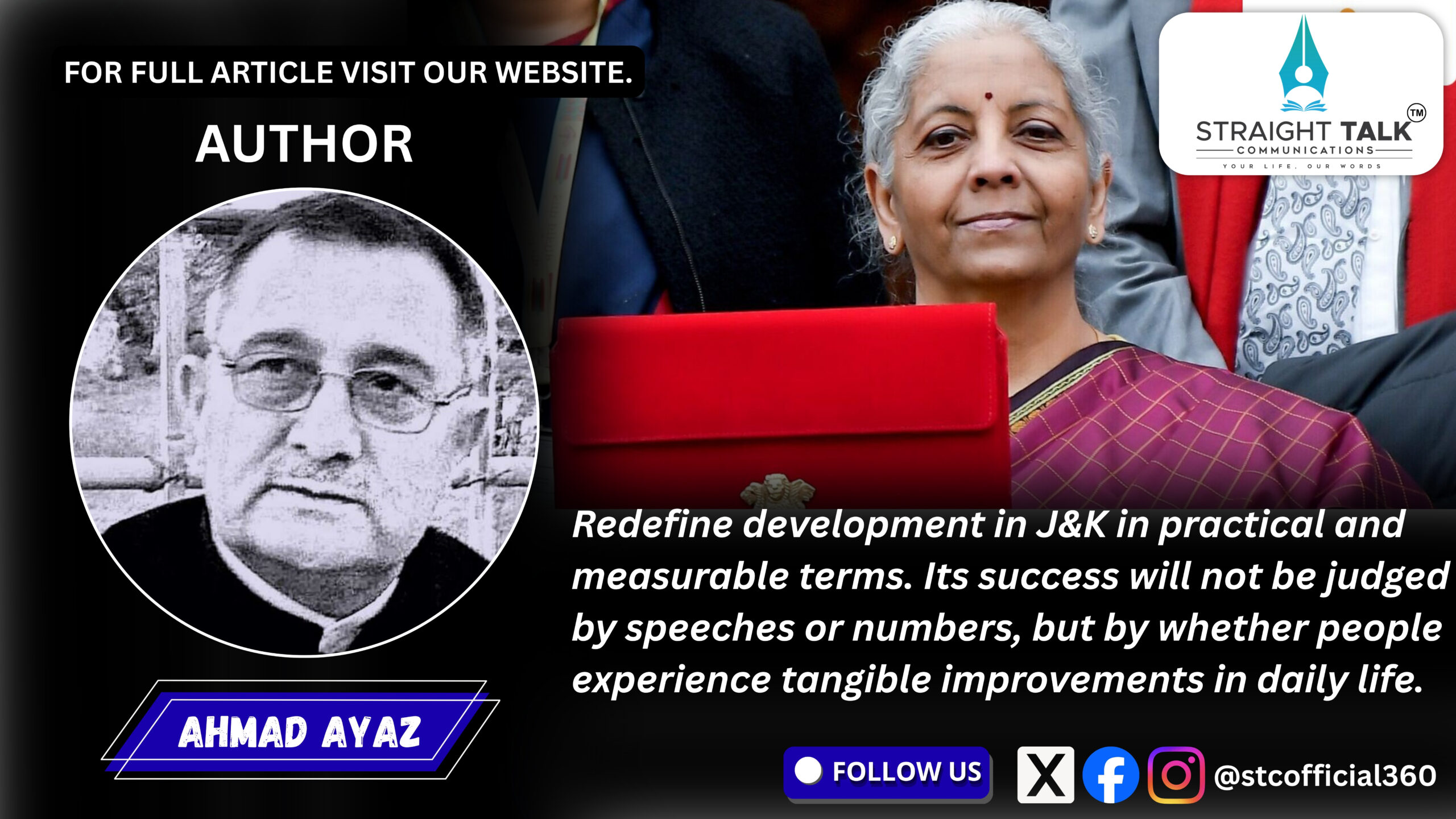
Redefine development in J&K in practical and measurable terms. Its success will not be judged by speeches or numbers, but by whether people experience tangible improvements in daily life.
Ahmad Ayaz
A budget is far more than a statement of income and expenditure. It is a political document, a governance blueprint, and a test of intent. It reveals not only where money is allocated, but whose lives are prioritised and which problems are acknowledged. In a region like Jammu and Kashmir—characterised by complex geography, prolonged political uncertainty, and persistent developmental deficits—the relevance of Budget 2026 cannot be assessed through headline figures or ministerial claims alone. Its real value lies in whether it brings tangible improvement to the daily lives of ordinary people.
For decades, budgets for Jammu and Kashmir have followed a familiar pattern: ambitious announcements, impressive numbers, and repeated assurances of transformation. Yet on the ground, delivery has remained uneven and outcomes inconsistent. Development has too often been reduced to optics—projects that look good on paper, serve political narratives, or remain confined to select constituencies—while deeper structural problems continue unresolved.
If Budget 2026 is to mark a genuine shift, it must move away from symbolic spending and constituency-centric politics and focus instead on outcomes that are real, equitable, and measurable across the region.
DEVELOPMENT AS EXPERIENCED BY PEOPLE
In Jammu and Kashmir, development is not an abstract policy goal. It is experienced through everyday realities: whether roads remain open during winter, whether electricity is available during peak hours, whether hospitals function without forcing patients into long-distance referrals, and whether young people can find dignified employment close to home.
Despite repeated policy commitments, service delivery remains unreliable. Welfare schemes exist in abundance, but weak implementation, bureaucratic hurdles, and poor grievance redressal dilute their impact. Citizens often spend more time navigating offices than benefiting from entitlements that should be routine.
Macroeconomic indicators and aggregate spending figures fail to capture these lived experiences. For Jammu and Kashmir, development must be measured not at the level of files and presentations, but at the household and community level—where policy either works or fails.
CONNECTIVITY: THE MOST ENDURING FAILURE
Connectivity remains Jammu and Kashmir’s most persistent vulnerability and arguably its most consequential development failure. Every winter, snowfall and adverse weather conditions cut off Kashmir from the rest of the country. This happened again this year, when even limited snowfall led to the closure of the Srinagar–Jammu National Highway, causing severe traffic disruption and exposing the fragility of the region’s primary lifeline.
The problem is not confined to winter alone. Even during normal months, interior, hilly, and border districts continue to suffer from poor and unreliable access. Road collapses, frequent blockades, and the absence of viable alternative routes have become routine rather than exceptional.
This is not merely a consequence of geography, but of long-standing policy neglect and inadequate investment in resilient, all-weather infrastructure. The impact is far-reaching: horticulture produce fails to reach markets on time, tourism suffers repeated setbacks, economic activity slows, and medical emergencies turn critical due to delayed connectivity.
For Jammu and Kashmir, connectivity is not a supplementary development goal—it is fundamental. Budget 2026 must therefore prioritise climate-resilient highways, tunnels, bridges, and emergency logistics systems that ensure uninterrupted access and economic continuity.
HEALTHCARE: ACCESS STILL DETERMINES OUTCOMES
Healthcare infrastructure across Jammu and Kashmir remains overstretched and unevenly distributed. While tertiary hospitals in Srinagar and Jammu carry the burden of the entire region, district and sub-district hospitals continue to struggle with shortages of doctors, specialists, medicines, diagnostics, and functional equipment.
Rural and peripheral areas are particularly neglected, forcing patients to travel long distances even for basic care. Preventable illnesses often escalate due to delayed treatment, while referrals have increasingly replaced genuine capacity building.
Basic amenities—clean water, sanitation, hygiene, and maintenance—are frequently missing in public health facilities. Access to healthcare too often depends on affordability, connections, or geography rather than entitlement.
Budget 2026 must move beyond infrastructure creation and focus on staffing, diagnostics, decentralised healthcare delivery, telemedicine, and mobile health units. Success should be measured by whether a patient in a remote village can access timely and quality treatment without financial or logistical hardship.
POWER SUPPLY: ABUNDANT POTENTIAL, WEAK DELIVERY
Jammu and Kashmir possesses vast hydropower potential, yet power supply remains unreliable across both urban and rural areas. Frequent and unannounced outages disrupt households, education, healthcare services, and small businesses. Even metered consumers face erratic supply, undermining trust in public institutions.
The problem is not lack of resources, but institutional inefficiency—outdated transmission systems, poor maintenance, high losses, and weak accountability within power distribution agencies. Reforms are announced repeatedly, but outcomes remain limited.
Budget 2026 must prioritise modernisation of transmission and distribution networks, enforce maintenance standards, and invest in decentralised and renewable energy solutions. Reliable electricity is not a luxury; it is essential for economic stability, service delivery, and public confidence.
UNEMPLOYMENT: THE SHARPEST INDICATOR OF POLICY FAILURE
Jammu and Kashmir continues to record one of the highest unemployment rates in the country, significantly above the national average. This alone exposes the inadequacy of existing development and employment strategies.
Educated youth face shrinking and irregular government recruitment, while the private sector remains too weak to absorb the growing workforce. Skill development programmes have proliferated, but many operate in isolation from market demand, producing certificates rather than employment.
Unemployment is not merely a statistical concern; it is a social and economic emergency. Prolonged joblessness erodes confidence, fuels frustration, and carries serious long-term consequences.
Budget 2026 must prioritise employment generation over announcements. Labour-intensive sectors such as agriculture, horticulture, tourism, construction, renewable energy, services, and MSMEs must receive targeted support. Entrepreneurship must be enabled through access to credit, infrastructure, and markets. Without credible pathways to dignified employment, development claims remain hollow.
INDUSTRIAL DEVELOPMENT: ECOSYSTEMS, NOT ENCLAVES
Despite available labour, raw materials, and strategic location, industrial development in Jammu and Kashmir remains limited. The economy continues to rely disproportionately on government employment, while the private sector lacks depth and resilience.
Industrial estates alone do not create industries. What is missing is an enabling ecosystem—reliable power, transport connectivity, regulatory clarity, access to finance, skilled manpower, and market linkages.
Budget 2026 must focus on building such ecosystems, particularly for small and medium enterprises aligned with regional strengths: food processing, horticulture-based industries, handicrafts, renewable energy components, and tourism-linked manufacturing.
Skill development must be directly linked to industry needs, not treated as an isolated intervention. Industrial policy must result in sustainable local employment, not temporary incentives or paper projects.
TOURISM: POTENTIAL WITHOUT PLANNING
Tourism has long been a strength of Jammu and Kashmir, attracting visitors from across the country and beyond. Yet the sector remains vulnerable due to inconsistent connectivity, inadequate infrastructure, environmental stress, and lack of long-term planning.
Seasonal surges cannot substitute for sustainable development. Overcrowding in select destinations, weak waste management, and limited diversification have exposed structural shortcomings.
Budget 2026 must invest in transport, accommodation, waste management, safety infrastructure, and destination planning. Skill development in hospitality, guiding, and cultural services is essential to ensure tourism benefits local communities rather than remaining concentrated.
Tourism must be treated as a serious economic sector, not merely a symbolic indicator of normalcy.
AGRICULTURE & HORTICULTURE: STRENGTHENING RURAL LIVELIHOODS
Agriculture and horticulture remain the backbone of Jammu and Kashmir’s rural economy. Yet farmers face outdated practices, inadequate irrigation, lack of cold storage, post-harvest losses, and limited market access.
Despite high-quality produce, value realisation remains low due to weak supply chains and dependence on intermediaries. Climate variability has further increased vulnerability.
Budget 2026 should prioritise modern irrigation systems, cold chains, storage facilities, processing and value-addition units, and fair market access. Cooperative models and farmer collectives can significantly improve incomes.
Strengthening these sectors is essential not only for rural livelihoods but for regional economic stability.
BEYOND CONSTITUENCIES AND VOTE-BANK POLITICS
For Jammu and Kashmir, development must not remain confined to narrow constituency boundaries or driven by vote-bank considerations alone. Selective visibility of projects, uneven regional allocation, and politically timed interventions deepen distrust and reinforce inequality.
Development must be region-wide, inclusive, and guided by need rather than electoral arithmetic. Roads, hospitals, power supply, employment opportunities, and public services must reach all districts equitably.
A budget that favours symbolism over substance, or constituencies over citizens, ultimately weakens governance and public trust.
FROM ALLOCATIONS TO ACCOUNTABILITY
Large allocations alone do not guarantee outcomes. The real challenge lies in implementation, monitoring, and accountability. Without transparency and institutional responsibility, even well-funded programmes risk remaining confined to files and press releases.
Progress must be measured through functional services—roads that remain open, hospitals that treat patients locally, power that is reliable, jobs that are real, and institutions that respond.
CONCLUSION
Budget 2026 offers an opportunity to redefine development in Jammu and Kashmir in practical and measurable terms. Its success will not be judged by speeches or numbers, but by whether people experience tangible improvements in daily life.
In a region where immense natural potential coexists with long-standing structural neglect, expectations are clear and reasonable: roads must remain open in winter, hospitals must function for all, electricity must be reliable, skills must translate into jobs, tourism must empower communities, industries must generate livelihoods, and agriculture must sustain rural households.
Development in Jammu and Kashmir must be real, visible, equitable, and lived. Anything less will fall short of both need and responsibility.
(STRAIGHT TALK COMMUNICATIONS EXCLUSIVE. The author is a political analyst, national TV debater, and columnist. The views expressed are personal. He can be reached at ahmadayaz08@gmail.com.)