
BY THE WAY: Budget 2026 on Tightrope
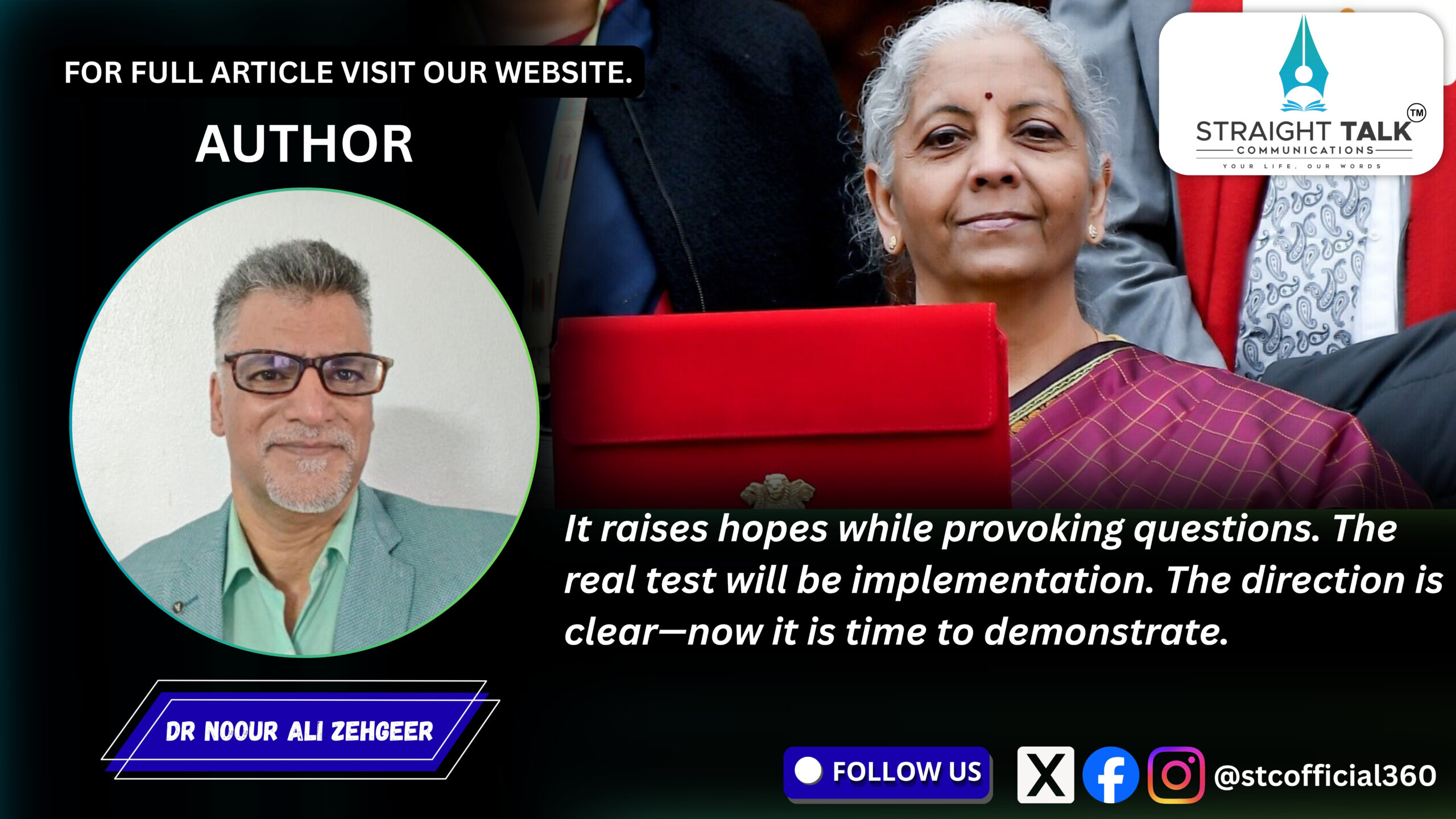
It raises hopes while provoking questions. The real test will be implementation. The direction is clear—now it is time to demonstrate.
Dr Noour Ali Zehgeer
I always felt Budget is a hope for 1.26 billion people. 80% of people may not understand minute details of this event and document but still they always hope something good is going to happen in their lives. People connect their unfulfilled dreams with new years budget, as they believe elected government is always pro people. This myth is broken in Last 10years when people have understood that Elected government can be pro RICH and support idea of Capitalism.
The Union Budget 2026, presented in Parliament on February 1, 2026, once again demonstrated the government’s narrow path between economic discipline and public aspirations. Finance Minister Nirmala Sitharaman began her speech with a vision of stability, continuity, and long-term growth. There were no unexpected populist announcements; instead, the budget adopted a realistic approach. The fiscal deficit was kept at 4.4 percent of gross domestic product (GDP) for the financial year 2026, below the previously set target of 4.5 percent. This move sets a strong example of fiscal discipline. Capital expenditure was increased from ₹11.2 lakh crore last year to ₹12.5 lakh crore, representing an increase of nearly 12 percent. This increase is focused on infrastructure, urban development projects, and the digital technology sector. A target of raising ₹10 lakh crore has been set under the asset monetisation scheme to encourage private sector investment.
For a common man, a budget is a money plan that decides how income is used wisely so that needs are met today and the future is secure.
The Indian economy achieved 6.8 percent growth in the last fiscal year, but challenges such as the global economic slowdown, U.S.–China trade tensions, and domestic inflation persist. The budget tightly controlled the fiscal deficit at 4.4 percent, while the effective revenue deficit was limited to ₹96,654 crore, a mere 0.3 percent of GDP. A provision of ₹12.5 lakh crore for capital expenditure will give new impetus to the national infrastructure pipeline. The target of an additional 50,000 kilometres for highway construction and an allocation of ₹2.5 lakh crore for railway electrification and modernisation demonstrate the commitment to laying the foundation for the future. States will be provided ₹1.5 lakh crore in 50-year interest-free loans, strengthening the federal structure. Measures such as tax exemptions, a single-window system, and faster approval processes have been implemented to promote the public-private partnership (PPP) model. The government has sent a clear message: investors, come—we are fully prepared. But the big question is whether these huge investments will create jobs in rural and semi-urban areas, or remain confined to the glitz of the metropolises.
The middle class, which contributes approximately 40 percent to the country’s GDP, received substantial tax relief in this budget. The standard deduction in the old tax regime was doubled from ₹50,000 to ₹1 lakh, while additional relief was provided for senior citizens. The new tax regime simplified the slabs, including zero tax on income up to ₹5 lakh. TCS on education loans was removed (up to ₹10 lakh), while the rent-TDS threshold was raised from ₹2.4 lakh to ₹6 lakh. Tax relief was provided on two self-occupied residential properties, and the deadline for filing income-tax returns was extended from two years to four years. The promise to simplify the tax code from 819 sections to 536 is commendable. These steps aim to transform taxpayers from mere sources of revenue into trusted partners. However, compliance processes must be simplified further at the ground level; otherwise, these reliefs may remain limited to paperwork.
The budget focused on the agricultural sector, which still accounts for 18 percent of GDP and supports 65 percent of the rural population. The Pradhan Mantri Dhan-Dhanya Yojana was expanded to 100 districts, encouraging crop diversification and increasing irrigation and storage capacity. PM-Kisan Samman Nidhi was enhanced, and the Kisan Credit Card limit was raised. Economic zones were declared in the Andaman and Lakshadweep islands for fisheries development, along with provisions to strengthen the fruit and vegetable supply chain. The MNREGA budget was increased, and the rural credit-scoring system will facilitate loans to self-help groups (SHGs). The leather, footwear, and toy industries are projected to generate 2.2 million new jobs. These provisions will boost the rural economy, but the real test will be whether these schemes move beyond paper and reach farms and markets. Small and marginal farmers must benefit—not only large landholders.
Prioritising women’s empowerment, the Lakshmi Vandana Yojana has been expanded, and guarantees on self-employment loans of up to ₹20 lakh have been removed. Home-based work for urban women will benefit from tax exemptions. A special provision of ₹10,000 crore for Panchayati Raj institutions will promote genuine leadership in states such as Haryana, where women’s reservation stands at 50 percent. These steps are significant toward gender equality, but effective implementation at the Panchayat level will be essential.
Loans and Free 5Kg Ration to 80 Cr people paints a different picture of India
To empower nearly 60 percent of the country’s youth population under 35, more than ₹1.35 lakh crore has been allocated for education, including the establishment of 50 new IITs and medical colleges. ₹2 lakh crore has been earmarked for the Skill India programme, while an internship scheme will provide monthly stipends of ₹10,000 to 50 million youth. Support for micro, small, and medium enterprises (MSMEs) and an employment-focused development model underline the intent to bring the unemployment rate below 8 percent. An allocation of ₹50,000 crore to the Start-up India Fund will encourage youth entrepreneurship. Yet the question remains: will these efforts translate into real jobs, or will young people continue to wander in search of opportunities?
In the areas of technology and innovation, the budget announced the establishment of an artificial-intelligence centre, a revenue target of ₹2 lakh crore from the 5G spectrum auction, and ₹1 lakh crore for Digital India. ₹5 lakh crore has been earmarked for clean energy projects, including solar parks and green hydrogen production. One hundred percent insurance coverage for foreign direct investment (FDI) and the Public Trust Bill 2.0—aimed at simplifying over 100 outdated laws—signal a reform-oriented push. These steps align with the goal of making India a developed nation by 2047, but the digital divide must be bridged so rural areas are not left behind.
The challenges, however, remain formidable: containing inflation at around 5.5 percent, curbing food prices, strengthening border security with a defence budget of ₹6.5 lakh crore, and allocating ₹1 lakh crore for environmental protection, export promotion, and innovation. The budget has set the direction clearly—now speed and integrity of implementation will determine its success. Special Packages for Trouble torn states is again a joke when Government of India failed to pay the GST payments to States and promising for last 12 months. Where do they intend to get money from and how will they fund the programs which are pro common man in true sense if implements
Budget 2026 is a realistic roadmap across ten key areas, focusing on the poor, farmers, youth, and women. It raises hopes while provoking questions. The real test will be implementation. The direction is clear—now it is time to demonstrate.
(STRAIGHT TALK COMMUNICATIONS EXCLUSIVE)