



I AM A JAMMUITE: Union Budget – Discipline over Display, Strategy over Spectacle
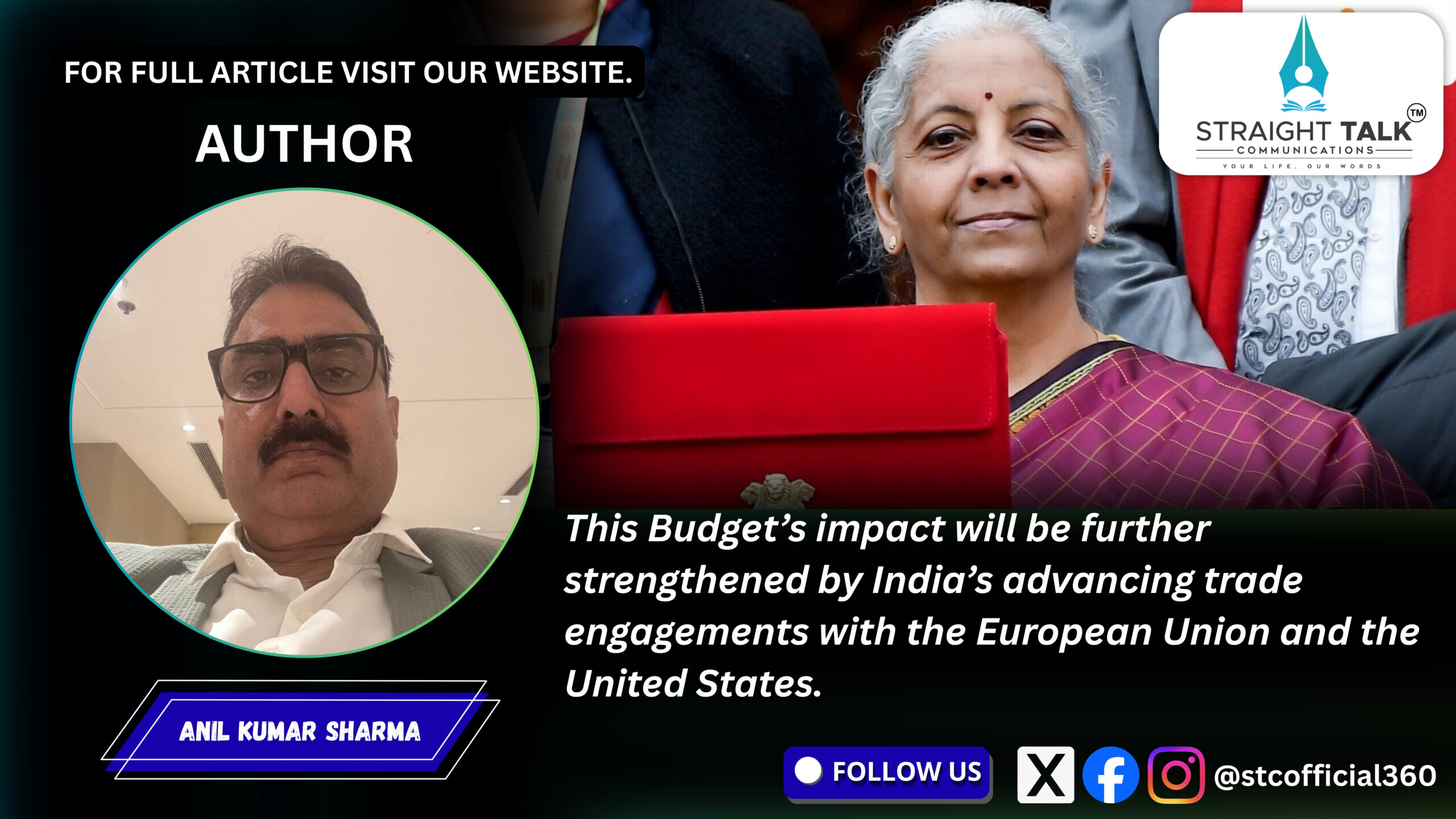
This Budget’s impact will be further strengthened by India’s advancing trade engagements with the European Union and the United States.
Anil Kumar Sharma
Budgets are often remembered for what they give away. This one will be remembered for what it chose to build. Presented on Sunday by the Hon’ble Finance Minister, the Union Budget stands apart not because it promised instant relief or headline friendly sops, but because it demonstrated quiet confidence in long term economic management. In a political climate where fiscal populism is often mistaken for compassion, the Budget made a deliberate choice: discipline over display, strategy over spectacle.
At a macro level, the Budget reflects a clear belief that sustainable growth cannot be manufactured through short term consumption stimuli alone. With total expenditure of about ₹53.5 lakh crore and a fiscal deficit projected at around 4.3 percent of GDP, the government has continued on the path of consolidation without undermining growth momentum. This balance is not accidental. It reflects a conscious political decision to protect macroeconomic credibility even when easier, more popular options were available.
The strongest expression of this long term thinking lies in the continued emphasis on capital expenditure, raised to around ₹12.2 lakh crore, with effective capex crossing ₹17 lakh crore when support to states and extra budgetary resources are included. Capital expenditure is neither instant nor emotional. Its dividends are delayed, but durable. It creates assets, not applause, and that is precisely why it is a true test of intent.
From a banking and credit transmission perspective, this emphasis is particularly significant. Capital expenditure remains the most effective fiscal lever for activating the credit cycle. Large public investments in infrastructure such as roads, railways, logistics, energy, and urban development generate demand for long term finance, project loans, working capital, and downstream MSME credit.
For regions like the Union Territory of Jammu and Kashmir, this linkage is even more critical. Infrastructure spending here is not merely an economic decision. It is an instrument of integration, stability, and opportunity. Improved highways, tunnels, rail connectivity, and power infrastructure directly influence tourism, trade, mobility, and private investment. For banks operating in the region, such investments create structured, asset backed lending opportunities rather than short term, consumption led credit exposure.
The allocation of nearly ₹2.8 lakh crore to Railways alone is illustrative. Rail projects, freight corridors, station redevelopment, and rolling stock expansion carry long gestation periods, but they offer stable cash flows and predictable repayment structures. In the Jammu and Kashmir context, improved rail connectivity has the potential to reduce isolation, lower logistics costs, and unlock new economic activity. For banks, this translates into healthier credit growth rooted in productivity rather than pressure driven lending.
Equally important is what the Budget avoided. There were no blanket loan waivers, no indiscriminate interest subventions, and no populist credit directives that could distort bank balance sheets. Instead, net tax revenues of about ₹28.7 lakh crore signal confidence in compliance and economic momentum rather than dependence on fiscal gimmicks. This restraint protects banks from policy induced stress and reinforces credit discipline, something particularly important in sensitive and developing regions.
The Budget’s approach to MSMEs further reinforces this philosophy. The proposed ₹10,000 crore SME Growth Fund and targeted credit facilitation measures aim not at subsidising inefficiency, but at scaling viable enterprises. In Jammu and Kashmir, where small businesses, artisans, tourism linked units, and service enterprises dominate, such support can strengthen credit absorption capacity. For banks, this means better rated borrowers, improved cash flows, and reduced slippage risk over time.
This distinction matters. True credit transmission does not occur when banks are instructed to lend. It occurs when economic conditions make lending viable and sustainable. By focusing on infrastructure, manufacturing, logistics, and supply chain depth, the Budget strengthens the demand side of credit while preserving the prudential integrity of the banking system.
The Budget’s tax stance also supports financial stability. Instead of dramatic rate cuts, the focus remains on simplification, predictability, and compliance stability, including progress towards the new Income Tax framework. For banks and financial institutions, policy certainty reduces risk, improves planning, and supports long term credit decisions. Stability, not surprise, is the friend of finance.
Defence expenditure of about ₹7.8 lakh crore and transfers to states exceeding ₹26 lakh crore, including devolution, further reinforce this framework. Stronger state finances translate into better project execution, fewer payment delays, and improved credit culture at the sub national level. For the Union Territory of Jammu and Kashmir, sustained central support combined with capital investment strengthens both fiscal capacity and development outcomes.
Critics may argue that the Budget lacks immediate relief or emotional resonance. That criticism is understandable, but incomplete. Not every Budget is meant to comfort. Some are meant to correct course. This one appears designed to strengthen the financial plumbing of the economy, from public investment to private enterprise, from fiscal policy to bank lending, from balance sheets to growth transmission.
Politically, the Budget signals confidence. Confidence that citizens can see beyond instant gratification, and that credibility ultimately matters. Technocratically, it reflects coherence: fiscal discipline aligned with capital formation, and credit health aligned with economic productivity.
In closing, this Budget should be judged not by what it announced, but by what it enables. It enables banks to lend with confidence, enterprises to borrow with purpose, and regions like Jammu and Kashmir to integrate more fully into the national growth story. It rejects the easy applause of appeasement in favour of the harder task of institution building. Such budgets rarely excite crowds, but they strengthen nations. And in the long run, that remains the truest measure of leadership.
This Budget’s impact will be further strengthened by India’s advancing trade engagements with the European Union and the United States. Expanded market access and supply chain integration will boost exports, manufacturing, and services. Aligned with strong public capex and stable credit conditions, these trade links can convert fiscal discipline into sustained growth momentum.
(STRAIGHT TALK COMMUNICATIONS EXCLUSIVE)