


Return of Power Projects in J&K: Sentiment VS Reality
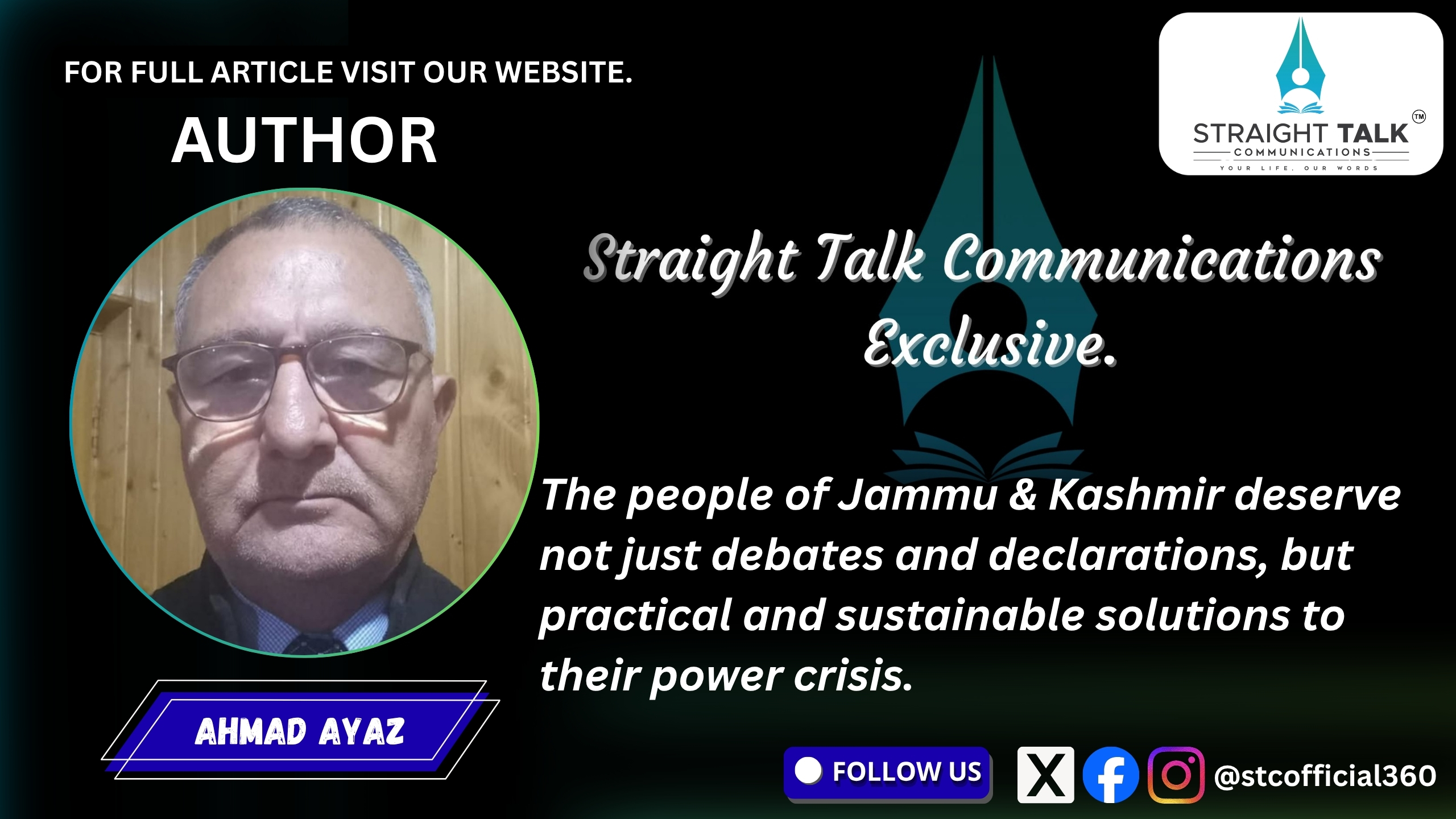
The people of Jammu & Kashmir deserve not just debates and declarations, but practical and sustainable solutions to their power crisis.
Ahmad Ayaz
Jammu & Kashmir continues to face a persistent and deeply frustrating power crisis despite being endowed with immense hydropower potential. On paper, the region has the capacity to generate far more electricity than it consumes. In reality, however, people continue to grapple with shortages, unscheduled power cuts, and heavy dependence on external procurement.
With demand fluctuating between 2800–3200 MW and availability hovering around 2400–2800 MW, even after imports, a 15–25% shortfall remains a recurring challenge. This gap is not merely technical—it directly impacts households, businesses, agriculture, and overall economic growth.
Against this backdrop, the renewed demand for the return of hydropower projects to Jammu & Kashmir—once again raised through a bill in the Assembly—has resonated strongly with the public. The sentiment is simple and compelling: resources belonging to the region should primarily benefit its people.
While this argument carries undeniable emotional and moral weight, the reality surrounding it is far more complex, layered, and constrained.
THE HISTORICAL CONTEXT OF POWER PROJECTS
To understand the present situation, one must revisit how major hydropower projects in Jammu & Kashmir came under external control.
Over the decades, several large hydroelectric projects were transferred to NHPC Limited, a central public sector undertaking. These transfers were not arbitrary; they were part of agreements shaped by specific political and financial circumstances.
At the time, the region lacked the financial strength, technical expertise, and institutional capacity required to independently execute large-scale hydropower projects. The involvement of NHPC ensured that these projects were built and operationalized, contributing to overall power generation.
However, these agreements came with long-term implications. Control, revenue sharing, and operational authority largely remained with NHPC, leaving Jammu & Kashmir with limited direct benefits relative to the scale of its natural resources.
Over time, this arrangement has increasingly been viewed as imbalanced, fueling demands for reassessment.
THE LEGAL FRAMEWORK: WHY REVERSAL IS NOT SIMPLE
One of the most overlooked aspects in public discourse is the legal framework governing these projects.
The agreements between Jammu & Kashmir and NHPC are legally binding contracts. They define ownership structures, revenue models, operational control, and tenure. These are not arrangements that can be undone through political declarations or legislative resolutions alone.
Reclaiming these projects would require navigating a complex legal process involving:
Contract renegotiation or termination
Arbitration or prolonged litigation
Compensation for investments already made
Settlement of liabilities and future revenue claims
Such processes are not only time-consuming but also financially and politically demanding. Any unilateral move could trigger serious legal consequences.
This is where the gap between political messaging and legal reality becomes evident.
FINANCIAL IMPLICATIONS: THE HIDDEN CHALLENGE
Beyond legal hurdles lies an equally daunting challenge—financial viability.
Hydropower projects require massive capital investment. Over the years, NHPC has invested thousands of crores in infrastructure, maintenance, and expansion. Reclaiming these assets would likely involve:
Paying compensation or buying out stakes
Assuming operational and maintenance costs
Ensuring technical efficiency and uninterrupted supply
For a region already facing fiscal constraints, this raises a critical question:
Does Jammu & Kashmir currently possess the financial capacity to undertake such a transition?
Without a well-defined financial roadmap, even a favourable legal outcome may prove difficult to implement.
THE ROLE OF THE CENTRAL GOVERNMENT
Another unavoidable reality is the role of the central government.
Since NHPC is a central public sector enterprise, any restructuring or transfer of its assets would require approval from New Delhi.
In the current political framework, Jammu & Kashmir does not enjoy the level of autonomy it once had, which further limits its negotiating leverage.
Even if the Assembly passes a resolution or bill, its implementation ultimately depends on:
Political alignment with the Centre
Negotiation strength of regional leadership
Willingness of central authorities to engage
Without convergence on these fronts, such proposals risk remaining confined to legislative discourse.
ASSEMBLY DYNAMICS VS GROUND EXECUTION
The introduction of a bill in the Assembly undoubtedly highlights the issue and creates political momentum. However, governance does not end with legislation—it begins there.
Key questions remain:
Will the bill pass without dilution?
Even if passed, does it carry enforceability beyond the House?
Can it override pre-existing agreements?
Recent legislative experiences suggest caution. Many initiatives, despite genuine intent, struggle to translate into actionable outcomes.
THE QUESTION OF POLITICAL WILL ABD CAPACITY
At its core, the issue raises a fundamental question:
Does the present leadership have the capacity to see such a complex process through?
Reclaiming hydropower projects is not a single decision but a multi-stage process requiring:
- Strong legislative backing
- Robust legal strategy
- Clear financial planning
- Sustained engagement with the Centre
- Administrative readiness for transition
Each stage demands not just intent, but institutional strength and political leverage—elements that currently appear misaligned.
SYMBOLISM VS SUBSTANTIVE OUTCOMES
This brings us to a crucial distinction—symbolism versus substance.
Raising the issue resonates deeply with public sentiment and reinforces political narratives around regional rights and resource control. However, without a clear execution pathway, such moves risk becoming symbolic rather than transformative.
Unmet expectations can lead to:
Public disillusionment
Erosion of institutional trust
Growing skepticism toward future initiatives
This pattern is not unfamiliar in Jammu & Kashmir’s governance landscape.
THE WAY FORWARD: BEYOND RHETORIC
For this demand to move beyond rhetoric, a structured and pragmatic approach is essential:
- Transparent Review of Agreements
A public audit of existing agreements with NHPC to clarify constraints and opportunities. - Phased Negotiation Strategy
Exploring models like enhanced revenue sharing, joint control, or gradual transfer. - Financial Planning
A realistic blueprint to manage costs, liabilities, and future investments. - Centre–State Engagement
Constructive dialogue with the central government, backed by clear strategy. - Institutional Strengthening
Building local capacity to manage large hydropower assets efficiently.
Only such a comprehensive approach can convert aspiration into reality.
LIKELY SCENARIO: MANAGING EXPECTATIONS
Given the current constraints, the immediate return of hydropower projects appears unlikely.
This does not diminish the legitimacy of the demand. It simply highlights the gap between what is desirable and what is feasible at present.
In the near term, the issue is likely to:
Remain part of political discourse
Serve as a narrative for public positioning
Witness limited policy-level progress
Unless there is a significant shift in political dynamics and institutional capacity, expectations must be calibrated accordingly.
CONCLUSION
The demand for reclaiming Jammu & Kashmir’s hydropower projects is rooted in genuine sentiment and legitimate concerns about resource ownership and economic justice.
However, governance operates within the constraints of law, finance, and political structure.
At present, these constraints are formidable:
Legally binding agreements limit flexibility
Financial realities restrict options
Political dynamics reduce bargaining power
The real test, therefore, lies not in raising the demand—but in demonstrating the ability to deliver it.
Until there is a clear roadmap, political alignment, and institutional preparedness, the issue risks becoming yet another unfulfilled promise—where intent is visible, but outcomes remain elusive.
Ultimately, the people of Jammu & Kashmir deserve not just debates and declarations, but practical and sustainable solutions to their power crisis.
(The author is a Political Analyst, national TV debater, and columnist. He can be reached at ahmadayaz08@gmail.com.)