



DATELINE: Liberation or Leverage? When Women’s Rights Become a Weapon of Power
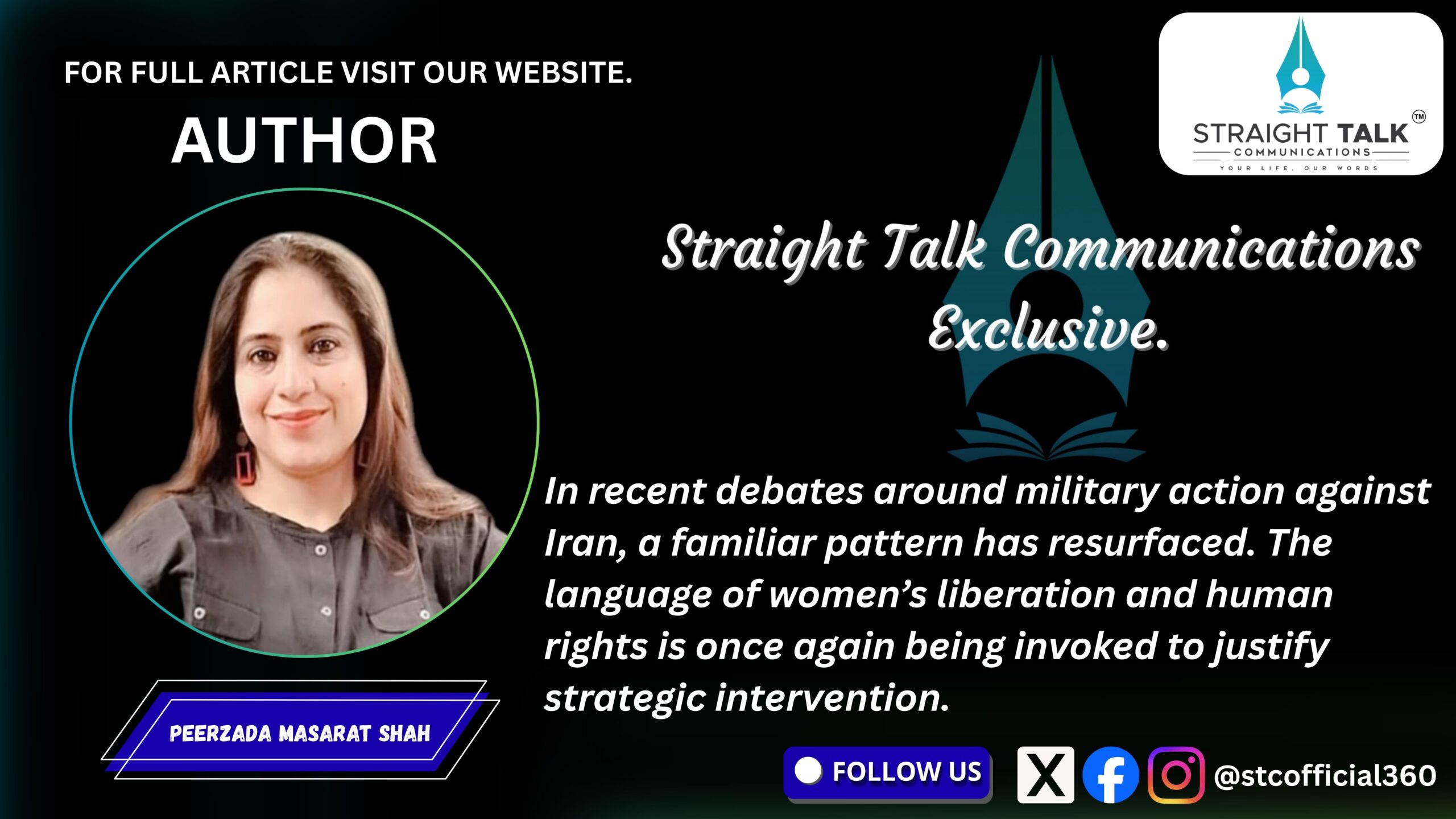
Peerzada Masarat Shah
In recent debates around military action against Iran, a familiar pattern has resurfaced. The language of women’s liberation and human rights is once again being invoked to justify strategic intervention. At first glance, it sounds morally compelling. But history urges caution. When the vocabulary of empowerment merges with military ambition, the outcome is rarely justice — it is usually power.
There is no denying that Iranian women have raised their voices for dignity and reform, particularly after the tragic death of Mahsa Amini in 2022. The protests that followed reflected real grievances and genuine pain. International observers, including a United Nations expert mission, documented serious human rights concerns. These issues deserve attention. They deserve moral clarity. They deserve solidarity.
But solidarity is not the same as sanctioning bombs.
Criticising oppression within a society is fundamentally different from celebrating foreign airstrikes as liberation. Modern history provides sobering lessons. In Afghanistan and Iraq, the rhetoric of “saving women” was prominently deployed to legitimise war. The promise was emancipation; the reality was prolonged instability, fractured institutions, and societies struggling to rebuild from devastation. Women, as always, bore a disproportionate share of the suffering.
This instrumental use of feminist language creates two profound distortions.
First, it converts human rights into a selective principle rather than a universal one. When advocacy emerges only where it aligns with geopolitical interests, it erodes credibility. Human rights begin to appear less as a moral commitment and more as strategic leverage. That perception weakens the very foundation of global rights discourse.
Second, it misunderstands how authentic social change occurs. Sustainable reform grows from within societies. It evolves through education, legal transformation, cultural negotiation, and civic participation. External force rarely cultivates these processes. More often, it disrupts them, hardens resistance, and deepens polarization.
There is another dimension that demands honest reflection. Women’s empowerment must not be recast as a project of cultural erasure. Societies are shaped by religion, tradition, and inherited moral frameworks. Reform and renewal are possible within these frameworks. Progress does not require contempt for faith, nor does it demand the abandonment of identity.
Women’s rights — dignity, safety, education, participation in public life, and equal protection under law — are not negotiable. But rights should not be confused with rootlessness. Freedom is not synonymous with vulgarity. Modernity does not require moral emptiness. Even vibrant democracies continue to wrestle with balancing liberty and social responsibility. Every society navigates its own ethical boundaries through dialogue, law, and lived experience.
The real question, then, is not whether women deserve rights. They unquestionably do. The deeper question is how those rights are advanced — and who defines their meaning. When liberation is framed through missiles rather than movements, it loses moral authority. When feminism is detached from cultural context, it risks becoming an ideological export rather than an organic reform.
True empowerment respects agency. It strengthens individuals without dismantling social cohesion. It challenges harmful practices without humiliating entire civilizations. It recognises that religion and tradition can serve as sources of stability and moral guidance, even as they evolve over time.
If the global conversation on women’s rights is to retain integrity, it must remain principled and consistent. It cannot be activated selectively. Nor can it be imposed by force. The path forward lies in amplifying women’s voices within their own societies, supporting lawful reform, and defending universal dignity without converting it into a geopolitical slogan.
Women’s liberation is not a weapon of war. It is a moral responsibility. And responsibility, unlike power, must be exercised with restraint, wisdom, and respect.
(STRAIGHT TALK COMMUNICATIONS EXCLUSIVE)