




DATELINE: When Walls Fell, Humanity Rose
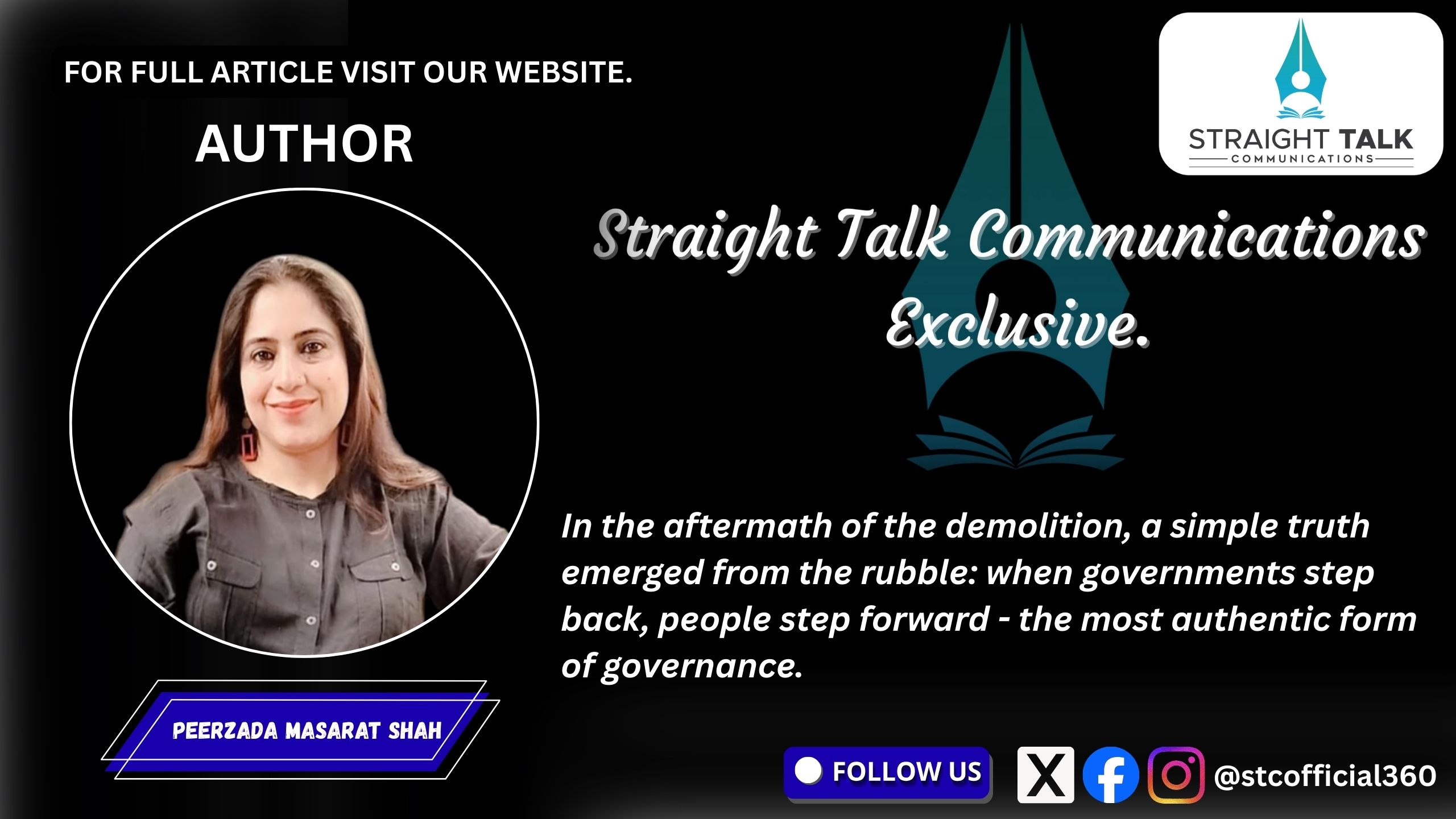
In the aftermath of the demolition, a simple truth emerged from the rubble: when governments step back, people step forward – the most authentic form of governance.
Peerzada Masarat Shah
When the bulldozers arrived at journalist Arfaz’s home in Jammu, the collapse of brick and mortar was not the story. The deeper rupture was the quiet breakdown of trust between citizen and state. A home can be rebuilt; the loss of faith in institutions is far harder to repair. What unfolded that day was not just a demolition—it was a moment that revealed the distance between the power of the state and the conscience of the people.
Administratively, the incident quickly turned into a maze of evasions. Files shuffled, departments distanced themselves, and responsibility became a moving target. “Procedure” was invoked repeatedly, but procedure, when weaponised without accountability, becomes nothing more than a bureaucratic shield. As officials debated legality, the family stood before the rubble, facing the harshest truth of all: when institutions hesitate, lives are altered in seconds.
But something remarkable happened in the vacuum created by governmental silence. Ordinary citizens, with no authority and no obligation, stepped forward with a clarity and decisiveness that the administration failed to demonstrate.
Kuldeep Sharma, a resident of Jammu with no official position, offered five marlas of his personal land. A businessman from Shopian committed one kanal. From Pampore, Mohammad Iqbal Shah extended ten marlas, and another citizen from Ramban contributed ten more. No one asked which department was responsible. No one demanded paperwork. They acted not out of ideology, but out of instinct—human instinct.
In that moment, the contrast was unmistakable. The state, equipped with machinery and mandate, appeared reluctant and defensive. The people, equipped with nothing but conscience, demonstrated what genuine leadership looks like. It recalled Nelson Mandela’s reminder that “our human compassion binds us the one to the other.”
This was compassion in action—not in speeches, not in schemes, not in circulars.
In a region often described through the narrow lenses of identity politics, this spontaneous solidarity shattered stereotypes. Hindus and Muslims, people from Jammu and Kashmir, stood together without hesitation. They offered land not to someone from their community, ideology, district, or religion—but simply to a fellow human being in distress. These gestures did more than support a family; they exposed the fault lines in an administrative culture where empathy is too often overshadowed by paperwork.
The bulldozers brought down a house.
The people began rebuilding a nation.
And yet, this episode raises a sharp moral question for those in power: If a citizen’s home can be demolished without full clarity and accountability, what credibility does governance retain? A system that can destroy but cannot protect loses its moral claim to authority. Governance is not measured by the force it can apply, but by the fairness it can uphold.
This is not an argument against law. It is an argument for humanity within law. The state’s role is not merely to enforce regulations—it is to ensure justice. When state machinery acts without empathy, even legal actions can feel unjust. Conversely, when people act with empathy, even small gestures can restore societal balance.
Kuldeep Sharma’s gesture, supported by his daughter Taniya, has become a symbol of the harmony many claim is “lost” in today’s India. The truth is the opposite: harmony is not lost; it is simply overshadowed by louder forces of division. The silent majority—those who act in kindness, who see beyond identity—rarely make headlines. But when they do, they remind us of the India that still exists beneath the noise.
This episode also offers a lesson to policymakers: leadership is not defined by title but by response. A file can authorise destruction; only empathy can authorise healing. The people who stepped up did not wait for instructions—they simply recognised that humanity demands action, not approval.
In the aftermath of the demolition, a simple truth emerged from the rubble: when governments step back, people step forward. And in that stepping forward lies the most authentic form of governance—one driven not by authority, but by accountability; not by power, but by compassion.
The institutions may have faltered. But society did not.
And sometimes, that is enough to rebuild more than a house—it rebuilds hope.
(STRAIGHT TALK COMMUNICATIONS EXCLUSIVE)