




I AM A JAMMUITE: Development Held Hostage – The Indian Paradox
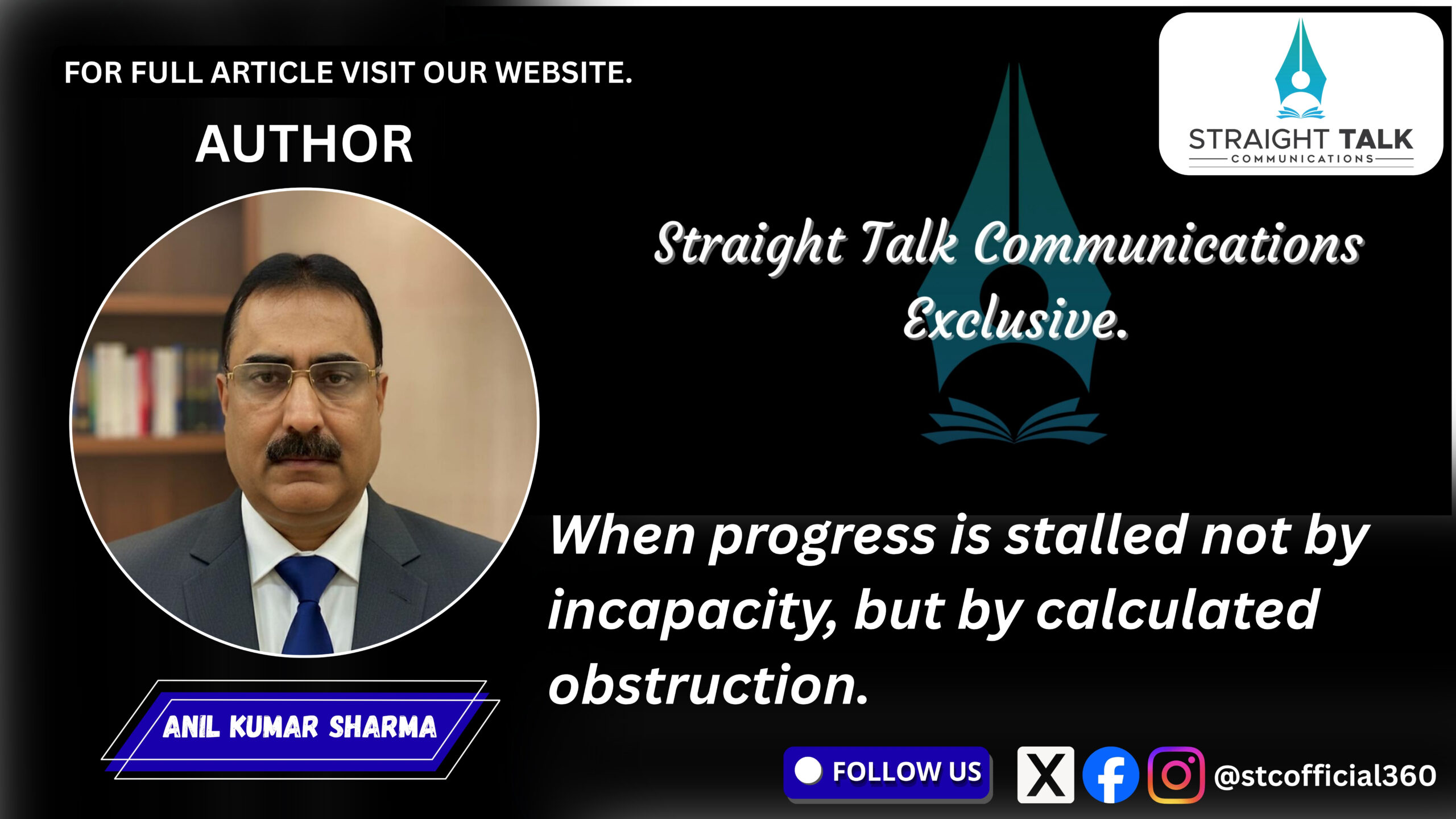
When progress is stalled not by incapacity, but by calculated obstruction.
Anil Kumar Sharma
It is difficult to escape a persistent and unsettling question:
Why does India, despite its vast human capital, technological depth, and institutional experience, continue to lag behind developed nations in infrastructure?
The answer does not lie in the absence of technology or technocrats. India produces engineers and planners who build highways in Africa, metros in the Middle East, and digital systems admired globally. Nor is it fair to say that our leadership lacks vision. Grand plans are announced with regularity and intent. Yet, somewhere between policy and execution, development in India repeatedly falters.
The real impediment is political obstruction and vote bank calculations, often driven by illegitimate interests that manipulate public sentiment in the name of compassion.
Across the country, development projects follow a familiar and troubling pattern. A highway expansion, an industrial corridor, a power project, or an urban redevelopment plan is proposed, aimed at long term national or state benefit. Almost immediately, resistance surfaces. Political intermediaries and local power brokers step forward as self appointed custodians of the poor. Narratives are carefully manufactured: farmers will lose livelihoods, the poor will lose shelter, the environment will be destroyed. Protests are organised, courts are approached, and the project is stalled.
The irony is stark. In the name of protecting livelihoods, accident prone single lane roads remain unchanged for years, continuing to claim lives. Highway and expressway projects delayed on political grounds keep farmers cut off from markets and youth cut off from jobs. Once elections pass or governments change, the same projects often resurface with marginal alterations, exposing that resistance was never about rehabilitation, but electoral arithmetic.
Power projects present another telling example. Thermal plants, hydro projects, and even transmission lines have been stalled for years due to selective political mobilisation. Regions opposing power generation simultaneously demand industrial growth and employment. Industries deprived of reliable electricity move elsewhere. Households continue to suffer erratic supply. Ironically, electricity is imported from other states at higher cost, while local potential remains locked behind political fear.
Urban redevelopment and slum rehabilitation reflect an even deeper moral contradiction. Projects meant to provide dignified housing, sanitation, and safety are resisted in the name of the poor, turning informal settlements into permanent vote banks. Residents continue to live amid overcrowding, fire hazards, disease, and insecurity, while political middlemen thrive on uncertainty. When redevelopment finally occurs through judicial or central intervention, beneficiaries often admit that fear was exaggerated and hope delayed for political convenience.
Industrial corridors and manufacturing zones tell a similar story. While states publicly compete for investment, land pooling and acquisition are resisted locally due to fear of electoral backlash. Projects migrate to more decisive regions or even outside the country. The result is predictable: lost employment, stunted regional growth, and yet another explanation offered in the name of the very people who remain unemployed.
Railway expansion and freight corridors, vital for reducing logistics costs and emissions, have also been altered or stalled due to local political pressures. Freight continues to move inefficiently by road, congestion worsens, fuel imports rise, and national competitiveness suffers, all because difficult decisions were postponed.
This is not empathy. This is paralysis disguised as morality.
A tiny number of influential actors benefit from delay. Uncertainty becomes leverage. Obstruction becomes a bargaining tool. Meanwhile, millions silently pay the price through unsafe roads, unreliable power, jobless growth, and uneven regional development. Development delayed is not neutral; it extracts a social and economic cost that disproportionately hurts the poor.
A developing nation cannot afford the luxury of perpetual protest without resolution. No country has progressed by freezing itself in fear of change. Development inevitably requires transition, but transition must be humane, transparent, and just. Those genuinely affected deserve fair compensation, dignified rehabilitation, and inclusion as stakeholders. What cannot be justified is holding national progress hostage to narrow political interests masquerading as concern for the downtrodden.
If India truly aspires to be a developed nation, it must learn to distinguish genuine grievance from engineered resistance. We must stop romanticising obstruction and start questioning who benefits from delay. Progress cannot be endlessly postponed in the name of the poor, while the poor continue to wait for opportunity.
The choice before us is stark:
either confront vested interests with clarity and courage, or continue to explain away our underdevelopment through comfortable political excuses.
History will not judge our intentions,
It will judge our outcomes.
(STRAIGHT TALK COMMUNICATIONS EXCLUSIVE)