




I AM A JAMMUITE: When Debate Replaces Action
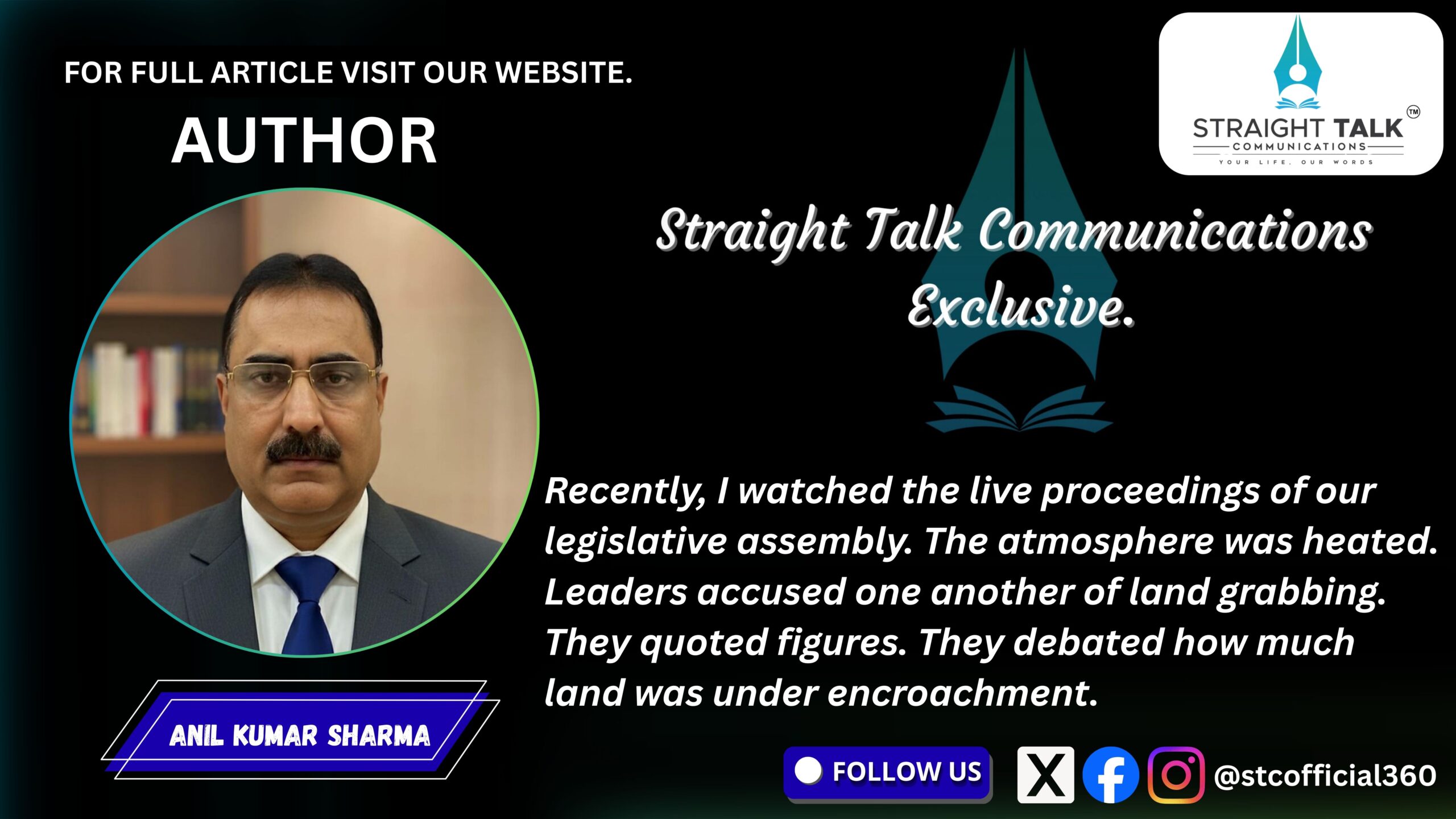
Anil Kumar Sharma
Recently, I watched the live proceedings of our legislative assembly. The atmosphere was heated. Leaders accused one another of land grabbing. They quoted figures. They debated how much land was under encroachment. They spoke forcefully, defending their positions with visible conviction.
They appeared as champions of the people they represent.
But as I listened carefully, one thing disturbed me deeply. Not a single member stood up and clearly committed that within a defined time frame the land would be reclaimed and justice ensured. There were arguments. There were statistics. There was noise.
But there was no commitment.
I returned home with a simple question: Is debate enough if there is no resolve to act?
A Larger Concern
That experience made me reflect on something much larger. It was not just about one day in the assembly. It reflected a pattern.
We live in a deeply divided world. In our subcontinent too, divisions shape daily life. We compete not always for development, but often for dominance. Power begins to matter more than progress.
Many leaders speak in the name of caste, religion, or region. They present themselves as protectors of their communities. But one must ask: is the objective service, or influence? Is it care, or control?
Division persists because unity threatens power structures. A divided society is easier to manage. Fragmented loyalties create dependable vote banks. Heightened grievances become political currency.
In the process, personal empires are built contracts secured, loyalties consolidated, memorials erected. But at what cost? Societies weaken. Economies slow. Aspirations shrink.
Religion and Its True Message
Every religion is rooted in universal principles truth, compassion, forgiveness, mutual respect. Yet these principles are often reinterpreted for political convenience. Sacred teachings become instruments of mobilisation.
Communities are gathered not for moral growth, but for electoral strength. Identity is sharpened. Fear is amplified.
The common citizen, meanwhile, is preoccupied with survival. Daily responsibilities leave little time for deeper scrutiny. When survival becomes the central struggle, questioning authority becomes secondary.
This is not condemnation. It is observation.
Power Changes People
In my long professional life, I have witnessed how power slowly reshapes behaviour. A leader who once walked freely among people begins to move within security perimeters. Distance grows gradually.
Privileges create comfort. Comfort becomes habit. Habit fosters separation.
Representation can quietly transform into a distinct class.
Instead of focusing on humanity, some begin focusing on maintaining position. Religion, caste, and region become convenient instruments. Dividing people becomes easier than uniting them.
Why do we so rarely hear sustained voices that rise above identity and speak for humanity as a whole?
Have We Examined Our Leaders?
Before following any leader unquestioningly, have we examined their character? Their integrity? Their capacity to serve beyond their immediate constituency?
It is easy to energise a crowd. It is difficult to improve lives.
History has always produced exceptional individuals who placed humanity above faction.
They spoke less and acted more.
The question is not whether such leaders exist.
The question is whether we choose them.
A Simple Appeal
Borders are natural. Regions are natural. Diversity is a strength.
But hostility manufactured for political advantage is neither natural nor necessary.
Nature has already drawn mountains and rivers. Why must we draw emotional borders between ourselves?
Why can we not aspire to the betterment of humanity as a shared objective?
I write this not as a critic, but as a concerned citizen.
Power is temporary. Humanity is enduring.
Let debates lead to decisions.
Let accusations lead to accountability.
Let leadership mean responsibility.
If we wish to leave behind a meaningful legacy, let it be one of unity, fairness, and development.
The future will not belong to those who divide people. It will belong to those who quietly work to unite them.
Let us rise above narrow thinking and work for a better life not only for our own group, but for the nation and for the world.
Only then will borders remain on maps and not in our hearts.
Sarhadon se nahi, soch se banti hai dooriyan,
Dil saaf ho to mit jaati hain saari majbooriyan.
(STRAIGHT TALK COMMUNICATIONS EXCLUSIVE)