


INTERNATIONAL ANTI-CORRUPTION DAY: UNDERSTANDING CORRUPTON, ITS FORMS, AND ITS CONSEQUENCES
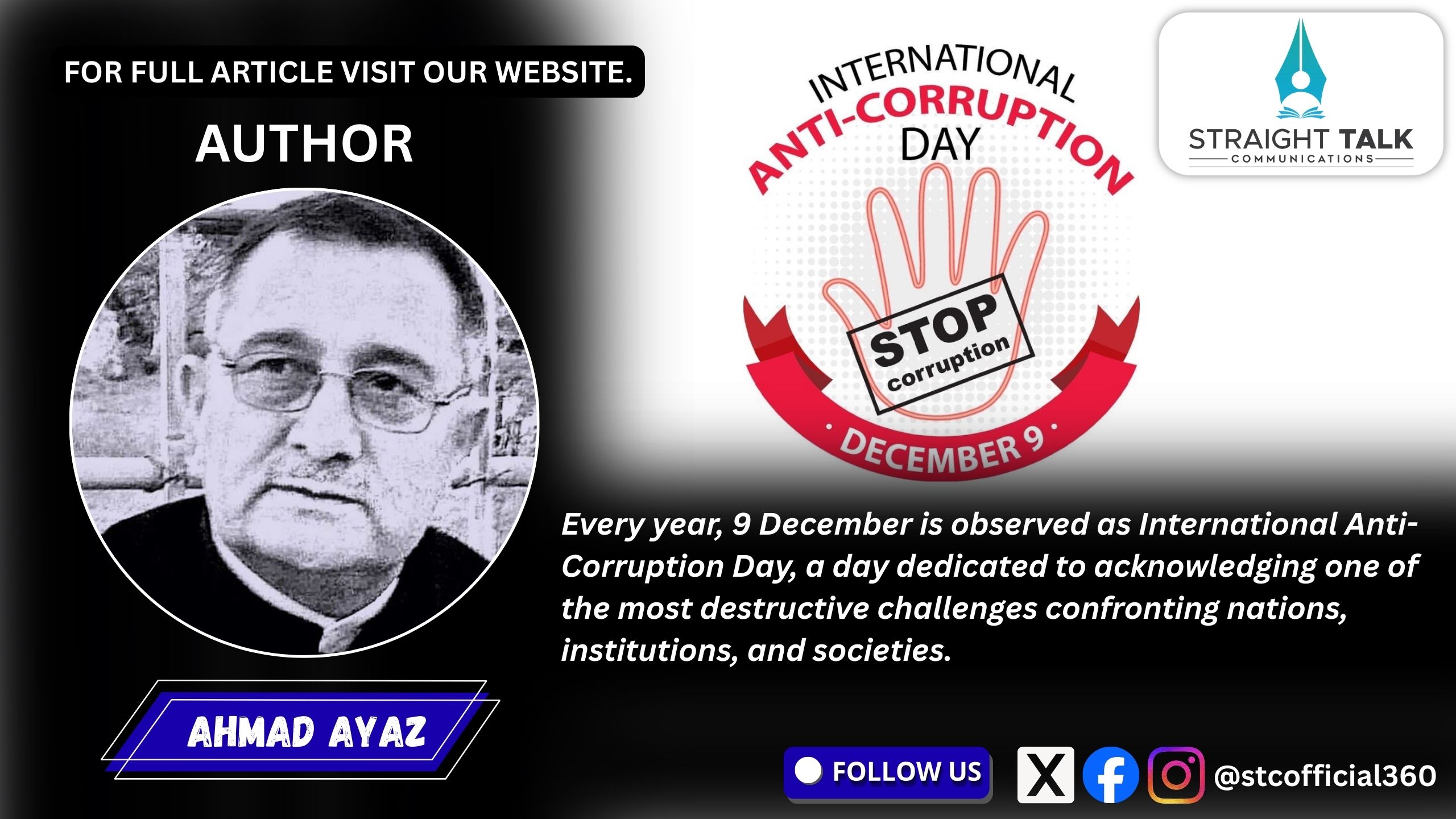
By Ahmad Ayaz
Every year, 9 December is observed as International Anti-Corruption Day, a day dedicated to acknowledging one of the most destructive challenges confronting nations, institutions, and societies. Corruption is not merely an administrative lapse—it is a deep-rooted moral, social, economic, and political problem that weakens institutions, drains public resources, and creates long-lasting inequalities.
This day serves as a reminder that corruption is a shared enemy and that fighting it requires the collective will of governments, institutions, civil society, and citizens committed to transparency, accountability, and integrity.
WHAT IS CORRUPTON?
Corruption is the misuse of public power, official authority, or entrusted resources for personal gain—whether financial, political, or otherwise. It includes any act that compromises fairness, transparency, accountability, or public interest.
It is not limited to paying or receiving bribes. Corruption begins where integrity ends. It can happen at all levels—administrative, political, judicial, corporate, and social—distorting governance and weakening the foundations of democracy.
WHY UNDERSTANDING CORRUPTON MATTERS
Corruption survives in silence, secrecy, and public acceptance. People see its effects but often fail to recognise its various forms. Understanding how corruption works and what damage it causes is the first step toward resisting it.
International Anti-Corruption Day pushes us to shed complacency and recognise corruption as a direct threat to justice, equality, and development.
FORMS OF CORRUPTION
Corruption manifests in several forms, each damaging in its own way. Some of the most common include:
- Bribery
Offering, giving, receiving, or soliciting something of value to influence a decision.
It creates a two-tier system where those with money bypass rules, while others face delays and injustice.
- Nepotism and Cronyism
Favouring relatives, friends, or political loyalists over merit. This weakens institutions, discourages talent, and erodes public trust.
- Embezzlement and Misappropriation of Funds
Stealing public money or diverting it from welfare schemes.
Schools remain incomplete, infrastructure collapses, and citizens suffer because resources are siphoned off.
- Procurement and Contract Manipulation
Inflated costs, rigged tenders, substandard materials.
This is a major cause of poor roads, unsafe structures, and endless project delays.
- Policy Corruption
Shaping laws or decisions to benefit specific groups rather than the public.
It is subtle but dangerous because its effects last for generations.
- Abuse of Power and Authority
Using official power to extract favours, harass citizens, or manipulate processes.
This destroys the rule of law and creates fear of institutions instead of trust.
- Electoral Corruption
Vote-buying, misuse of government machinery, or manipulating voter lists.
When elections are compromised, democracy loses its meaning.
- Judicial and Administrative Corruption
When decisions are influenced by money, pressure, or personal interest.
It undermines justice and denies citizens their fundamental rights.
CONSEQUENCES OF CORRUPTON
Corruption is not merely illegal—it has far-reaching consequences:
- Weakening of Governance
Decision-making is distorted. Officers serve vested interests instead of the public. Accountability collapses.
- Economic Loss and Slow Development
Public money meant for essential services is wasted. Projects become costlier and inefficient.
- Inequality and Injustice
The influential get what they want; the poor suffer delays and harassment. Inequality deepens.
- Erosion of Trust in Institutions
People lose faith in government, judiciary, and administration when they see dishonesty rewarded.
- Poor Public Infrastructure
Procurement corruption results in unsafe bridges, weak power systems, failed water supply, and bad roads.
- Loss of Talent and Brain Drain
When merit is ignored and corruption thrives, honest people lose motivation and leave the system.
- Decline in Investment
Investors avoid places with corrupt systems, affecting job creation and economic confidence.
- Social Frustration and Instability
Corruption leads to resentment, protests, unrest, and a breakdown of social harmony.
WHY INTERNATIONAL ANTI-CORTUPTION DAY MATTERS
This day serves as a global reminder that corruption is not a minor administrative issue but a major obstacle to progress. It highlights the need for:
Strong anti-corruption laws
Independent oversight bodies
Transparent governance
Ethical leadership
Vigilant and empowered citizens
THE ROLE OF GOVERNMENT
Governments must lead through:
Enacting strong anti-corruption legislation
Ensuring independence of vigilance and auditing bodies
Digitalising public services
Publishing tenders, audits, and expenditures
Ensuring time-bound and transparent service delivery
A clean system begins with honest and accountable leadership.
THE ROLE OF CITIZENS
Citizens are equal partners in this fight. Corruption survives because people often participate in it, willingly or reluctantly.
Citizens must:
Refuse to pay bribes
Report wrongdoing
Demand accountability
Vote for clean and credible leaders
Practice integrity in everyday life
No law can succeed if society normalises unethical behaviour.
THE MORAL DIMENSION
Above all, corruption is a moral failure. The decay of values, ethics, and integrity is far more dangerous than financial losses.
When dishonesty becomes a norm, future generations inherit a broken system.
International Anti-Corruption Day reminds us that the battle against corruption is not only institutional—it is also deeply personal.
CONCLUSION
Corruption remains one of the greatest barriers to justice, equality, development, and good governance. It weakens institutions, deepens inequality, and destroys public trust.
However, corruption is not invincible.
With strong laws, accountable leadership, citizen vigilance, transparent systems, and a collective commitment to integrity, societies can significantly reduce corruption.
A corruption-free society is not a dream—it is achievable when governments and citizens act together.
Let this day renew our resolve to uphold honesty, demand accountability, and build a future where corruption finds no space to survive.
The author is a Columnist and National TV Debater. Views are personal. He can be reached at: ahmadayaz08@gmail.com