



IUST hosts 2-day national seminar on Indian Knowledge System and Digital Learning
STC NEWS DESK
SRINAGAR, MARCH 26 (STC):
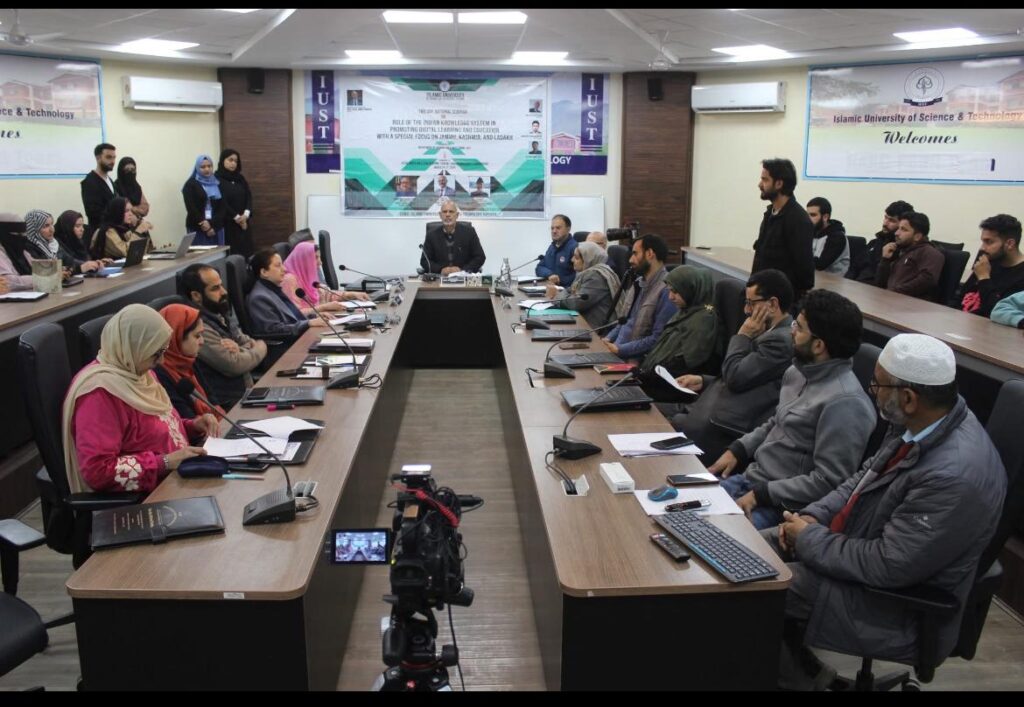
A two-day national seminar on ‘Role of the Indian Knowledge System (IKS) in Promoting Digital Learning and Education’ was inaugurated on Wednesday by the Department of Journalism and Mass Communication (DJMC), Islamic University of Science and Technology (IUST).
Sponsored by the Indian Council of Social Science Research (ICSSR), the seminar aims to explore the integration of India’s intellectual heritage with modern digital education practices.
Chief Guest on the occasion and Dean Academic Affairs, IUST, Prof. Ayaz Hassan Moon, reaffirmed the University’s commitment to integrating IKS into its academic framework. “The National Education Policy (NEP) promotes a holistic and multidisciplinary approach, which seamlessly complements the inclusion of IKS,” he stated.
Guest of Honor and Registrar, IUST, Prof. Abdul Wahid Makhdoomi, highlighted the significance of recognizing traditional knowledge systems and their deep-rooted connection with technology throughout history.
Prof. Afroz Ahmad Bisati, Guest of Honour, and Dean, School of Humanities and Social Sciences, stressed the need for practical approaches to incorporate the IKS into modern education.
The keynote addresses were delivered by Prof. Rakesh Vaid, Director, Poonch Campus, University of Jammu, and renowned Kashmiri poet, Zareef Ahmad Zareef. Prof. Vaid emphasized the vast scope of research in IKS, stating that a deeper academic exploration would uncover a wealth of knowledge within India’s intellectual traditions. Meanwhile, Zareef traced evolution of Kashmir’s mother tongue and cultural values, stressing the importance of preserving the region’s heritage. He referenced various Kashmiri literary works, reinforcing how knowledge has always been an integral part of the region’s identity.
Earlier, the event commenced with a welcome address by Dr. Rabia Noor, Head of DJMC, who set the stage for in-depth discussions on the relevance of traditional knowledge systems in the digital age. The inaugural session concluded with a vote of thanks by Dr. Ruheela Hassan, Dean Outreach IUST and Associate Professor, DJMC, who acknowledged the contributions of the speakers, participants and organizing team.
Later, two technical sessions were held that were chaired by Dr. Munejah Khan, Head, Department of English Language and Literature, IUST, and Dr. Muzaffar Ali Malla, Coordinator, Department of Philosophy, IUST, respectively.
The seminar shall continue over two days with paper presentations and panel discussions, featuring researchers and experts from across the country. The sessions will delve into innovative strategies to integrate traditional knowledge with emerging digital technologies, fostering a deeper understanding of India’s intellectual legacy in the digital age. (STC)