





Kashmiri Artisans Struggle Between Tradition, Turbulence, and Survival

Governments must enforce protective policies, institutions must amplify artisan voices, and consumers must learn to recognize and respect authenticity.
Mohammad Hanief
In the narrow bylanes of Kashmir’s towns and villages, where the rhythm of life once moved in harmony with the soft clatter of looms and the steady movement of skilled hands, a centuries-old cultural legacy now stands at a critical juncture. The artisans of Kashmiri handicrafts—custodians of one of the world’s most intricate and refined craft traditions—are confronting an uncertain present shaped by economic distress, market distortions, and changing social realities.
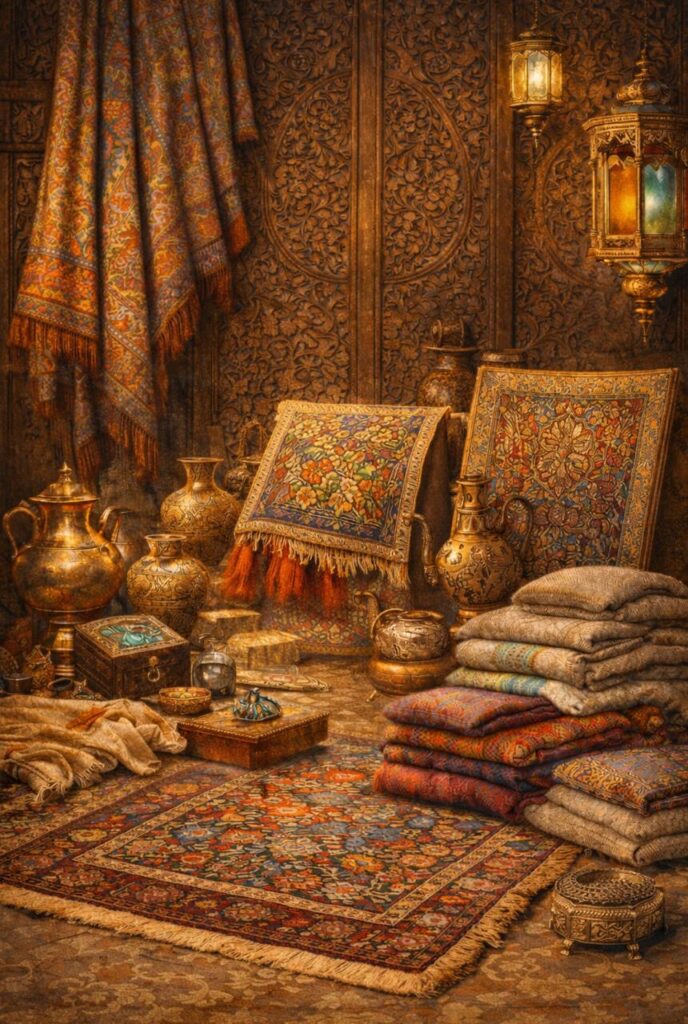
For generations, Kashmir’s identity has been inseparable from its handicrafts. Pashmina shawls known for their feather-light warmth, hand-knotted carpets admired across continents, delicate Sozni and Kani embroidery, finely carved walnut wood, copperware, willow craft, papier-mâché, and traditional jewellery have all been products of patient craftsmanship passed down within families. These crafts were not merely sources of income; they formed the backbone of community life and cultural continuity. Today, however, the artisans behind these masterpieces increasingly find themselves marginalized in the very markets that thrive on the reputation of their labour.
One of the most profound challenges facing Kashmiri artisans today is the growing dominance of machine-made imitations. Advances in industrial production have made it possible to replicate traditional designs at a fraction of the cost and time required for handcrafted items. These products, often marketed alongside genuine handicrafts, have created confusion among buyers and eroded trust in the authenticity of Kashmiri crafts. While machine-made goods cater to price-sensitive markets, their unchecked presence has undermined the livelihoods of artisans whose survival depends on slow, meticulous manual work.
Efforts by authorities to regulate this imbalance have met with mixed outcomes. Policy interventions aimed at protecting handmade crafts have been followed by reversals and compromises that have left many artisans disillusioned. The absence of a clearly enforced distinction between handmade and machine-produced goods continues to blur market boundaries, placing traditional craftsmen at a structural disadvantage. For artisans who spend weeks or months completing a single piece, competing with mass production has become nearly impossible.
Economic insecurity remains a defining feature of the artisan community. Despite being a primary source of income for a large section of Kashmir’s population, handicrafts often yield inconsistent and inadequate returns. Many artisans work long hours only to receive payments that barely cover basic household expenses. Middlemen dominate supply chains, capturing a significant share of profits while craftsmen remain dependent and underpaid. Women artisans, who play a central role in embroidery and finishing work, face additional challenges, including lower wages and limited recognition for their contribution.
These economic pressures have had a visible social impact. Younger generations, observing the instability and limited financial prospects associated with traditional crafts, are increasingly reluctant to inherit family occupations. Many choose alternative career paths or migrate in search of more secure employment, leaving behind an aging artisan population struggling to sustain both livelihoods and heritage. The gradual erosion of generational skill transfer threatens the survival of several rare art forms that exist only in small pockets of the Valley.
For many, the loss was not just economic but emotional, as crafts refined over lifetimes were reduced to stagnant stock. Although tourism has shown signs of revival, recovery remains uneven, and many artisans continue to operate on the margins.
At the same time, there have been notable efforts to arrest the decline and revive confidence within the sector. Government-backed welfare schemes, skill development programs, and artisan registration initiatives have sought to provide financial assistance, training, and social security. Master artisans have been encouraged to train younger craftspeople, while exhibitions and handicraft fairs have been organized to improve direct market access. Such platforms have allowed artisans to interact with buyers, demonstrate their skills, and reclaim some control over pricing and visibility.
Recognition at national and international levels has also played a role in restoring morale. Awards and certifications bestowed upon Kashmiri artisans have highlighted the exceptional quality of their work and reinforced the cultural value of handmade crafts. These acknowledgements, though limited in reach, serve as reminders that Kashmiri handicrafts still command respect and admiration when authenticity is preserved.
Another emerging dimension of resilience is the gradual integration of traditional crafts with modern marketing tools. A new generation of entrepreneurs has begun using digital platforms to connect artisans directly with consumers beyond the Valley. Through online marketplaces and social media storytelling, they are presenting Kashmiri handicrafts not merely as products, but as expressions of history, identity, and human skill. This shift has helped some artisans reduce dependency on intermediaries and access niche markets that value ethical and handmade goods.
Export potential continues to offer cautious optimism. Despite fluctuations in global demand and logistical challenges, Kashmiri handicrafts remain sought after in international markets. Strategic improvements in quality assurance, branding, and geographical indication tagging have the potential to strengthen exports while safeguarding authenticity. However, sustained growth will require consistent policy support, infrastructure development, and greater investment in artisan welfare.
Beyond economics, the condition of Kashmiri handicraft artists raises deeper questions about cultural preservation in a rapidly modernizing world. These crafts embody collective memory, patience, and aesthetic values refined over centuries. When artisans abandon their looms and tools, it is not just an occupation that disappears, but an entire worldview shaped by skill, discipline, and artistic integrity.
Today, Kashmir’s artisans stand at a delicate intersection of decline and renewal. Their future depends on more than short-term relief or symbolic recognition. It requires a holistic approach that values craftsmanship as both cultural capital and viable livelihood. Clear market regulation, fair pricing, youth engagement, gender equity, and consumer awareness must converge to ensure that handmade crafts are not reduced to museum relics or luxury labels detached from their makers.
The survival of Kashmiri handicrafts ultimately rests on collective responsibility. Governments must enforce protective policies, institutions must amplify artisan voices, and consumers must learn to recognize and respect authenticity. If sustained efforts align, the hands that have woven Kashmir’s artistic legacy for centuries may yet continue their work—not in nostalgia, but with dignity, security, and renewed purpose in the modern world.
(STRAIGHT TALK COMMUNICATIONS EXCLUSIVE)