



Ladakh’s Future Beyond Personal Ambitions
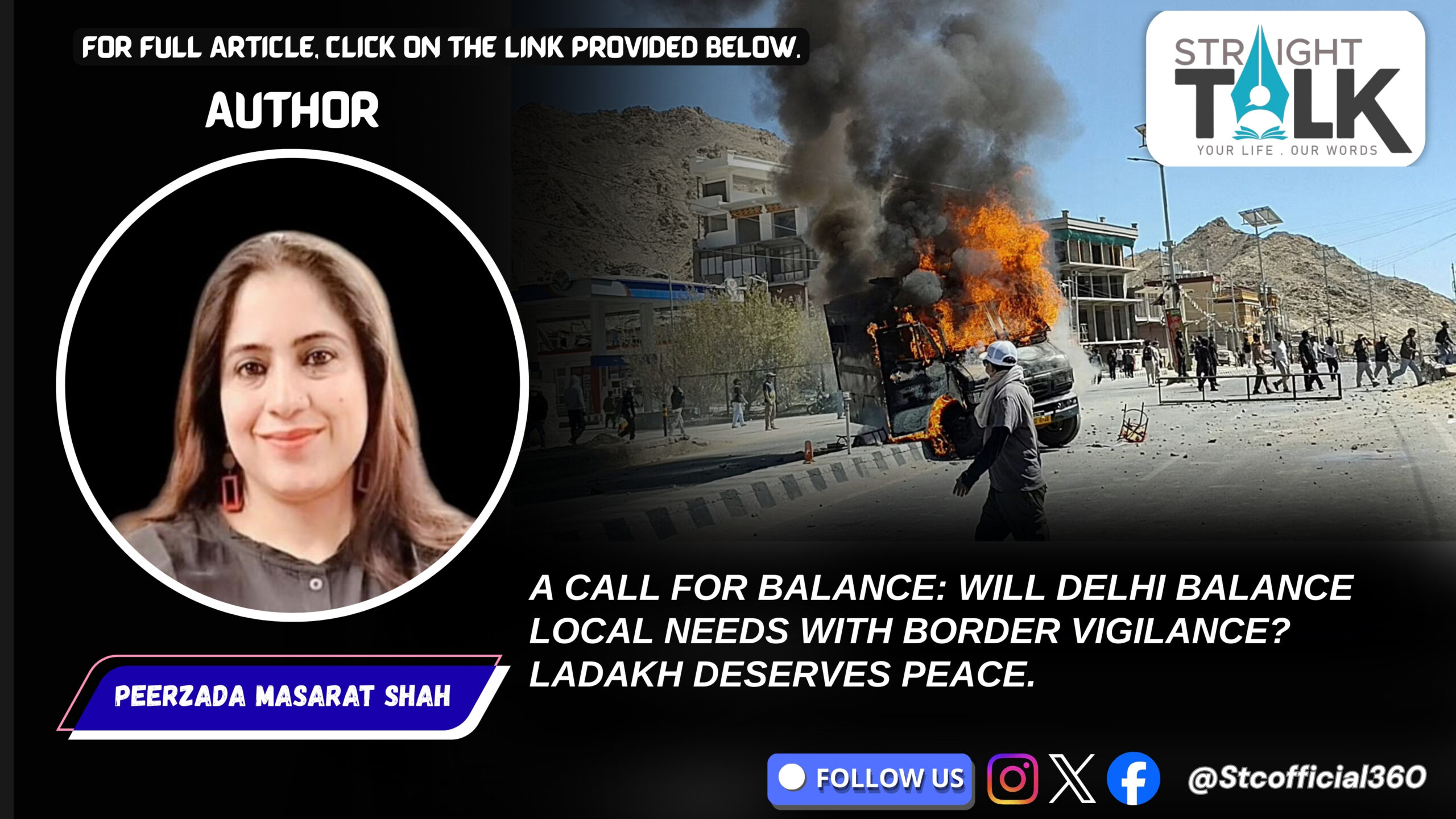
A Call for Balance: Will Delhi balance local needs with border vigilance? Ladakh deserves peace.
Peerzada Masarat Shah
In the serene heights of Leh, where the Indus River winds through stark, majestic peaks, a photograph from August 5, 2019, captures a moment of heartfelt gratitude. Sonam Wangchuk, the humble engineer and activist known from 3 Idiots, stands proudly beside a faded banner reading “Our Demand: Union Territory.” His X post @Wangchuk66 radiates warmth: “Thank you Prime Minister,” he writes, tagging @narendramodi and @PMOIndia. “Ladakh thanks you for fulfilling our long-held dream. It was 30 years ago, in August 1989, that our leaders began this movement for UT status.” With folded-hand emojis and a nostalgic image of 1989 protesters in traditional robes, the tweet celebrates a three-decade struggle against perceived Kashmiri oversight.
Today, at 03:25 PM IST on September 27, 2025, that same account echoes a stark contrast. Wangchuk’s recent posts detail a 17-day hunger strike, “Anshan,” which spiraled into violence, leaving four dead and over 90 injured in Leh. “INDIAN ARMY AND PEOPLE OF LADAKH ARE ALL WEATHER FRIENDS,” one tweet asserts, linking to a podcast honoring the army’s integrity. Another from September 23 praises Arunachal Pradesh: “You’ve lifted the voice of Ladakh and all tribal cultures. DAY 14 OF LADAKH ANSHAN #SaveLadakh #SaveHimalayas #BharatBachao.” Once a voice of appreciation, Wangchuk now accuses the Centre of “witch-hunting” and broken promises, citing Lord Ram’s wisdom: “Life may go, but a vow must not be broken.” Arrested yesterday under the National Security Act (NSA) and sent to Jodhpur, with his NGO’s funding license revoked, his focus has shifted from gratitude to a fervent demand for statehood, rejecting the Union Territory (UT) status as inadequate.
This transformation mirrors a broader narrative in Ladakh, where 300,000 residents navigate a vast, cold desert—larger than 13 European countries—balancing Buddhist and Shia traditions while securing India’s borders with China and Pakistan. Yet, amid this shift, a critical perspective emerges: leaders like Wangchuk, driven to remain relevant, sometimes overshadow the national interest. Ladakh’s strategic location demands vigilance, and Delhi’s focus on security must take precedence over personal or political ambitions. The region’s youth and vulnerable teens also need attention to curb issues like hawala channels, ensuring stability over unrest.
The Dream’s Origins: 1989’s Quiet Resolve
To grasp 2019’s joy, reflect on August 1989. As a district under Jammu and Kashmir (J&K), Ladakh felt neglected by Srinagar’s leadership, which funneled resources away, leaving Leh’s Buddhist community with prolonged power cuts, poor roads, and limited jobs. Leaders like Brij Mohan Lal Atal and the Ladakh Buddhist Association (LBA), draped in gonchas, marched with the “Our Demand: Union Territory” banner—a gentle plea for autonomy, resonating with Saadat Hasan Manto’s critique of imposed silence.
The 35-day shutdown in 1989 saw boycotts of Kashmiri goods, fasts, and appeals to Delhi, with the mantra, “We are Indians first.” The 1995 Ladakh Autonomous Hill Development Council (LAHDC) offered some local say, but unemployment lingered at 20%, and cultural erosion loomed as outsiders arrived. By the 2010s, Wangchuk—whose SECMOL built solar schools for dropouts—joined the call for UT status. The 2019 J&K Reorganisation Act granted it without a legislature, with Modi calling it a milestone. Leh’s 78% voter turnout and BJP’s 61% win in the 2019 Lok Sabha polls reflected hope for land, job, and cultural protections.
The Fade of Hope: Unmet Expectations
The initial cheer faded quickly. By 2020, COVID-19 exposed Delhi’s missteps—bureaucrats struggled with relief, and the Lieutenant Governor (LG) overruled LAHDCs. Jobs dwindled as the J&K Public Service Commission vanished, favoring outsiders, while land safeguards weakened post-Article 370, inviting mining and tourism. “We swapped one overseer for another,” a Leh shopkeeper noted in a 2022 viral clip.
Wangchuk’s stance shifted in 2021 with a 21-day fast against a solar project threatening nomad lands. “UT status was a hope, but without Sixth Schedule, it’s a challenge,” he posted, seeking tribal protections like Mizoram’s. The Leh Apex Body (LAB) and Kargil Democratic Alliance (KDA) pushed for statehood, Sixth Schedule, a Ladakh PSC with 85% local jobs, and separate Lok Sabha seats. MHA talks since December 2024 stalled; BJP’s 2019 Sixth Schedule promise faded, and 2024 elections saw independents win on anti-UT sentiment. Modest gains like a 15-year domicile rule in June 2025 and job quotas in July fell short. Statehood remained off the table due to border concerns. Wangchuk’s 500-mile “Delhi Chalo Padyatra” in September 2024 drew crowds but no results. “We walked for dignity, not charity,” he tweeted.
By 2025, frustration peaked. On September 21, he warned, “Corruption is rising in UT Ladakh! CBI is investigating,” citing shady deals. On September 10, 15 fasters, including ex-Army men, began the Anshan. “Day 1: Talks failed again,” he streamed, honoring the Ladakh Scouts: “We guarded India; now guard our land.” A soldier’s plea followed: “A skier asks Modi ji to honor our service.”
Leaders and Relevance: A Delicate Balance
Wangchuk’s shift—from 2019’s praise to 2025’s critique—reflects a drive to stay relevant. Atal, a 1989 leader, joined BJP post-UT but left in 2023 over broken promises. Cherchup Chocho now warns of a “Ladakh Spring” if ignored. Kargil’s Sajad Hussain Kargili, a 2019 UT supporter, now calls it a “flawed experiment.” “The government must deliver statehood and Sixth Schedule,” he posted during unrest.
This pivot stems from necessity. With 60% of Ladakh’s population under 30, unemployment hits 25%, illegal mining has risen 40% since 2019, and migrant influx has tripled, threatening culture. Wangchuk, whose SECMOL faces CBI scrutiny over Adani-linked funds, adapts to lead this discontent. BJP IT cells say, “He fled trouble,” ignoring his peace appeals. A youth countered, “The UT changed, not him.”
Yet, leaders must recognize they are centers of influence, not creators of power. Ladakh’s strategic border with China and Pakistan demands Delhi’s focus on national security over local agendas. The region’s youth and teens, vulnerable to hawala networks, need guidance, not unrest fueled by relevance-seeking.
Social Media’s Dual Role: Voices and Jokes
On X, Wangchuk’s followers grew from 50,000 to 500,000, his posts blending science (strong Ladakhi genes) with humor (Modi’s Day 8 wish as “scarves over rocks”) going viral. But memes followed. A popular edit turns 3 Idiots’ Rancho into an angry Wangchuk: “Rancho 2009: All is well. 2025: Ladakh struggles! #Uturn,” shared 10,000 times. BJP added Chinese flags: “From UT fan to China’s friend?” with 15,000 likes. Opposition cast him as Bhagat Singh: “From fast to NSA?” Kargil memes show a broken stupa as “2019 Plans,” Modi as the cause.
These divide: pro-Wangchuk views hit 1 million, exciting youth. Critics justify crackdowns: “He left kids to burn the office.” Support from Arunachal (3,000 shares) and Manipur (500 replies) shows solidarity. Social media amplifies, but security concerns must guide its use.
The Turning Point: Stability Over Strife
On September 24, Day 15, two fasters collapsed, prompting a youth shutdown. Chants of “Statehood Forever!” turned to violence—BJP office burned, four died, 90 injured, curfew imposed. Wangchuk ended the fast: “This hurts our cause. Stop.” MHA blamed him, cutting NGO funds and arresting him under NSA. Ladakh’s dream falters; leaders must prioritize national security.
Will Delhi balance local needs with border vigilance? Ladakh deserves peace.
(The views are of the author & not that of Straight Talk Communications)