




Mother Language Day: A call to preserve linguistic diversity and protect cultural heritage
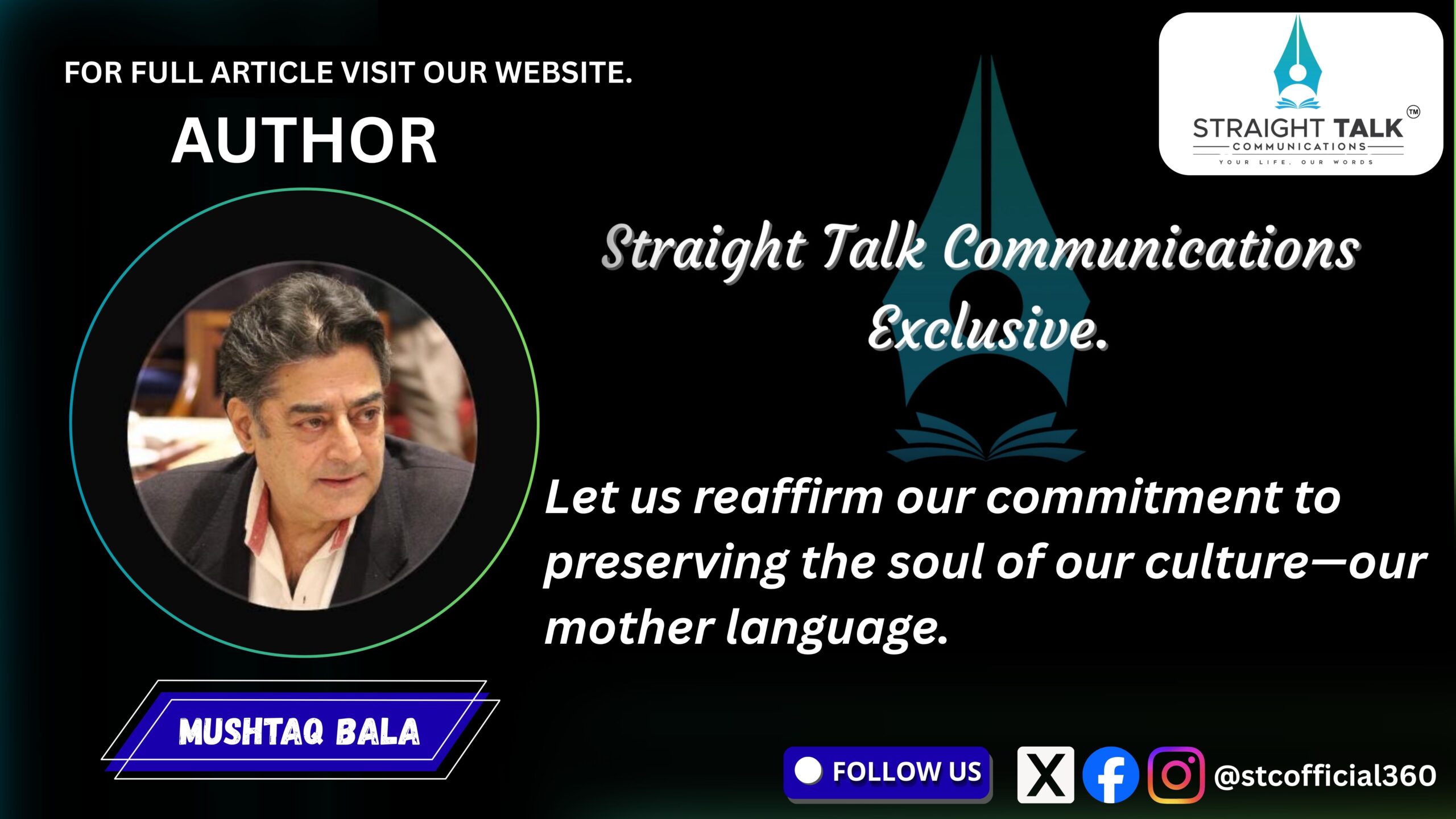
Let us reaffirm our commitment to preserving the soul of our culture—our mother language.
Mushtaq Bala
Every year on 21st February, the world observes International Mother Language Day—a day that reminds humanity of the beauty, dignity, and power of one’s mother tongue. Proclaimed by UNESCO in 1999 and observed globally since 2000, this day is not merely symbolic; it is a call to preserve linguistic diversity and protect cultural heritage.
Language is not just a medium of communication. It is memory. It is identity. It is history breathing through words. A mother language carries within it the lullabies of childhood, the wisdom of ancestors, the proverbs of rural life, the poetry of seasons, and the collective conscience of a people.
The observance of this day traces back to the Language Movement of 1952 in present-day Bangladesh, when students sacrificed their lives demanding recognition of Bangla as a state language. Their struggle became a global symbol of linguistic rights and cultural dignity. Today, International Mother Language Day stands as a tribute to those martyrs and to every community striving to keep its language alive.
The Kashmiri Context
In our own land of Kashmir, language forms the backbone of our cultural identity. Kashmiri, Dogri, Balti, Gojri, Pahari, Ladakhi, and other regional languages are not just dialects; they are living civilizations. Yet, we must honestly acknowledge that many of our young generations are gradually distancing themselves from their mother tongues, often due to social pressures, migration, or an overemphasis on dominant global languages.
While English and Hindi have practical importance in education and employment, neglecting one’s mother tongue weakens the roots of cultural belonging. A language that is not spoken at home slowly fades from literature, theatre, cinema, and daily discourse.
As a filmmaker and cultural practitioner, I have always believed that storytelling in one’s mother language has unmatched emotional depth. When a character speaks in Kashmiri, the dialogue carries a resonance that no translation can fully replicate. Language shapes authenticity.
Language and Creative Expression
The preservation of mother languages is not merely the responsibility of governments. Writers, filmmakers, poets, journalists, educators, and parents all play a crucial role. Schools must encourage children to read and write in their native languages. Cultural institutions should document folklore, oral histories, and traditional narratives. Media platforms must provide space for regional voices.
In an era of digital transformation, technology can either accelerate linguistic erosion or become a powerful tool for revival. Podcasts, web portals, subtitles in regional languages, digital archives, and social media storytelling can breathe new life into endangered tongues.
A Moral Responsibility
International Mother Language Day is not about resisting globalization; it is about harmonizing it with cultural rootedness. True progress is inclusive—it respects diversity. When a language disappears, a worldview disappears with it. Humanity becomes poorer.
Let us pledge to speak our mother tongue with pride at home, to write in it, to create in it, and to pass it on to our children not as a relic of the past but as a vibrant instrument of the future.
For language is not only what we speak.
It is who we are.
On this International Mother Language Day, let us celebrate linguistic diversity and reaffirm our commitment to preserving the soul of our culture—our mother language.
(STRAIGHT TALK COMMUNICATIONS EXCLUSIVE)