





Mountains Rage to Teach Us a Lesson
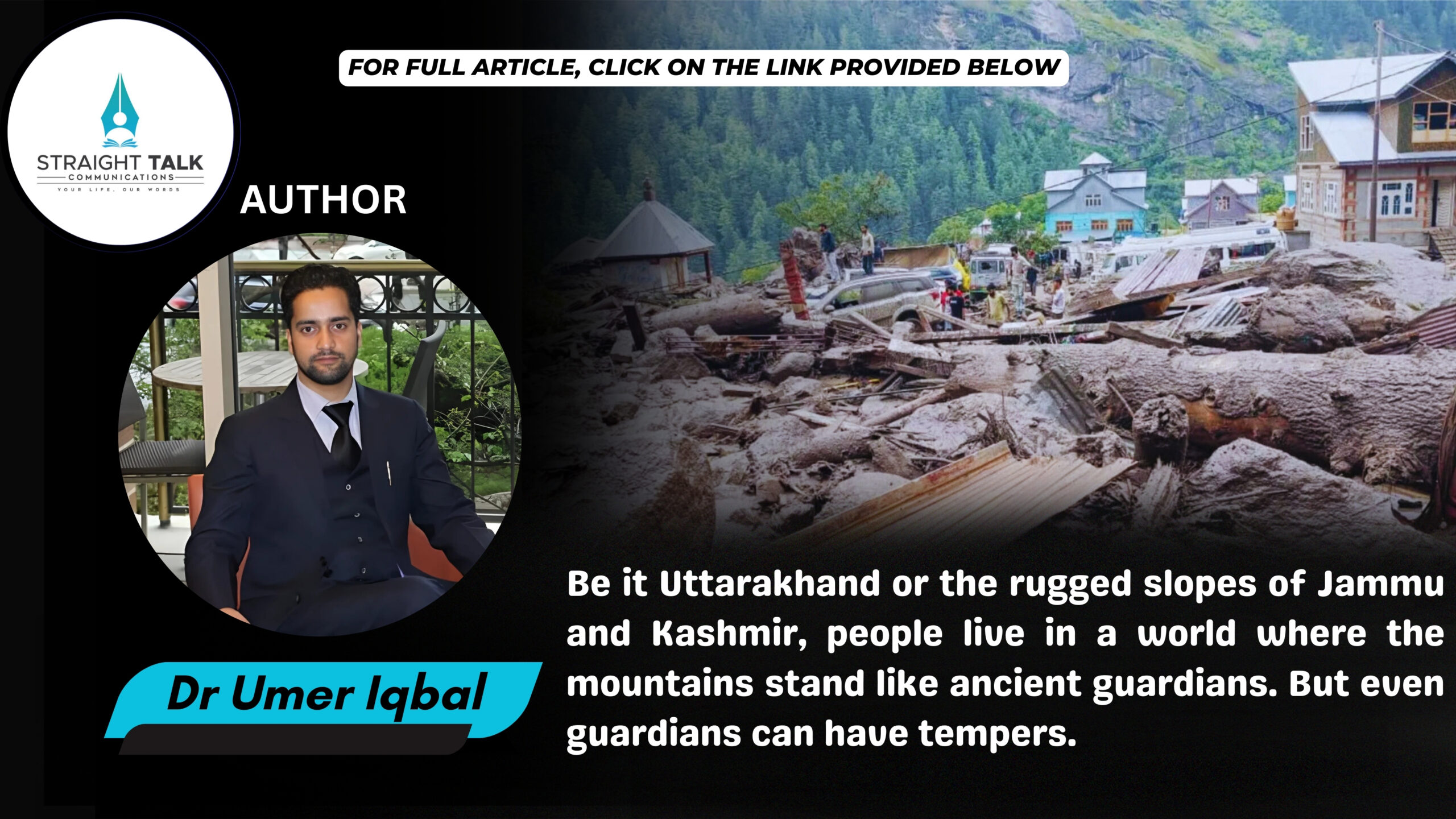
Today’s fatalities are a stark reminder to respect nature
Dr Umer Iqbal
Be it Uttarakhand or the rugged slopes of Jammu and Kashmir, people live in a world where the mountains stand like ancient guardians. But even guardians can have tempers. Sometimes, the sky itself seems to lose patience, releasing torrents of water in minutes, ripping apart roads, homes, and lives. We call it a cloudburst, but the word feels too small for something so sudden and so fierce.
Cloudbursts are, at their heart, a meeting of forces. Warm, moisture-laden winds, often from the Bay of Bengal or Arabian Sea, are pushed upward by the steep Himalayan slopes. As the air rises, it cools rapidly, condensing moisture into heavy rain clouds. Sometimes, local atmospheric instability locks these clouds over a small area, turning the sky into a bursting dam.
In such moments, 100 millimeters of rain can fall in under an hour, more water than the earth or rivers can swallow.
Hilly regions like Uttarakhand and Jammu and Kashmir’s Kishtwar are particularly prone because of the orographic effect (mountains forcing clouds upward) and the narrow valleys that trap and intensify rainfall. The geology of the Himalayas, still young and unstable means landslides follow close behind.
Nature’s patterns are now tangled with our own footprints. Climate change is warming the Indian Ocean, loading the monsoon winds with more moisture, making intense rainfall events more likely. Deforestation and road blasting strip the mountains of their natural armor.Unchecked construction blocks natural drainage paths, turning rain into sudden floods.
The mountains are speaking louder, but we have built too close to their lips.
For the people who live here, the cloudburst is not just a weather event, it is an interruption of the thread of daily life. A farmer’s fields are not just mud, but his inheritance washed away. A mother looking at the rushing waters is not thinking about climate models, she’s thinking about her child who didn’t return from school.
When the water recedes, what remains is silence. And in that silence, people begin the long work of rebuilding, again and again.
The Himalayas teach a hard lesson, permanence is an illusion. Mountains that seem unshakable are, in truth, moving, eroding, changing. Our settlements, our roads, our temples, these are temporary guests on an ancient, restless landscape.
We often speak of “fighting nature” in disasters, but perhaps the wiser path is listening to nature. The river will take its own course; the clouds will burst where they will. If we live as though the land belongs to us entirely, we will be reminded, sometimes cruelly, that we belong to the land instead.
A cloudburst is both a scientific phenomenon and a parable: a sudden reminder that stability is a story we tell ourselves, and that humility is the only safe foundation in the mountains.
Dr Umer Iqbal is Editor Straight Talk Communications. He can be mailed at: editor@straight-talk-communications.com