


Peace, Prizes and Political Clowns
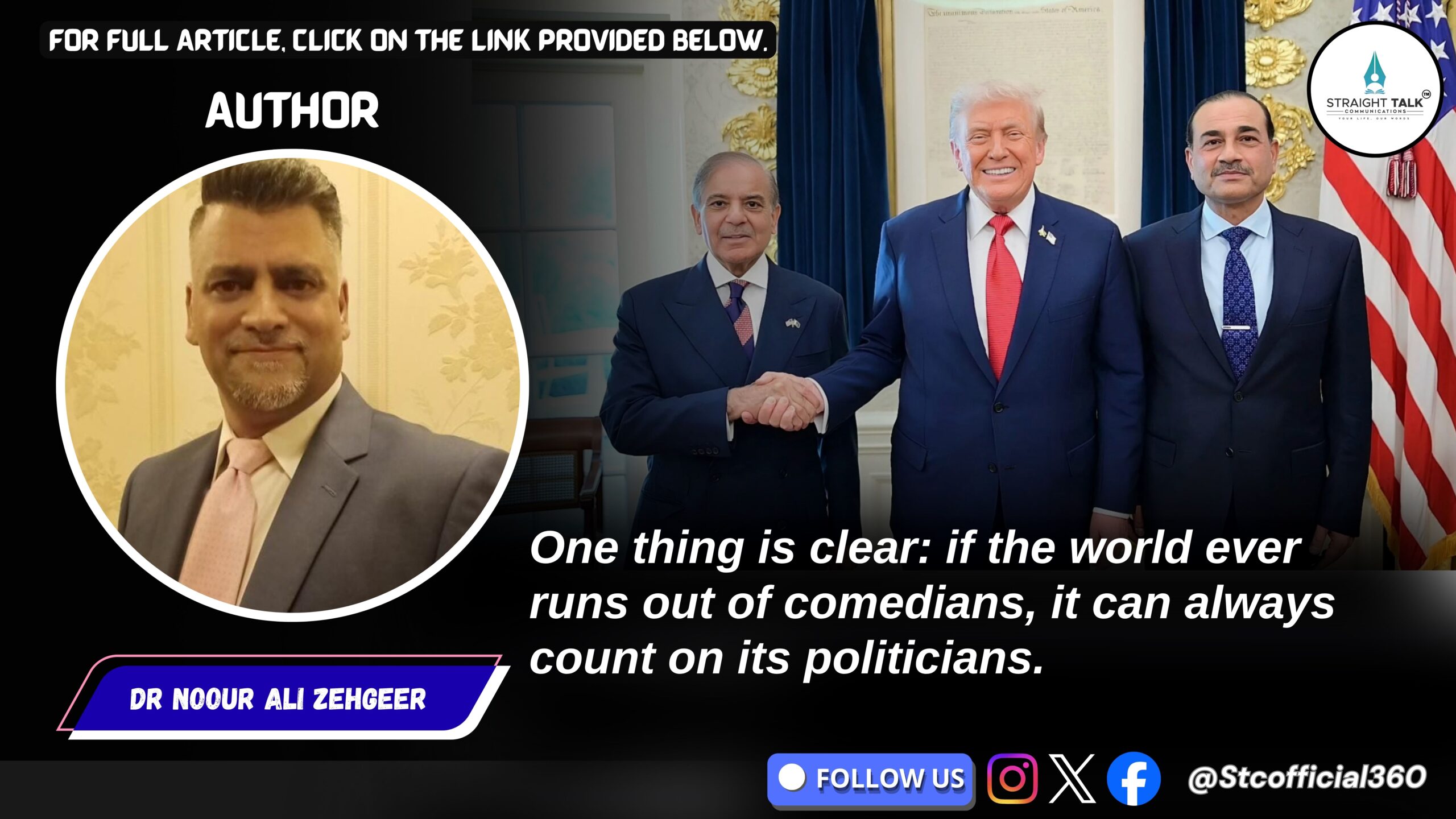
One thing is clear: if the world ever runs out of comedians, it can always count on its politicians.
Dr Noour Ali Zehgeer
In a world that has already seen enough absurdity to last a century, Pakistan’s Prime Minister Shehbaz Sharif has managed to add a new chapter to the global comedy of diplomacy — by nominating former U.S. President Donald Trump for the Nobel Peace Prize. Yes, you read that right. The same Trump whose idea of peace often involved Twitter feuds, trade wars, and threats of “fire and fury.”
Pakistan has never failed to lure China and America for personal gains, I would complement the political wit of politicians and army chiefs of Pakistan who have always managed to create a balance for themselves between these super powers and Islamic world. The bargain has been always financial support for rotten economy of Pakistan. They have managed to keep all sides happy for personal gains and at times managed to score political gains over India
The announcement, made during the Gaza Ceasefire Summit, sent waves of disbelief across the international stage. World leaders blinked, journalists double-checked their notes, and social media erupted into collective laughter. But perhaps the best part came from Italian Prime Minister Giorgia Meloni, whose candid, viral reaction said it all — a raised brow, a suppressed smirk, and the unmistakable look of someone realizing she’s trapped in the wrong episode of World Politics: The Sitcom.
It was a moment that could make even seasoned diplomats question reality. Was Sharif serious? Was Trump aware? Or had someone accidentally switched the teleprompter script with a satire column from The Onion?
Sharif, with all the confidence of a man unveiling a historic peace accord, stood tall at the podium, passionately hailing Trump’s supposed contributions to world peace. The irony was so thick you could almost cut it with a diplomatic dagger. He sounded like a man auditioning for a role in “World’s Most Talkative Cartoon,” earnestly convincing the audience that chaos deserves a medal.
Meanwhile, Trump — sporting his trademark red tie and expressionless demeanour — stood behind him like a wax statue from Madame Tussauds that had been accidentally powered down. He didn’t blink, didn’t nod, didn’t even smirk. One could almost hear the faint hum of silence, as if someone had unplugged him mid-speech.
The Nobel Peace Prize and Donald Trump look like an unholy alliance for some reasons as US president could never exhibit the political intelligence except bargaining tact’s as he is a businessman and knows the that part well.
Together, the two created a visual masterpiece: one overacting politician trying to sell sincerity, and another underacting like a mannequin who wandered onto the wrong stage. If this was meant to be a serious diplomatic gesture, it played out more like a political comedy special — a joint performance titled “The Peace Prize Paradox.”
The internet, of course, wasted no time turning the moment into a meme carnival. One user aptly commented, “When a clown ascends a throne, he doesn’t become a king — the palace turns into a circus.” Another quipped, “The beggar wants money from the rich, and the rich wants a peace prize without knowing the meaning of peace.”
Memes comparing the scene to a Netflix reality show flooded timelines. Some dubbed it “The Nobel Peace Prize Auditions,” while others jokingly proposed that the two leaders be given honorary awards for “Outstanding Performance in Political Comedy.”
But beneath the laughter lies an uncomfortable truth — the line between diplomacy and entertainment is disappearing fast. Politics, once a domain of strategy and substance, now thrives on spectacle and soundbites. Leaders seem more interested in going viral than in governing wisely.
Trump, whose presidency was a cocktail of controversy and charisma, has long considered himself deserving of the Nobel Peace Prize. His reasoning? He “stopped wars,” “made friends with dictators,” and “brought peace to the Middle East” — claims as debatable as they are dramatic. Sharif’s decision to echo that sentiment seems less like admiration and more like an attempt to hitch Pakistan’s diplomatic wagon to a spectacle that guarantees attention.
Perhaps the Prime Minister thought that by nominating Trump, he was sending a message of global unity. Instead, he delivered a global punchline.
Even Giorgia Meloni, known for her blunt candor, couldn’t contain her surprise. Her expression, immortalized in countless memes, became the symbol of collective disbelief. It was the look of every rational observer thinking, “Surely, this can’t be serious?”
In an era where populism thrives and theatrics replace thought, such moments are not isolated. They reflect a larger trend — where politics is no longer about principles but about performance. Leaders chase applause, not approval; headlines, not history. And in doing so, they turn the stage of world diplomacy into a circus ring where clowns compete for the loudest laugh.
Maybe that’s the saddest part of all. Because somewhere, among the laughter and the memes, the meaning of peace — true, hard-earned peace — gets lost.
The Nobel Peace Prize once stood as a symbol of selflessness and global compassion. Today, it risks becoming a prop in political theatre — a trophy for those who can shout “peace” the loudest, even if they’ve never practiced it.
As the curtains fall on this latest episode of global irony, one thing is clear: if the world ever runs out of comedians, it can always count on its politicians.
(Disclaimer: The views are of the author and doesn’t necessarily reflect the views of Straight Talk Communications)