



Pseudo journalists more dangerous than cyber criminals
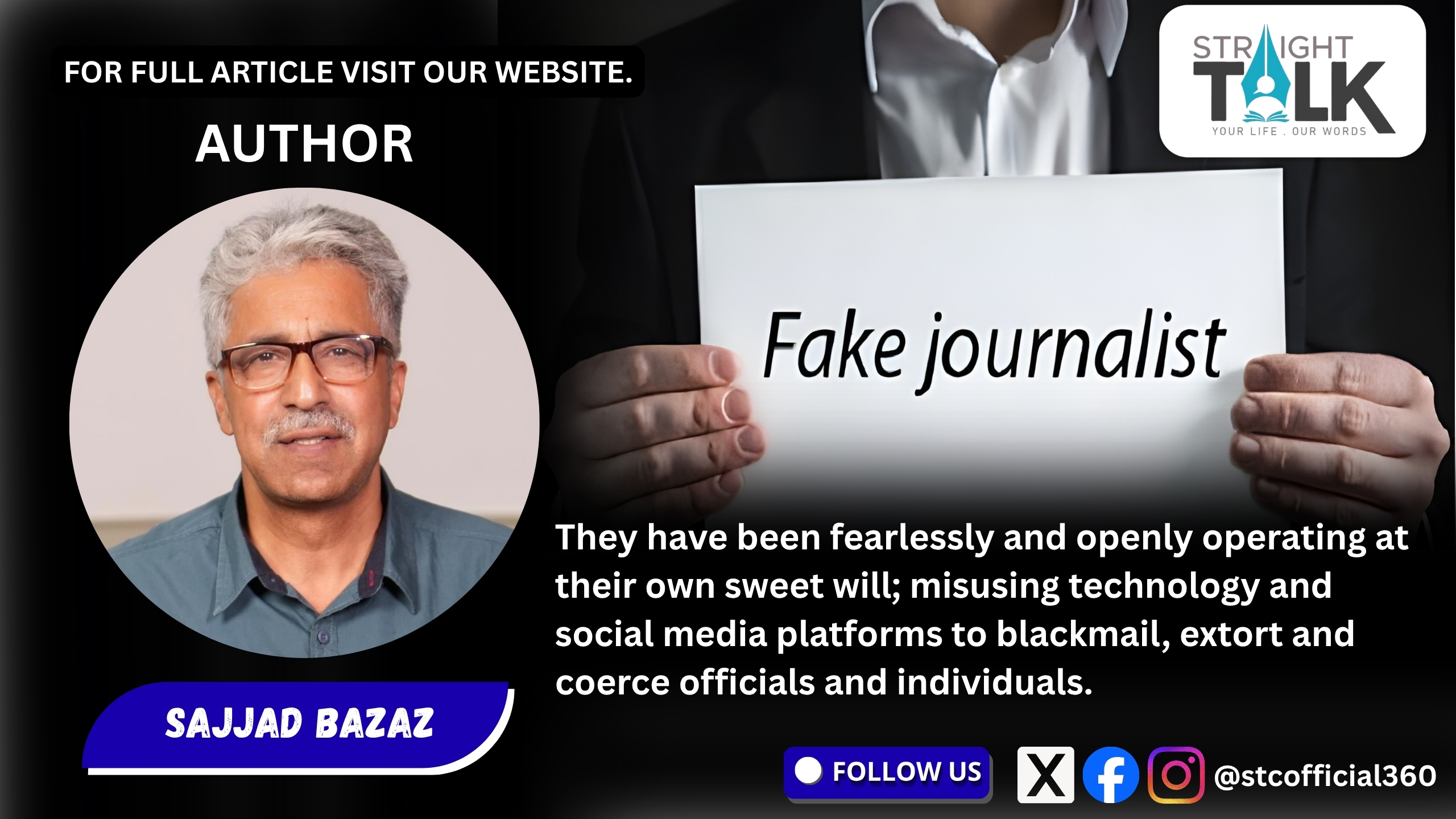
They have been fearlessly and openly operating at their own sweet will; misusing technology and social media platforms to blackmail, extort and coerce officials and individuals.
Sajjad Bazaz
Journalism in Kashmir is in the News for not good reasons. The government has expressed displeasure over the growing breed of fake/self-styled journalists who are into the business of bringing disrepute to individuals and institutions in Jammu and Kashmir. It has contemplated a plan to “ensure that press releases, media invites, and official briefings are shared only with verified and recognised journalists or media outlets through email and social media channels.” Besides, the authorities have announced a vigil on persons or entities misusing media credentials, indulging in coercion, or attempting to malign officials, institutions, or private individuals for personal or financial gain.
However, the big thing happened when none other than the Lieutenant Governor Manoj Sinha ordered mapping of genuine journalist so that fake journalists are weeded out to restore credibility of the profession of journalism in Jammu and Kashmir. In fact, the intervention of LG Sinha to lend credibility to the genuine journalists is a shot in the arm of media landscape in the region. However, it’s imperative to tailor a comprehensive social media policy to protect and promote professional journalism practices which leaves no scope of pseudo journalists to operate.
To be precise, journalism is loaded with huge issues in the region. And the influx of fake/self-styled journalists is growing as a menace. These fake journalists like the cyber criminals have been misusing technology and social media platforms to blackmail, extort and coerce officials. Not only this, this breed has the only job to circulate unverified and defamatory material against public institutions and officers and also private individuals. They are more dangerous than the cyber criminals as they have been fearlessly and openly operating at their own sweet will.
Basically, this is an unresolved major concern which Press Club of Kashmir (PCK) has been raising time and again to restore the credibility of the profession of journalism in Kashmir. Even, the PCK, as disclosed by its President Mohammad Saleem Pandit, has already moved the Hon’ble Jammu and Kashmir High Court for a writ of mandamus and sought the direction to the Jammu and Kashmir government to fix graduation as the minimum qualification for journalists and photojournalists and preferably a graduation in Mass Communication or Post Graduation. The court has admitted the writ and issued notice to the UT government to formalise modalities for fixing qualification for the journalists in Jammu and Kashmir to arrest the misuse of the right to express under Article 19 (a).
I have been deliberating upon this growing menace in the past also. It makes sense to revisit the issue. Every Tom, Dick and Harry have taken to journalism by capitalizing on the power of the Internet and social media only to be known as black spots in this noble profession.
In other words, the huge influx of non-professionals in the field of journalism, especially through digital channels of communication, has now challenged the nobility of the profession. The public trust on this once noble profession is dwindling fast owing to the freedom of speech and expression observed by these self-styled journalists who shamelessly introduce themselves as reporters, editors and experts of everything.
Here, an important question merits a mention. Is freedom of press guaranteed under our constitution? This question may sound surprising, but the fact is that there is no mention of ‘freedom of press’ in our constitution. Our Constitution provides for “the right to freedom of speech and expression” (Article 19(1) a). There is no mention of the word “press”. The right to freedom of speech and expression, however, is subject to restrictions under sub clause (2), whereby this freedom can be restricted for reasons of sovereignty and integrity of India, the security of the State, friendly relations with foreign States, public order, preserving decency, preserving morality, in relation to contempt of court, defamation, or incitement to an offence.
We all understand that in today’s modern era, the need to be informed is critical. Here emerges the role of media by providing the people with long-term and sometimes life-saving social support through the means of information. Being one of the students of Journalism for over 35 years now, I have been one of the close observers of the media scene in Jammu & Kashmir and its transformation from a lesser known to a vibrant profession with a modern outlook. We witnessed an influx of trained journalists into the profession. It was not so strong till 1988, but assumed tremendous significance after the advent of militancy. As bomb blasts here and there, curfews, hartals, encounters, killings, arson etc. became the order of the day; media became the first diet of the local people. In fact by 1990, the dearth of local media channels, particularly in the shape of newspapers etc. surfaced and readers were hunting for more and more news.
With the passage of time, media grew at tremendous pace and the market was flooded with dozens of local newspapers, both in English and Urdu languages. Nonetheless, the growth of media in Kashmir during that period should not be mistaken as growth in quality, but in quantity. This kind of growth led to a huge crowd in the profession where people remotely connected with the profession, even illiterates, appeared on the scene as reporters, correspondents, editors, printers and publishers and to a greater extent outnumbered the professional/literate class of journalists.
These self-styled journalists resort to the brazen misuse of internet and social media channels where most of the time they run targeted campaigns to malign institutions, communities, societies and individuals. Their activities are widespread and overshadow the genuinely professional journalists.
In this digital era, where the world has in true sense been converted into a global village, flow of information is taking place at lightning pace. Most of the information is mishandled and pushed across geographies in a twisted form to preach hatred and gain the maximum possible audience. Here a breed of professional journalists has also been seen indulging in unethical practices while reporting or commenting on an event for public information.
A journalist should never look for power, but his services with responsibility in the line of duty towards his nation and its subjects. It’s the power which sidelines responsibility and while pursuing it, professionalism is sacrificed. They have to exhibit their ability to mould or mobilize public opinion in a positive direction through their write-ups or productions. Let them be opinion makers or analysts enjoying readers’ trustworthiness.
Basically, we should seek moral journalism – a journalism that cares as well as it knows. One thing is most crucial. A journalist must be careful not to become more important than the event and he should not even prescribe how the audience should feel and react. He should be – to the people, by the people and for the people.
Lastly, the current mess demands disciplinary approach from its stakeholders, especially the authorities. The tremendous use of digital media channels and their far and wide reach make regulatory measures inevitable to regulate the operations of journalists in a fair way. A debate on licensing of Journalists has already ignited where experts have been pitching for a system whereby individuals would be required to apply to an external authority for permission to practice journalism, which may be refused or revoked. Here accreditation should not be construed as license. Accreditation facilitates a journalist to special privileges, most commonly access to restricted areas such as legislatures, courts etc. While as, licensing will take care of genuine persons with professional qualification and background to practice journalism. For this, there is a need for a regulatory authority where a database of professional journalists would be built up. Once under its ambit, various welfare schemes for the journalist community can be tailored by the government. Even as licensing of journalists is a rough idea, it will axe fake and self-styled journalists who have been on prowl to rob people of their peace of mind as well as prosperity. The idea needs brainstorming deliberations.
To achieve this goal, Press Club of Kashmir is a genuine platform where professional journalists can assemble to protect their profession against fake/self-styled journalists and seek welfare measures to better their financial standing. Frankly speaking, Kashmiri journalists are not financially sound in the given economic scenario around him. To be precise, all stakeholders need to pool their efforts to protect nobility of the profession of journalism in Kashmir
(The author is Editor-In-Chief at Straight Talk Communications. He is former Head of Corporate Communications and CSR Department and Internal Communication & Knowledge Management Department of J&K Bank)