




SUNDAY BYTES: Untold Story of Social Ailment
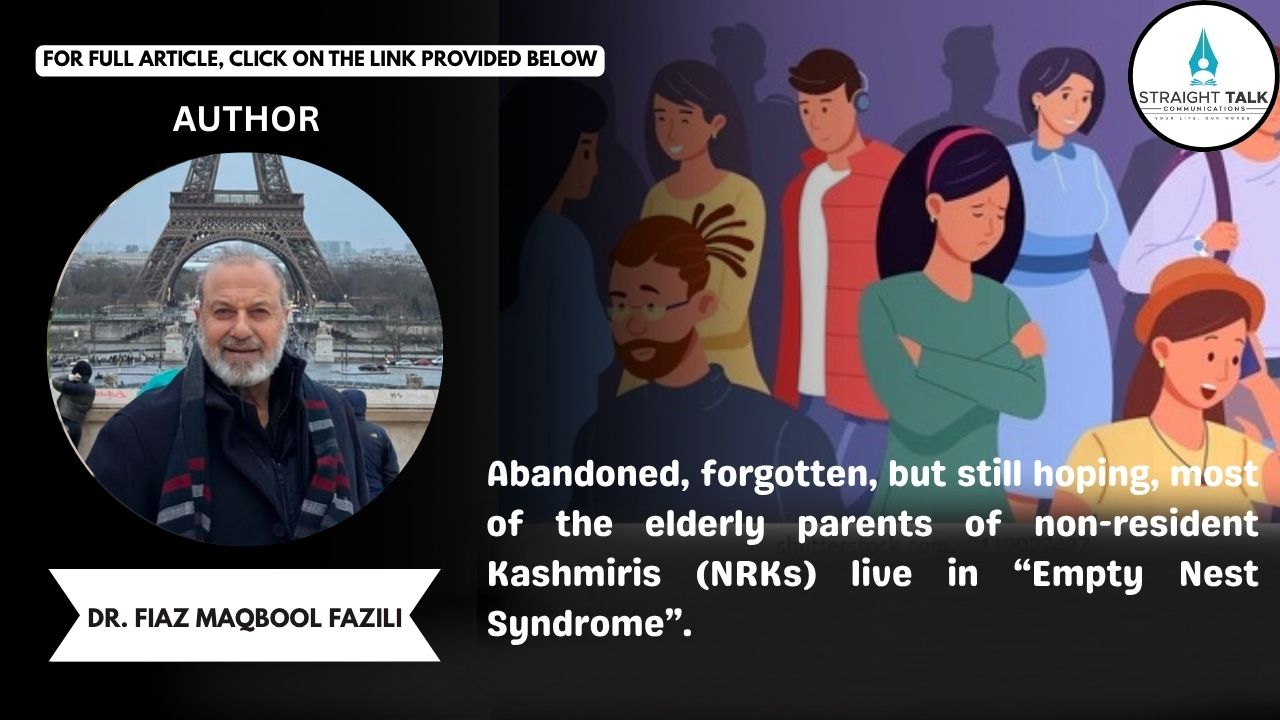
Abandoned, forgotten, but still hoping, most of the elderly parents of non-resident Kashmiris (NRKs) live in “Empty Nest Syndrome”.
Dr. Fiaz Maqbool Fazili
In the quiet alleys of Rajbagh, Barzulla, Hyderpora and Nishat etc , behind the wooden windows and closed curtains of once vibrant homes, live parents who were once someone’s world — nurturers of dreams, builders of lives, and guardians of hope. Today, many of them are lonely, helpless, and forgotten, their homes echoing with memories of children now thousands of miles away.
The phenomenon is not new. Years ago, I wrote about Empty Nest Syndrome — that silent emotional wound that surfaces when children leave their parental homes to build lives elsewhere. But what was once a passing ache for many has now turned into a chronic social ailment, worsened by migration, modernisation, and indifference. The syndrome is no longer confined to emotion; it has acquired the face of abandonment.
Kashmir has witnessed waves of migration — doctors, engineers, IT professionals, and entrepreneurs leaving for better opportunities abroad. The reasons are understandable: limited job prospects, political uncertainty, and the allure of stability. Yet what remains unspoken is the trail of emptiness left behind in the hearts of parents who once celebrated their children’s success but now live amid silence and memories.
Walk through the lanes of the city’s so called posh localities, and you’ll find them — elderly couples living in houses too big for their frail bodies. The dining tables meant for six now seat two; the laughter once spilling from the kitchen has turned into the whir of a ceiling fan. Some live with domestic help who barely understand their pain; others live entirely alone, depending on neighbors or distant relatives for emergencies.
The tragedy deepens when we realize how little our society has done for them. Kashmir still has no dedicated Old Age Home worth its name. Social clubs for the elderly exist only in concept — burdened by stigma or disinterest. Our NGOs, otherwise vibrant and visible, seem too preoccupied with causes that bring recognition, visibility, and financial benefit. The plight of the elderly seldom qualifies as a “project.”
What these parents need is neither sympathy nor charity. They need what they once gave us unconditionally — dignity, care, and presence. A warm bed, a nutritious meal, someone to remind them to take their medicines, and, above all, someone to talk to. These are not luxuries; they are rights earned over a lifetime of sacrifice.
The State, meanwhile, remains distracted — engrossed in debates over whether we are a Union Territory or should reclaim statehood, as if the constitutional status alone could heal our social decay. The government’s apathy towards the elderly reflects the same misplaced priorities that have weakened the moral fibre of our society. Policies focus on infrastructure, tourism, and investment, but not on the silent citizens who once built the very foundation of this land.
Technology, we are told, bridges distance. Video calls, WhatsApp chats, and virtual celebrations help families stay “connected.” Yet, from a distance, one cannot refill an empty plate or hold a trembling hand. Love transmitted through a screen cannot replace the comfort of a shared meal or the reassurance of a familiar voice in the same room.
Most of these Non-Resident Kashmiri (NRK) children live in a permanent state of inner conflict. They cannot abandon their new lives — built painstakingly in foreign lands — but neither can they ignore their parents, whose faces haunt their conscience. The guilt is real and corrosive. They send money, make frequent calls, and sometimes arrange visits, but nothing truly fills the void. On the other hand, parents cling to their homes — the very nests they built brick by brick with lifelong savings. They refuse to migrate abroad, fearing alienation in a foreign culture. Between these two emotional poles lies a growing social crisis that few are willing to address.
The question, then, is not simply about loneliness. It is about the failure of a community to evolve with compassion. We glorify education, modernity, and success, but we rarely discuss their cost. When every young mind is trained to look outward, who remains to look inward — to care for those who once cared for us?
It is time we confront this with honesty. Kashmir needs a civil society framework that recognizes and responds to the aging population left behind by migration. We need community centers that double as day-care facilities for the elderly — places where they can interact, exercise, and receive medical check-ups. We need NGOs willing to create neighbourhood support programs — volunteers who can visit, talk, and assist with daily needs. Religious institutions, too, can play a constructive role by reviving the ethics of collective care deeply rooted in our traditions.
The concept of “home” must be reimagined. It is not just a structure of walls and memories; it is a living relationship sustained by care. For many elderly parents, the home is both sanctuary and prison — a place filled with love but emptied of life. Their survival often depends on the occasional ring of a phone or a festival visit that comes too rarely.
If we continue down this path, the numbers will only rise. Within a few decades, the Valley may witness a demographic inversion — more parents living alone than families living together. The emotional toll of this transformation will be immense, and without structured interventions, we risk breeding a generation of forgotten elders — emotionally alive but socially invisible.
For some elderly parents, visiting their children abroad may seem like a solution — but it rarely is. Travelling to nearby destinations such as the Middle East — the UAE, Qatar, or Saudi Arabia — is still manageable. The flights are short, the weather familiar, and the cultural distance not overwhelming. But journeys to far-off lands — Canada, the United States, Australia, or even the United Kingdom — are a different story altogether.
Long-haul travel, harsh climates, and complex health insurance systems make such visits physically and emotionally taxing for elderly couples. Many find it exhausting to navigate airports, adapt to foreign routines, or live in isolation while their children work long hours. What begins as a gesture of reunion often ends in quiet discomfort, with parents longing to return to their own homes — the places that still smell of belonging.
Repeated invitations every winter, though well-meaning, become more demanding than affectionate. For parents in their seventies or eighties, each such journey feels heavier — a reminder not only of distance but of age itself. The irony is that while the world has become more connected, their worlds have grown smaller, limited to a few rooms, a few memories, and an occasional flight ticket that brings more fatigue than joy.
To the NRKs, this is not a call to guilt but to awareness. Life abroad comes with its compulsions, and not every child can uproot themselves to return home. But small gestures — regular communication, emotional presence, arranging community care — can make a difference. To the State and NGOs, this is a reminder that progress cannot be measured only in GDP or highways but also in how we treat those who once walked us to school and fed us through their struggle.
The empty nest is not merely a metaphor; it is a reality with beating hearts inside. Each lonely parent is a story of love waiting to be reciprocated, of silence asking to be heard.
They are not asking for luxury — only warmth, care, and the dignity of not being forgotten. Their homes run not on electricity or pension, but on the faint hope that one day, the familiar knock on the door will return, and the silence will finally be broken.
And till then, they wait — abandoned, forgotten, but still hoping.
(Straight Talk Communications)