




The Demolition That Rejuvenated Brotherhood
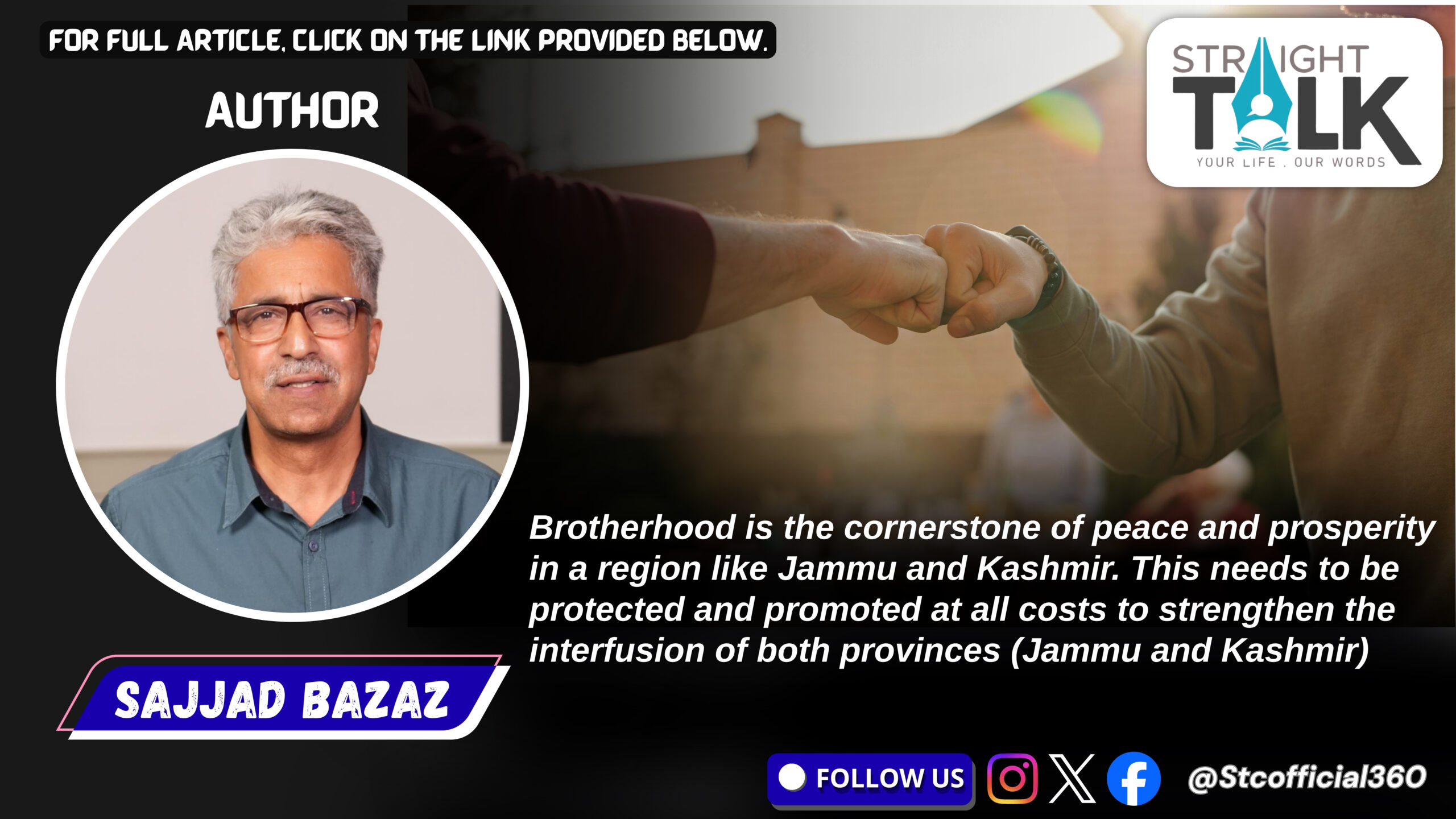
Brotherhood is the cornerstone of peace and prosperity in a region like Jammu and Kashmir. This needs to be protected and promoted at all costs to strengthen the interfusion of both provinces (Jammu and Kashmir).
Sajjad Bazaz
The demolition of residential house of a Journalist in Jammu last week by the Jammu Development Authority (JDA) for ‘being unauthorised construction on a piece of government land’ has unwittingly revived the hope of restoring brotherhood in the Union Territory of Jammu and Kashmir. At the same time, it has exposed some gaps in the political as well as bureaucratic governance system of the Union Territory. Both, the elected government and the Lieutenant Governor administration distanced itself from the demolition act. Interestingly, former minister Altaf Bukhari mocked both and asked: “Should we then ask the United Nations (UN) on whose instructions this demolition was carried out?”
If we look at the incident in the context of governance, there is no second thought to it that all is not well in the system. It also hints at the possible extraordinary influence peddling in the system where top brass, both in the elected government and the LG administration, have been either misguided/misinformed or totally kept unaware about the demolition. May be, somebody down the line uses such acts for vested interests.
In the given scenario, where top authorities are clueless about the authority who ordered it, a thorough probe within a stipulated time frame is need of the hour. Who knows, there may be many such anti-people incidents committed at the back of the formal governance system without the knowledge of top government authorities (elected government as well as LG administration) and have remained unreported. Only an in-depth probe on fast track basis can reveal the truth. Otherwise, the efforts of the LG administration and the elected government to provide an accountable and transparent governance system without caste, creed and colour are inclined to go waste. This is of paramount importance to remove unrest in the public as the JDA’s selective demolition act has shaken their trust on the kind of governance in Jammu and Kashmir being experienced by them after the elected government assumed power within the ambit of union territory status.
Without getting deep into the governance system, let’s look at the positives which the demolition act has delivered, though unwittingly. It has rejuvenated brotherhood in J&K at a time when communal harmony has taken a back seat and people have been discussing things in terms of ‘Hindus and Muslims’ in every sphere. The void between the two distinct religious communities has been widening on one pretext or the other. The irony is that every routine matter is looked through the prism of religion, breeding communal disharmony.
J&K’s Culture of Brotherhood
We have the distinctiveness of having a colourful, varied unique cultural blend, which differentiates our region from the rest of India. J&K is precisely a spectrum of variance and variation. Even as Jammu and Kashmir divisions yield diverse religion, language and culture, they constantly interfuse with each other reflecting a spectrum of unity in diversity in real sense. The various cultural forms like art and architecture, fairs and festivals, rites and rituals, languages and landscapes, reflect uniformity and diversity with matchless cultural symmetry and service.
Kashmir has a long and cherished history of 5000 years and is rightly called by some authors – ‘the mother of all civilizations’. History on record reveals that Kashmir has been the highest learning point of Sanskrit and Persian where early Indo-Aryanic civilization has originated and flourished. Similarly Jammu has been the axis of Rajas and Maharajas, who have enriched the cultural, historical and social bonds of all these diverse ethnic and linguistic sections of the state.
Social Heritage
I think, this is the appropriate time to revisit our social heritage, which has taken back seat when it comes to its preservation, protection and promotion.This social heritage consists of non-physical aspects of our culture, involving our social customs, ways and means of culturally learned social behaviours in our society. Our social heritage has everything precious. Peace, tolerance, devotion to spiritual and academic pursuits have remained hallmarks of our culture. And brotherhood constitutes one of the important parts of our social heritage. Here the famous shrines and the people of every faith hold pilgrimage centres in highest esteem and the offerings made and obeisance paid at such places by people of all faiths has created waves across the globe.
But over the past several decades, it’s this brotherhood which has taken a back seat where all human values have been thrown to the wind. Crime, cruelty and outrage of humankind have been let loose and we are fast losing social values. So reviving social heritage needs to prioritized restoring traditional links of brotherhood among the people of the region. It is here where the intellectual class including scholars and artistes of the State need to rise to the occasion and play an important role in maintaining and preserving this important pillar of our social heritage.
Even as this kind of intangible cultural heritage is more difficult to preserve, combined efforts always make it possible. Let us bear it in mind that brotherhood and language are considered corner stone for other forms of the cultural heritage.
Way Forward
Any preservation programme needs to be designed in such a way so as to develop an extensive cross-disciplinary knowledge of heritage principles and practice and an awareness of community sensibilities. Most importantly, intangible aspects such as language and brotherhood should get priority as far as such programmes are concerned.
Active involvement of practitioners, scholars and students across the state in the revival of social heritage cannot be overlooked. Dissemination of professional information by means of newsletters and conferences, educational programmes, training workshops and seminars should be a continuous process. More particularly, involvement of youth will yield quick and effective results.
To be precise, brotherhood is the cornerstone of peace and prosperity in a region like Jammu and Kashmir. This needs to be protected and promoted at all costs to strengthen the interfusion of both provinces (Jammu and Kashmir) with diverse religion, language and culture, and restore a spectrum of unity in diversity in real sense.
(Sajjad Bazaz is Editor-In-Chief at Straight Talk Communications. He is former Head of Corporate Communications & CSR Department and Internal Communications & Knowledge Management Department of J&K Bank)