





Achan Dumping Site: Growing Threat to the Environment and the Soul of Srinagar
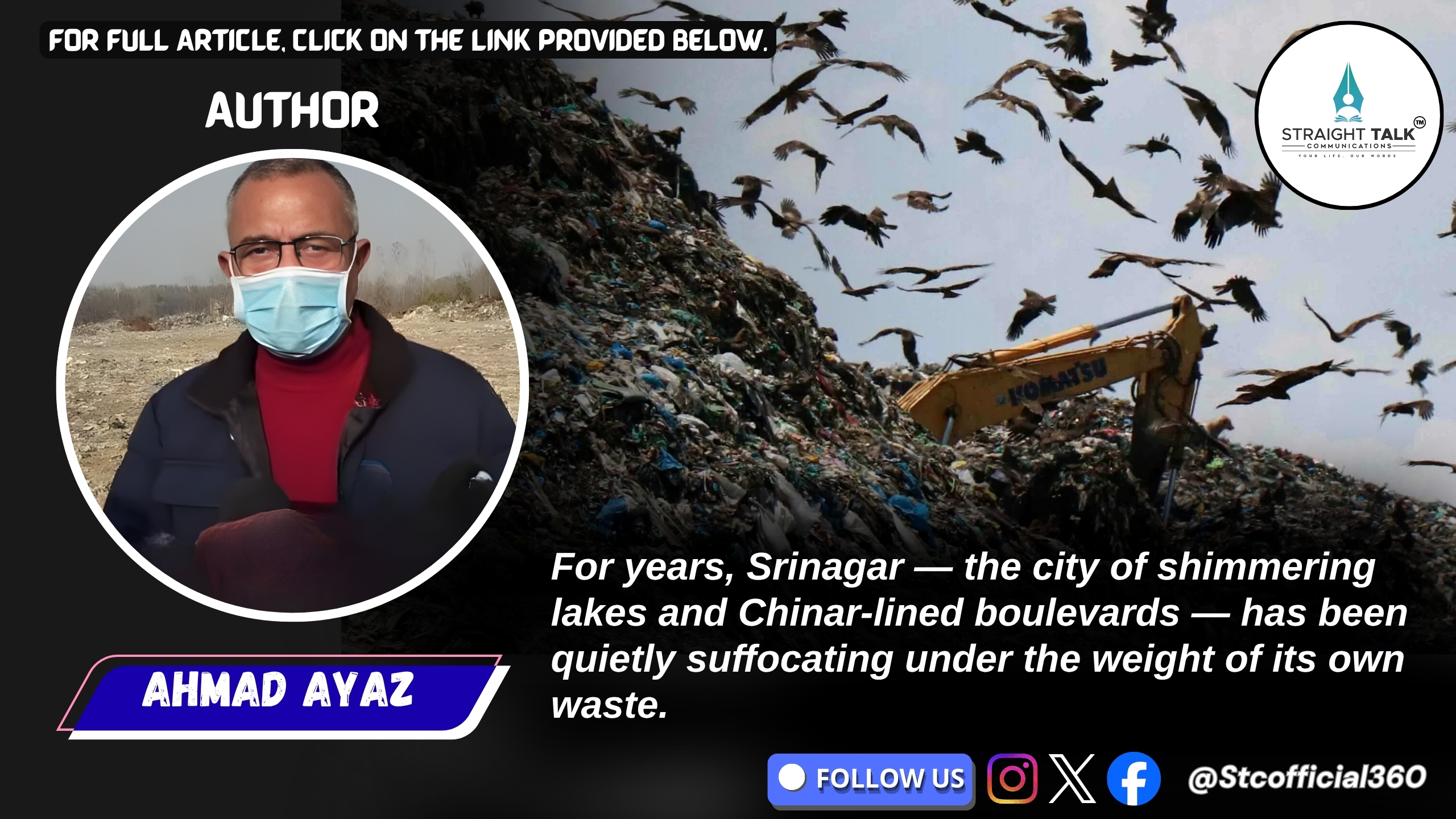
By Ahmad Ayaz
For years, Srinagar — the city of shimmering lakes and Chinar-lined boulevards — has been quietly suffocating under the weight of its own waste. The city once celebrated for its pristine beauty now battles a slow-moving environmental crisis centred around one place: the Achan dumping site.
What began decades ago as a temporary landfill has today become a symbol of urban neglect and administrative apathy. The problem is no longer confined to the nearby neighbourhoods — its stench and toxicity have begun to seep into the very heart of Srinagar, reportedly reaching Lal Chowk itself.
A Brief Background
Established in the early 1980s as a stopgap arrangement for solid waste disposal, the Achan site was never meant to serve as a permanent landfill. Back then, the city’s population and waste generation were modest, and urban planners assumed that better systems would follow.
But over the decades, in the absence of a scientific waste management policy, Achan quietly turned into Srinagar’s main dumping ground. Today, over 400–500 tonnes of waste — from homes, markets, hospitals, hotels, and commercial areas — are brought here every day.
The site has far exceeded its capacity. Yet the trucks keep coming, the piles keep growing, and the crisis keeps deepening — a slow-motion catastrophe unfolding in plain sight.
A City Choking on Its Waste
At the root of the problem is the lack of segregation at source. Across Srinagar, waste is collected in mixed form — biodegradable, plastic, medical, and even construction debris all thrown together. This not only makes recycling impossible but also prevents any meaningful scientific processing.
While the Srinagar Municipal Corporation (SMC) has often spoken of adopting modern waste segregation models, little has changed on the ground. The result is a growing mountain of mixed waste that emits toxic gases, contaminates groundwater, and poisons the air the city breathes.
The Stench That Travels Miles
Residents around Achan — from Saidapora to Noorbagh, Eidgah to Ali Jan Road — have for years been raising alarm over the unbearable smell and health risks. What’s new, however, is that the stench now travels miles across the city. During summer, it reportedly reaches Lal Chowk, the symbolic centre of Srinagar.
“Some evenings, the smell is so strong you can feel it in your throat,” says a shopkeeper in Nowhatta. “It’s not just bad odour — it’s toxic.”
Air quality in the surrounding areas has deteriorated significantly. Methane and other harmful gases rising from decomposing waste contribute to respiratory illnesses, cardiac stress, and broader air pollution — while also adding to greenhouse emissions.
An Ecological and Health Time Bomb
Beyond the smell lies a deeper danger — the poisoning of Srinagar’s ecosystem. The leachate, a black toxic liquid that seeps from decomposing garbage, has been found to infiltrate the soil and nearby water bodies. Over time, this can contaminate underground aquifers that many residents rely on for daily water use.
Environmental experts warn that this could have long-term, possibly irreversible, consequences.
“Once groundwater contamination begins, it can take decades to reverse — if at all,” notes a local environmental researcher.
Nearby wetlands, once rich with birdlife and vegetation, have also suffered. Waste encroachment and pollution have degraded these natural buffers, weakening the valley’s resilience to floods and further threatening biodiversity.
A System Stuck in the Past
Despite being the summer capital of Jammu & Kashmir, Srinagar still lacks a modern waste management system. There is no fully functional waste-to-energy plant, no large-scale composting units, and no material recovery facilities operating at capacity.
A few small composting efforts exist, but they are negligible compared to the city’s daily waste inflow. Experts agree that without segregation at the household level, even the best treatment technologies cannot work.
“You can’t solve a 21st-century waste crisis with a 1980s model,” says an urban planner from the University of Kashmir. “Srinagar needs segregation, recycling, and waste-to-energy — not open dumping.”
Over 90% of the city’s garbage still ends up in Achan — untreated and unmanaged. The system is collapsing under its own weight.
Public Health and Civic Impact
For the people living around Achan, life has become unbearable. The foul air, swarms of flies, and contaminated water have turned daily living into a health hazard.
Local doctors have noticed a worrying trend.
“We see a higher number of patients with respiratory allergies and asthma from the Eidgah–Achan belt,” says a physician at SKIMS. “Poor waste management is definitely a contributing factor.”
During monsoons, rainwater runoff carries pollutants from Achan into local drains, worsening waterlogging and spreading contaminants further afield. Stray animals scavenge through the waste, dragging garbage into residential lanes and open fields.
A City’s Image at Stake
The Achan crisis is not just about waste; it’s about the image and identity of Srinagar. Tourists visiting the city often pass by the area — and the sight and smell leave a lasting, unpleasant impression.
It’s ironic that the same city that calls itself Paradise on Earth tolerates one of the most unscientific dumping grounds in the region. The contradiction is painful.
Moreover, the problem undermines the very spirit of the Smart City Mission, which promises clean air, sustainable infrastructure, and improved quality of life. Without addressing waste management, such goals remain hollow rhetoric.
Administrative Apathy and Public Responsibility
Successive administrations have made repeated announcements about shifting or upgrading the landfill. Committees have been formed, tenders floated, and feasibility reports prepared — yet on the ground, little changes.
Officials cite financial constraints and land scarcity, but the deeper issue is a lack of political will and continuity. Temporary clean-up drives and awareness campaigns cannot fix a structural crisis.
Citizens, too, share part of the blame. Reluctance to segregate waste, casual littering, and apathy toward civic responsibility have worsened the situation. Environmental collapse is not just a failure of governance — it’s a failure of collective discipline.
A Way Forward
Experts propose a practical, multi-pronged solution that begins at the household level:
- Segregation at Source: Separate waste into biodegradable, non-biodegradable, and hazardous categories.
- Decentralized Processing: Establish small composting and recycling units across the city to reduce dependency on Achan.
- Waste-to-Energy Conversion: Set up a scientifically managed plant to generate electricity from non-recyclable waste.
- Public Awareness: Promote responsible waste habits through schools, media, and community outreach.
- Environmental Monitoring: Conduct regular air, soil, and water testing around the site.
- Phased Closure and Restoration: Gradually close and rehabilitate the existing landfill through afforestation and soil treatment.
Implementing such a plan would not only restore Srinagar’s ecological balance but also make it a model for other hill cities facing similar challenges.
The Smell That Should Awaken Conscience
Perhaps the most telling symbol of this crisis is the smell itself — the invisible reminder of neglect. When the foul odour from Achan reaches Lal Chowk, it carries more than stench; it carries a message.
It speaks of a city gasping for attention, a system desperate for reform, and a public that can no longer look away. The air that once carried the fragrance of Chinar leaves now carries the stench of civic failure.
This is not merely about garbage. It’s about governance, accountability, and the citizens’ right to live in a clean and dignified environment.
Conclusion: Before the Stench Spreads Further
The Achan dumping site stands today as both a monument of failure and a call to action. Left unchecked, it threatens to undo years of environmental progress, tarnish Srinagar’s image, and endanger public health.
Srinagar can no longer afford to treat waste as an afterthought. What’s at stake is not only the environment but the city’s very soul — its lakes, wetlands, and the health of its people.
Cleaning Achan is not just about clearing waste — it’s about reclaiming Srinagar’s soul.
(The author, Ahmad Ayaz, is a social activist, national TV debater, and columnist. Views are personal. He can be reached at ahmadayaz08@gmail.com.)


Fantastic whistle blowing, nobody writes about it, I think there should be a series of story on it. Normally what the authorities do, in the evening after 5 pm they start its processing and smell spreads in the air almost 5 to 7 km around the area.