




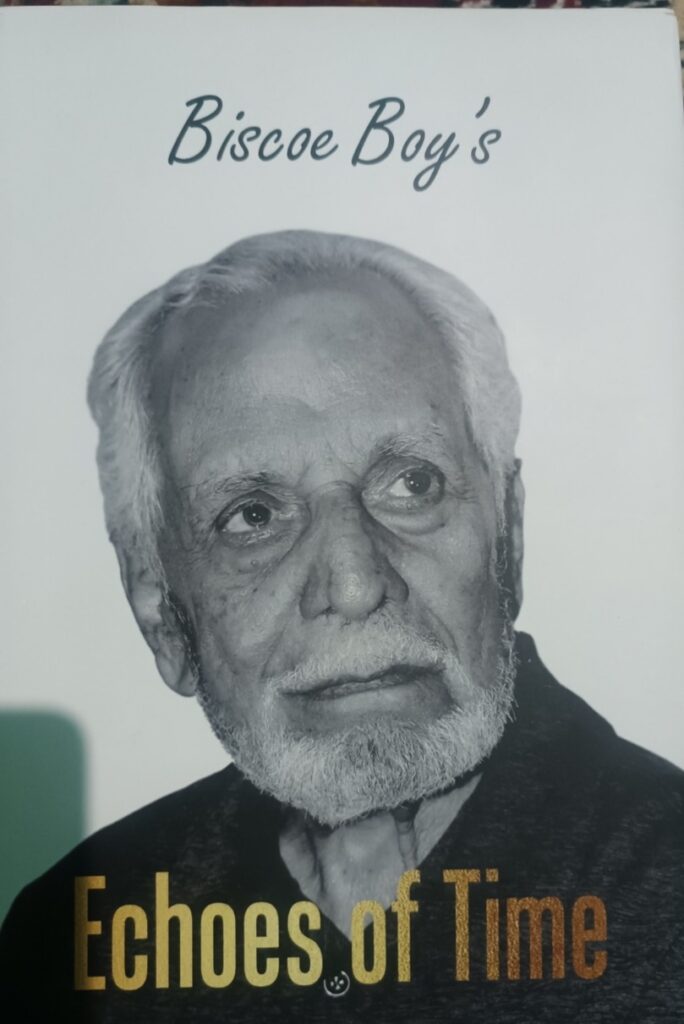
Book Review | Biscoe Boy’s: Echoes of Time by Nazir Ahmad Khan

It is ultimately a work that endures. A book that lingers in the mind, not because it demands attention, but because it quietly earns it.
Gowher Bhat
Nazir Ahmad Khan’s Biscoe Boy: Echoes of Time stands as a remarkable work of memory, insight, and quiet brilliance. It is not merely an autobiography. It is a living archive, a deeply felt narrative that preserves the soul of Kashmir through the life of a man who both witnessed and shaped its changing realities. With grace and clarity, Nazir Ahmad Khan transforms personal recollection into a powerful literary and historical document, offering readers an intimate, ground level view of twentieth century Kashmir, a region often spoken about in abstractions but rarely understood through such human depth.
At its core, this memoir is an act of preservation. It rescues from the erosion of time the textures of everyday life, the rhythms of community, and the values that once defined a generation. In doing so, it becomes not just the story of one individual, but a collective memory, carefully reconstructed and generously shared. Nazir Ahmad Khan writes not with urgency, but with patience. His voice is measured, reflective, and deeply sincere, allowing the narrative to unfold with a natural dignity that commands attention without ever demanding it.
From its opening pages, the memoir carries a sense of authenticity that is difficult to replicate. Born in 1933 in Baramulla, Nazir Ahmad Khan recounts his early life with striking vividness that immediately draws the reader in. His childhood is not romanticized, yet it is filled with a quiet warmth that lingers throughout the narrative. His years at Tyndale Biscoe School emerge as a defining influence, shaping not only his education but his entire worldview. The school’s emphasis on discipline, courage, physical endurance, and service to society is woven into his identity, becoming a recurring thread throughout the memoir.
Through scenes of regattas on Dal Lake, rigorous physical training, and classroom learning, Nazir Ahmad Khan captures a unique educational ethos that went beyond textbooks. It was an education of character, one that encouraged resilience, leadership, and a sense of responsibility towards the community. Equally significant is the diversity of the student body, with peers from Ladakh, Baltistan, and Gilgit, reflecting a Kashmir that was open, interconnected, and culturally rich. These recollections illuminate a syncretic world where differences coexisted naturally, where friendships transcended religious and regional identities, and where shared experiences created lasting bonds.
Nazir Ahmad Khan’s ability to evoke this world with such tenderness and precision is one of the memoir’s greatest achievements. He does not simply describe places and events, he brings them to life. The reader can almost see the shimmering waters of Dal Lake, hear the laughter of schoolboys, and feel the quiet discipline of the school corridors. There is a sensory richness in his writing that transforms memory into experience.
Yet Echoes of Time is not confined to the realm of personal nostalgia. What elevates it is its profound engagement with institutional and developmental history. Nazir Ahmad Khan’s narrative reveals a man deeply committed to progress, innovation, and collective upliftment. His father’s work as a civil engineer, involving the construction of bridges, roads, and other infrastructural landmarks, serves as an early influence, instilling in him a respect for building, both literally and metaphorically.
Nazir Ahmad Khan’s own professional journey is equally compelling. Beginning as an unpaid apprentice, he rises through dedication, skill, and perseverance to become a key figure in the transport sector. His work is described with remarkable detail, offering insights into the challenges of infrastructure, logistics, and administration in a region defined by difficult terrain and limited resources. These sections of the memoir are particularly valuable, as they document aspects of Kashmir’s development that are often overlooked in mainstream narratives.
One of the most striking episodes is his role in initiating the first truck convoy to Leh. This achievement is not presented as a moment of personal triumph alone, but as a milestone in the region’s connectivity and growth. It reflects vision, courage, and an ability to translate ideas into action. Similarly, his efforts in promoting scouting, youth development, and sports reveal a broader commitment to nurturing future generations. For Nazir Ahmad Khan, progress is not merely infrastructural. It is human, rooted in education, discipline, and opportunity.
The memoir’s engagement with history is equally nuanced and powerful. Nazir Ahmad Khan’s recollections of the Partition of India and the tribal raids that followed are rendered with restraint and dignity. Rather than presenting these events through a political lens, he focuses on their human impact. The loss of friends, the disruption of communal harmony, and the sense of uncertainty that pervaded everyday life are conveyed with quiet sorrow.
This approach lends the narrative a profound emotional resonance. The reader is not overwhelmed by rhetoric, but moved by experience. Nazir Ahmad khan’s reflections on figures such as Sheikh Abdullah are similarly grounded, offering insight without judgment, observation without exaggeration. Through his eyes, history becomes personal, immediate, and deeply human.
At its heart, Echoes of Time is also a meditation on identity and belonging. Nazir Khan’s love for Kashmir is evident in every chapter. His descriptions of its landscapes, gardens, lakes, and seasons are infused with affection, while his accounts of craftsmanship, cuisine, and cultural traditions reveal a deep appreciation for the region’s heritage. He writes of willow basket makers, of festive gatherings, of shared meals and communal celebrations, each detail contributing to a rich cultural tapestry.
There is, however, an undercurrent of melancholy that runs through the narrative. It is not overt, but it is present, a quiet acknowledgment of change and loss. The Kashmir that Nazir Ahmad Khan remembers is not entirely the Kashmir that exists today. His reflections on syncretic traditions, on a time when religious tolerance and mutual respect were integral to social life, carry a sense of longing. This elegiac quality adds depth to the memoir, transforming it from mere recollection into reflection.
Nazir Ahmad Khan’s prose plays a crucial role in shaping the reader’s experience. It is simple, elegant, and deeply effective. He does not rely on elaborate language or stylistic flourishes. Instead, he writes with clarity and sincerity, allowing the weight of his experiences to speak for themselves. This understated approach enhances the authenticity of the narrative. It feels honest, unembellished, and deeply personal.
His attention to detail is particularly noteworthy. Whether describing the mechanics of a workshop, the challenges of maintaining vehicles in harsh conditions, or the atmosphere of a festive Kashmiri household, he captures the essence of each moment with precision. These details do not overwhelm the narrative. They enrich it, grounding it in reality while adding texture and depth.
The structure of the memoir further strengthens its impact. Moving chronologically, it allows readers to journey alongside Nazir Ahmad Khan, experiencing his growth, challenges, and achievements in a natural progression. This structure creates a sense of continuity, linking personal milestones with broader historical developments. It also reinforces the idea that individual lives are inseparable from the contexts in which they unfold.
While the narrative relies heavily on personal memory, this is not a limitation. It is, in fact, one of its greatest strengths. Nazir Ahmad Khan writes as someone who has lived through the events he describes. His perspective is not secondhand or reconstructed. It is immediate and authentic. While memory can be selective, the sincerity of his voice lends credibility to his account, making it both engaging and trustworthy.
What ultimately sets Biscoe Boy: Echoes of Time apart is the stature of the man behind it. Nazir Ahmad Khan emerges as a figure of integrity, resilience, and vision. His life reflects a rare balance of humility and excellence. He does not present himself as extraordinary, yet his achievements speak for themselves. His commitment to sports, education, youth development, and institutional growth reveals a deep sense of responsibility towards society.
There is something profoundly inspiring about his journey. It is a reminder that meaningful change often comes not from grand gestures, but from consistent effort, quiet determination, and a willingness to serve. Nazir Ahmad Khan’s life is a testament to these values. It reflects a generation that built with limited resources but immense dedication, a generation that believed in progress, community, and the power of collective effort.
As a work of literature, Echoes of Time occupies an important place within Kashmiri writing. It bridges the gap between personal narrative and historical documentation, offering a textured understanding of a region that is often simplified or misunderstood. It adds depth to Kashmiri historiography by focusing on institutions, everyday life, and human experience, areas that are frequently overlooked in conventional accounts.
For readers, the memoir offers multiple layers of engagement. It can be read as a personal story, as a historical document, or as a cultural reflection. Each reading reveals something new, a detail previously unnoticed, a connection previously unmade. This richness is a testament to Khan’s skill as a storyteller and observer.
In the end, Biscoe Boy: Echoes of Time is more than a book. It is a testament to a life well lived, to a legacy built with integrity and purpose, and to a Kashmir that continues to exist in memory, story, and hope. It reminds us that history is not only found in official records or political narratives. It lives in the experiences of individuals, in their struggles, achievements, and reflections.
Nazir Ahmad Khan has given readers a gift, a narrative that preserves the past while illuminating the present. His memoir is not only an act of remembrance, but also an act of generosity. It invites readers to step into his world, to see through his eyes, and to understand a place and time with greater depth and empathy.
It is ultimately a work that endures. A book that lingers in the mind, not because it demands attention, but because it quietly earns it.
(Gowher Bhat is a columnist, freelance journalist, beta reader, book reviewer, avid reader, and educator from Kashmir. He is also a published author of both fiction and nonfiction.)