





The Transformative Legacy of Mr. Biscoe Through the Eyes of Nazir Ahmed Khan
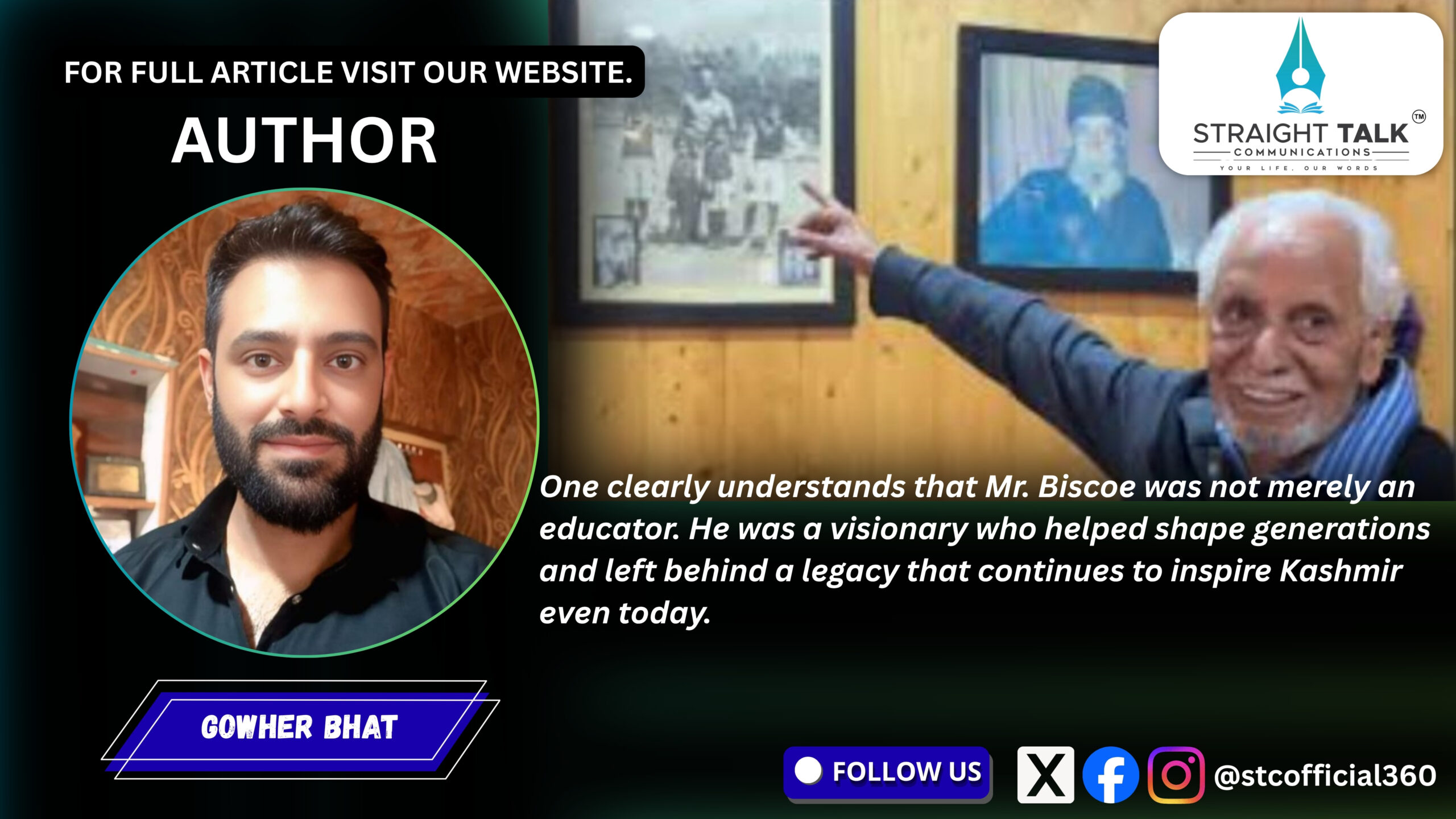
One clearly understands that Mr. Biscoe was not merely an educator. He was a visionary who helped shape generations and left behind a legacy that continues to inspire Kashmir even today.
Gowher Bhat
The contribution of Tyndale Biscoe to the educational, social, and intellectual development of Kashmir was profound, transformative, and far ahead of its time. His role was not limited to establishing a school or introducing a curriculum. He helped shape generations of young Kashmiris into disciplined, courageous, educated, socially responsible, and confident individuals who later went on to occupy some of the highest and most respected positions in society.
Mr. Nazir Ahmed Khan, former Director General of Youth Services & Sports, J&K, stated this in a candid conversation while revisiting his years at the Biscoe institution in Srinagar. He spoke about those years with deep admiration and emotion. Listening to him, one could immediately sense that the Biscoe institution was not merely a place of formal learning. It was a place where personalities were shaped, confidence was built, fears were overcome, and character was formed. According to him, the education imparted there was fundamentally different from ordinary schooling of that era.
Mr. Biscoe believed education should not remain confined to books, examinations, and memorization. He wanted education to produce strong human beings, individuals who possessed courage, discipline, integrity, compassion, leadership, and the ability to serve society. He believed students should become mentally resilient, physically active, morally upright, and socially conscious citizens capable of contributing positively to the world around them.
At a time when society in Kashmir remained deeply traditional in many ways, physical activities such as swimming, boating, football, mountain climbing, and athletics were not widely encouraged among young boys. There was hesitation, fear, and even social resistance toward many such activities. Yet Mr. Biscoe introduced an entirely new culture of education, one that encouraged students to challenge themselves physically and mentally.
Nazir Ahmed Khan vividly recalled how students were rigorously trained in swimming and boating activities in Dal Lake. Regattas, rowing competitions, and Dal-cross races became an important and unforgettable part of student life. Students learned not only how to swim and row boats, but also how to work together, trust one another, develop endurance, and face fear with courage.
The memories shared by Nazir Ahmed Khan reveal how advanced and unique the Biscoe educational system truly was. Students participated in demanding boat races that required discipline, coordination, physical stamina, and mental toughness. There were flat races, turning races, standing races, and even sinking races in which boats deliberately filled with water had to be collectively managed and rowed by students. Such activities were not merely recreational exercises. They were carefully designed lessons in teamwork, responsibility, leadership, resilience, and determination.
The institution also encouraged students to take responsibility for their surroundings. Nazir Ahmed Khan recalled how students themselves managed boats, collected paddles, organized equipment, and participated actively in maintaining discipline during regattas and other activities. Through this system, students learned practical responsibility from an early age.
Another remarkable aspect of the Biscoe institution was its emphasis on communal harmony and mutual respect. Students from different religious backgrounds studied together in an atmosphere marked by understanding, cordiality, and brotherhood. Muslim students were taught Islamic studies by Muslim teachers, Sikh students studied under Sikh teachers, and Hindu students were guided by Pandit teachers. Yet despite these differences, students remained united as members of one educational family.
There was no atmosphere of division or hostility. Instead, there existed mutual respect, coexistence, and a shared sense of belonging. Students grew up learning to understand and value one another despite religious differences. In a place as culturally and religiously diverse as Kashmir, this educational philosophy carried enormous significance and reflected the broader human values Mr. Biscoe sought to cultivate within his students.
Mr. Biscoe also believed strongly in compassion, social responsibility, and service to humanity. Students were encouraged to help the poor, support needy people, and show kindness toward animals and society. Nazir Ahmed Khan recalled how such values were deeply embedded within school culture. Education, according to Mr. Biscoe’s philosophy, was never meant to produce individuals concerned solely with personal achievement or financial success. He wanted students to become compassionate and responsible human beings who would contribute positively to society.
One of the most remarkable aspects repeatedly emphasized by Nazir Ahmed Khan was the confidence the institution instilled in its students. Boys who came from ordinary backgrounds gradually transformed into self-assured individuals capable of leading institutions and serving society at the highest levels. Through physical training, discipline, academics, teamwork, and leadership opportunities, students developed tremendous self-belief.
Nazir Ahmed Khan himself later went on to hold some of the highest and most respected positions in public service, including Director General of Youth Services and Sports and director of various important departments. His own journey stands as a reflection of the kind of confidence, leadership, discipline, and administrative capability the institution nurtured in its students.
Nazir Ahmed Khan particularly highlighted how Mr. Biscoe’s educational philosophy produced extraordinary individuals. One of the most striking examples comes from his own batch of approximately forty students. According to him, a remarkable number of those students later rose to highly prestigious and influential positions in society.
Among his classmates were individuals who later rose to remarkable positions in society — senior administrators, Additional Directors General of Police, chief engineers, army officers, transport chiefs, prominent businessmen, and respected doctors. Nazir Ahmed Khan himself mentions several notable names: Gulam Mohammad Narwaroo, who became a Chief Engineer; Abdul Rahim Nanda, who rose to the position of Additional Director General of Police; Chaman Sawhney, who became a prominent businessman; Aslam Khan, who served as Chief Electrical Engineer; Abdul Aziz, who emerged as a leading transport chief; Tajam-ul-Hussain, who became a Chief Mechanical Engineer; Abdul Majid Siraj and N. A. Khalid, both of whom became prominent doctors; and K. K. Batra, who became a major businessman. Mohsin later became a Colonel in the Army, R. K. Dechen rose to the rank of Director General of Police, Rigzin became an Army Major, and Gulam Nabi established himself as a prominent transporter.
This achievement from a single classroom is truly extraordinary.
When one reflects deeply upon this reality, it becomes impossible not to recognize the immense magnitude of Mr. Biscoe’s contribution to Kashmiri society. If one batch consisting of merely forty students could produce such a remarkable number of highly accomplished individuals, then one can only imagine how many thousands of influential personalities emerged from the institution over decades.
Over the years, the Biscoe institution produced administrators, senior police officers, army officers, engineers, bureaucrats, doctors, businessmen, educators, and leaders who later contributed immensely to Kashmir and society at large. Its impact extended far beyond classrooms and examination halls. The institution played a foundational role in shaping modern educated Kashmiri society itself.
Nazir Ahmed Khan repeatedly stressed that this success was not accidental. According to him, the school systematically instilled discipline, courage, punctuality, leadership, teamwork, confidence, endurance, and public spirit into students from a very young age. Students were trained not to fear hardship or difficulty. They were encouraged to challenge themselves physically and mentally and to face life with dignity and determination.
The institution’s influence extended far beyond academics. It shaped personalities, transformed attitudes, and built confidence that remained with students throughout their lives. Nazir Ahmed Khan recalled how the school encouraged students to become active participants in life rather than passive observers. Whether through sports, regattas, climbing activities, leadership responsibilities, or social service, students constantly learned how to take initiative and responsibility.
One of the most powerful observations made by Nazir Ahmed Khan concerned the lasting impact the institution had upon society itself. He explained that the influence of the Biscoe institution could be measured not merely through infrastructure or educational statistics, but through the generations of individuals it helped produce. Many former students later became some of the most respected and influential figures in Kashmir across different professions and institutions.
This enduring legacy demonstrates that Mr. Biscoe’s contribution was not temporary or superficial. His educational philosophy continued to shape lives long after students left school. Even decades later, former students still carried within them the discipline, courage, confidence, and values instilled during their years at the institution.
Another important dimension of Mr. Biscoe’s vision was his belief in combining intellectual growth with physical development. Nazir Ahmed Khan’s recollections clearly show that students were encouraged to become active, energetic, and fearless individuals. Swimming across Dal Lake, rowing long distances, participating in demanding sports, and engaging in physically rigorous activities helped students develop resilience and mental strength alongside academic knowledge.
The institution helped shape not merely educated individuals, but complete human beings.
Through Nazir Ahmed Khan’s memories and reflections, one begins to understand that the Biscoe institution represented something much larger than a school. It was an educational movement that helped transform the social fabric of Kashmir. It introduced new ways of thinking, new standards of discipline, and a broader vision of education that combined academics, physical training, moral values, leadership, and social responsibility.
Even today, decades later, the legacy of Tyndale Biscoe continues to live through the countless students who passed through the institution and later illuminated society through their service, leadership, integrity, and achievements. His influence remains deeply embedded within the educational and social history of Kashmir.
Perhaps the greatest tribute to Mr. Biscoe lies not in monuments, buildings, or memorials, but in the lives of the countless individuals who emerged from his institution and went on to serve society with distinction, discipline, humanity, and excellence. Through the reflections of Nazir Ahmed Khan, one clearly understands that Mr. Biscoe was not merely an educator. He was a visionary who helped shape generations and left behind a legacy that continues to inspire Kashmir even today.
(The author is a columnist, freelance journalist, beta reader, book reviewer, avid reader, and educator from Kashmir. He is also a published author of both fiction and nonfiction)