



FRIDAY FOCUS: Minaz-Zulumāti ilā an-Nūr – The Messenger Who Brought Us from Darkness to Light
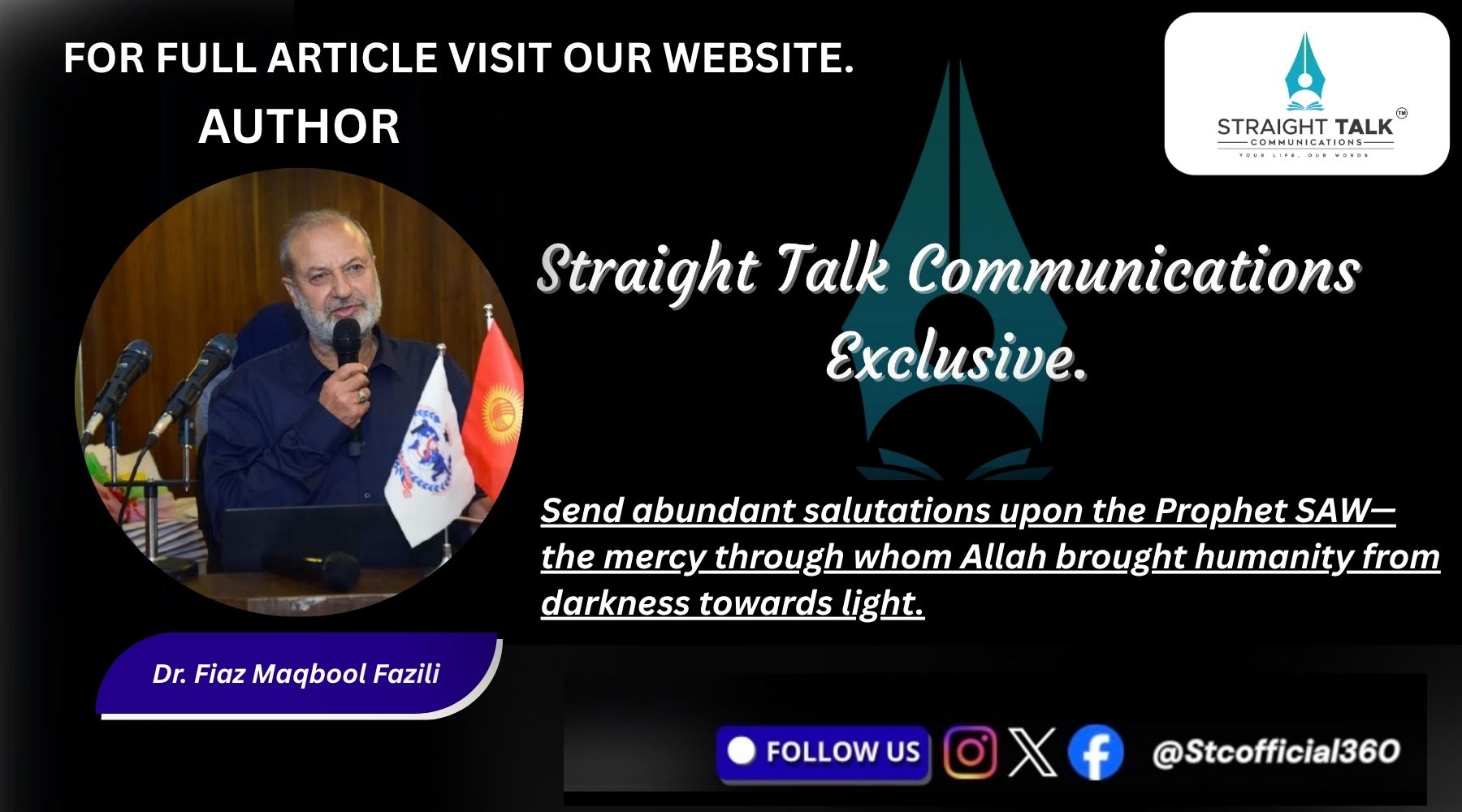
Dr. Fiaz Maqbool Fazili
Send abundant salutations upon the Prophet SAW—the mercy through whom Allah brought humanity from darkness towards light. There are words in the Qur’an that, once they enter the heart, refuse to remain merely words. They become an image, a history, a warning and a hope. One such profound Qur’anic expression is:Minaz-zulumāti ilā an-nūr- “From darkness into light.” The phrase occurs in the Qur’an in connection with Allah’s guidance and His mission of rescuing humanity from the darkness of ignorance, disbelief, injustice and moral confusion and bringing it into the light of faith, knowledge, justice and truth. Allah says: He is the Protector of those who believe. He brings them out of darkness into light.” The Qur’an repeatedly presents the prophetic mission in this language. The Messenger SAW was sent with revelation so that people could be brought from darkness into light. And this is perhaps one of the most beautiful ways to understand who Muhammad SAW was and why his arrival changed human history.
Before him was darkness—but not darkness in the sense that there was no sun in the sky. Arabia had stars, poets, merchants, warriors and tribes. The darkness was within human beings. It was the darkness of the heart and conscience. It was the darkness in which a daughter could be buried alive because society considered her birth a source of shame. It was the darkness in which the strong could exploit the weak and the wealthy could crush the poor. Tribal pride could outweigh justice. Revenge could continue for generations. Slavery had little moral restraint. Alcohol, gambling, sexual exploitation and idol worship had become woven into social life. Human beings had knowledge but lacked guidance. They had power but lacked mercy. They had pride but lacked humility. Then came Muhammad SAW. Not as a king surrounded by armies. Not as a philosopher seeking applause. Not as a tribal chief demanding submission.
He came as Allah’s Messenger—reciting His verses, purifying hearts, teaching people and reminding humanity of the One before whom kings and slaves, rich and poor, Arabs and non-Arabs would ultimately stand equally accountable. The Qur’an describes this transformation beautifully. The Messenger SAW was sent to recite Allah’s revelations and lead people towards purification and knowledge. His was not simply a mission of changing governments. It was a mission of changing the human beings. And that is why the Qur’anic expression is so powerful: “Minaz-zulumāti ilā an-nūr.” Notice the contrast. Darkness is plural— “zulumāt”. Light is singular— “nūr”.
There are many paths into darkness: arrogance, hatred, injustice, ignorance, greed, prejudice, lust, corruption and cruelty. A society may leave one darkness only to enter another. But truth is one. The light of divine guidance is one. The Prophet SAW came to show humanity that light. He taught the arrogant that greatness lies in humility. He taught the wealthy that wealth is a trust. He taught rulers that authority is accountability. He taught husbands to honour their wives. He elevated the status of women and gave rights to those who had long been denied dignity. He taught that an orphan should not be humiliated. He warned against oppression. He declared that no Arab was inherently superior to a non-Arab, nor a non-Arab to an Arab, except through righteousness and consciousness of Allah.
What a revolution this was—not merely political, but moral and spiritual. The Messenger SAW did not simply tell people to believe. He showed them what belief should look like when it enters a human heart. Mercy became action. Justice became action. Forgiveness became action. Compassion became action. When he was abused, he did not answer every insult with an insult. When he gained power, revenge was not his instinct. When people who had persecuted him stood defeated before him at the conquest of Makkah, the man who had been driven from his home showed a capacity for forgiveness that history still struggles to comprehend.
This was light. And perhaps this is the question for us today: If we claim to love the Messenger SAW, how much of this light is visible in us? We live in an age illuminated by electricity and technology yet often darkened by human behaviour. We can communicate with the entire world in seconds yet cannot speak kindly to our neighbour. We have access to libraries in our phones, yet ignorance spreads rapidly. We quote the Qur’an but sometimes insult one another in the same conversation. We send blessings upon the Prophet SAW, yet mock people, expose their past, humiliate the weak and spread rumours without verification. Can we claim to be walking towards nūr while carrying zulmāt in our speech and conduct? This is where sending salutations—salawat and durood—upon the Prophet SAW must become more than a movement of the tongue.Allah Himself commands the believers: “Innallāha wa malā’ikatahu yuṣallūna ‘alan-nabiyy. Yā ayyuhalladhīna āmanū ṣallū ‘alayhi wa sallimū taslīmā.Indeed, Allah and His angels send blessings upon the Prophet. O you who believe, send blessings and peace upon him abundantly.”(Surah Al-Ahzab) How fortunate are we to be commanded to send blessings upon the one who brought the message of guidance to us. When we say, Allahumma salli ’ala Muhammad, (saw) we are remembering the man through whom Allah delivered the Qur’an to humanity. When we say, wa ’ala aali Muhammad, we remember a family that carried immense sacrifice. When we say, sallallahu ’alayhi wa sallam, we should pause and ask ourselves: What would it mean if his character entered my own life? Would I still ridicule people? Would I still enjoy someone’s public humiliation? Would I still remind a repentant person of his or her past? Would I still spread unverified allegations? Would I still treat those poorer, weaker or less educated than me with contempt?
Love for the Prophet SAW cannot be separated from the effort to follow his character. The world today desperately needs this prophetic light. Not another competition over who can shout the loudest. Not another sectarian quarrel. Not another social-media trial where people become judges, prosecutors and executioners of another person’s reputation. We need the light that teaches us to verify before speaking. The light that teaches us to forgive. The light that teaches us to correct with wisdom. The light that teaches us that the dignity of another human being is not entertainment. The light that teaches us to look inward before pointing outward. Perhaps the greatest tribute we can offer the Messenger SAW is not merely to speak endlessly about our love for him, but to allow that love to reform us. Let our homes become lighter because of his teachings. Let our mosques become places of mercy. Let our social media become less poisonous. Let our disagreements retain dignity. Let our children learn that strength does not mean aggression. Let our communities understand that piety is not the length of a speech but the beauty of character.
The Prophet SAW came into a world fractured by tribalism and ignorance. He built hearts before institutions and conscience before power. His message crossed deserts, languages, continents and centuries because it addressed something eternal in the human soul: the longing to emerge from darkness and find the way home. And perhaps that journey is still ours. Every time we overcome arrogance, we take a step from darkness towards light. Every time we forgive when revenge is easy, we take a step towards light. Every time we speak the truth when silence would protect our interests, we take a step towards light. Every time we repent sincerely and refuse to return to wrongdoing, we take a step towards light. Every time we send sincere salutations upon Muhammad SAW and try to live according to what he taught, we remind ourselves where the road leads.Minaz-zulumāti ilā an-nūr. From the many darknesses to the one light, A Road to Paradise, Insha Alalh.
Let us therefore send abundant blessings and peace upon the Messenger SAW—not as a ritual divorced from life, but as an expression of gratitude to the one through whom the final revelation reached us.Allahumma salli wa sallim wa barik ’ala Sayyidina Muhammad SAW, wa ‘ala alihi wa sahbihi ajma’in.O Allah, fill our hearts with love for Your Messenger SAW. Remove from us the darkness of arrogance, hatred, ignorance and cruelty.Give us the courage to follow his Sunnah not only in appearance, but in character. And make us among those who walk, in sincerity and humility,
The Light Must Enter the Heart; From darkness to light. Perhaps the greatest tragedy is not that the world has darkness. Darkness has always existed. The tragedy is when a person carries the Qur’an but remains cruel. When he speaks about Sunnah but humiliates others. When he sends salawat upon the Prophet saw but refuses to forgive. When he claims to defend Islam but wounds fellow Muslims with his tongue, hands, pen,dark heart. When knowledge increases but humility disappears. The real return to the Messenger saw is a return of the heart. We must read Ar-Raheeq Al-Makhtum (The Sealed Nectar), the best book on the Seerah, and strive to bring the light, lessons, and character of the Prophet saw into our everyday lifestyle. We need to ask today: Has the “Sirāj Munīr” reached my heart?
(STRAIGHT TALK COMMUNICATIONS EXCLUSIVE)

Very well penned down to be remembered for ever.Now how much can be followed is to be seen. Let us try our best Inshallah.Pray for us and whole Ummah Ameen yahramatulallameen.
Great Great testimony for Truth &a great guidance for all Humanity/particularly young Muslims all over world.
Thanks a lot Dear Dr Fayaz, Allah Bless t
Thanx dear,we pray that Allah bring us out of Darkness to Light n show us the Right Path,may our sins be Forgiven,Aameen