




Wular: The Lifeline of Kashmir’s Water System
Survival of Kashmir’s water bodies is ultimately the survival of Kashmir itself
Dr. Touseef Bhatt
Kashmir is often described through its mountains, gardens and rivers, but its real ecological strength lies in a far more interconnected system—the network of lakes, wetlands, marshes, channels and the Jhelum River. At the heart of this system stands Wular Lake, not merely as another lake, but as one of the Valley’s most important natural regulators.
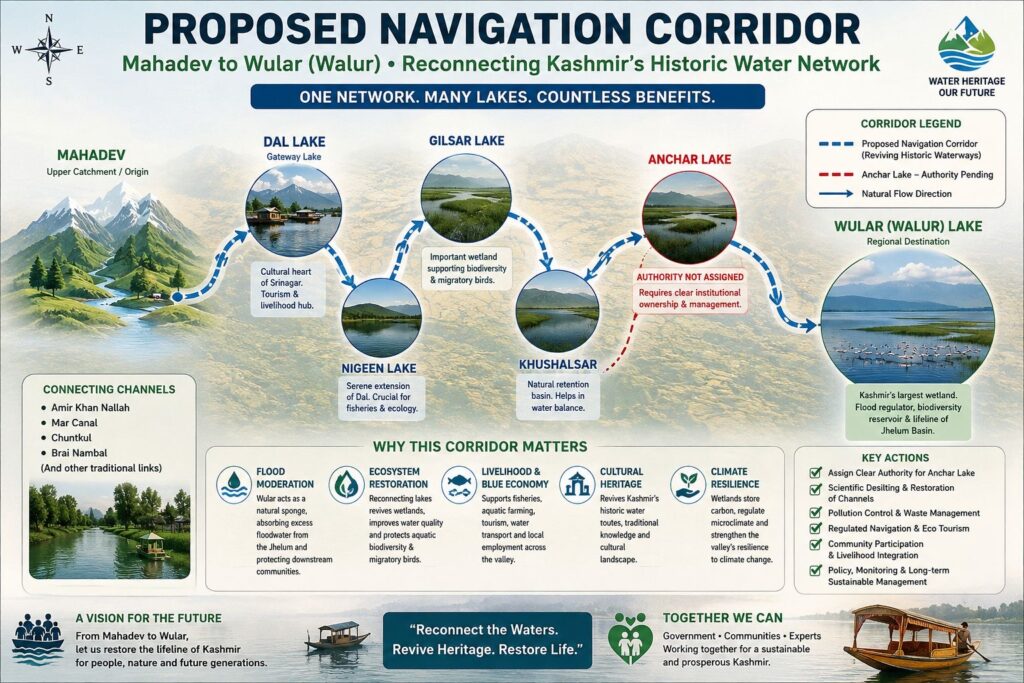
The proposed Mahadev–Wular Navigation Corridor, connecting Mahadev with Dal, Nigeen, Gilsar, Khushalsar, Anchar and ultimately Wular, therefore offers an opportunity to think beyond navigation. It should be viewed as a proposal for ecological reconnection and restoration of Kashmir’s historic water network.
Wular is Kashmir’s natural flood regulator
The most important function of Wular is hydrological.
The Jhelum carries water through the Valley and eventually enters Wular. Because of its enormous wetland basin and associated marshes, Wular can absorb and temporarily store excess water, reducing the pressure on downstream areas. Government and Ramsar documentation recognise its critical role in the hydrographic system of Kashmir and its function as a major floodwater absorption basin.
This means that protecting Wular is not simply about protecting a lake in Bandipora. It is about protecting Srinagar, Sopore, Baramulla and communities across the Jhelum basin from greater hydrological vulnerability.
A weakened Wular means a weakened natural defence against floods.
The survival of Wular is connected to the survival of other water bodies
The most important message from the proposed corridor is that Kashmir’s water bodies cannot be treated as isolated lakes.
Dal, Nigeen, Gilsar, Khushalsar, Anchar and other wetlands form parts of a historically interconnected landscape. The Jhelum and its associated channels provide the larger hydrological spine of this system. Official documentation notes that the Jhelum directly or indirectly connects many wetlands of Kashmir longitudinally and altitudinally before reaching Wular.
Therefore, cleaning one lake while allowing its feeder channels to remain polluted or blocked is not a sustainable solution.
The Valley needs a water-body-to-water-body approach rather than lake-by-lake management.
Wular is a biodiversity reservoir
Wular is also a globally important wetland. It was designated a Ramsar Site in 1990, recognising its international ecological importance. Its open waters, marshes and surrounding habitats support fish, aquatic vegetation and large populations of resident and migratory birds.
Its ecological health therefore contributes to the health of the wider Himalayan ecosystem.
The loss of wetlands does not simply mean losing water. It means losing fish habitat, bird habitat, aquatic vegetation, natural filtration, carbon storage and ecological resilience.
Wular is also an economic lifeline
For communities around Kashmir’s wetlands, water is not merely an environmental resource—it is an economic resource.
Fishing, water chestnut, aquatic vegetation, agriculture, tourism and other wetland-dependent activities support thousands of families. Government sources continue to recognise Wular’s importance for fisheries and livelihoods.
A restored Wular can therefore become the foundation of a blue economy for Kashmir, based on sustainable fisheries, eco-tourism, regulated navigation, aquatic agriculture and community-led conservation.
But Wular cannot survive if its feeder system dies
This is where the proposed corridor becomes particularly significant.
If Dal is polluted, Nigeen is choked, Gilsar and Khushalsar lose their ecological connectivity, Anchar continues to deteriorate and channels become dumping grounds, the cumulative consequences eventually reach the larger Jhelum–Wular system.
The threats are already recognised: encroachment, pollution, hydrological alteration, siltation and invasive species are among the documented pressures on Wular.
Therefore, restoring connectivity must not mean simply dredging channels and allowing boats to move.
It must mean restoring the ecological connectivity of water itself.
Navigation should follow ecology—not replace it
The idea of reconnecting Kashmir’s historic waterways is attractive and potentially transformative. It could create new tourism circuits, reduce pressure on roads, generate employment and revive an important part of Kashmir’s cultural history.
But there is an important condition:
Navigation infrastructure must never come at the cost of ecological integrity.
Every proposed channel should undergo scientific assessment of:
- hydrological flows;
- water quality;
- carrying capacity;
- biodiversity and bird habitats;
- sediment movement;
- flood behaviour;
- pollution loads;
- invasive species;
- seasonal water levels; and
- impacts on local communities.
And, as the graphic rightly highlights, Anchar requires clear institutional ownership. A water body without clear responsibility is ultimately a water body without effective protection.
Think of Kashmir as one living water system
The greatest mistake we can make is to ask:
How do we save Dal? Or: How do we save Wular? The correct question is: How do we restore Kashmir’s entire water network?
From the upper catchments around Mahadev, through the channels and lakes of Srinagar, into the Jhelum and finally Wular, Kashmir possesses a natural hydraulic system that evolved over centuries.
Wular is the great receiving basin of this system—and its health is inseparable from the health of the waters that feed it.
Wular is not just a lake.
It is Kashmir’s flood buffer.
It is a biodiversity sanctuary.
It is a livelihood system.
It is a climate-resilience asset.
It is a regulator of the Jhelum.
And, ultimately, it is part of Kashmir’s ecological life-support system.
If we want Kashmir to remain habitable, resilient and prosperous in an era of climate change, the restoration of Wular and its connected water bodies must become a strategic priority—not merely an environmental project.
Save Wular. Restore the channels. Reconnect the wetlands. Revive the Jhelum.
Because the survival of Kashmir’s water bodies is ultimately the survival of Kashmir itself.
(STRAIGHT TALK COMMUNICATIONS EXCLUSIVE)