




DATELINE: Tradition Policing
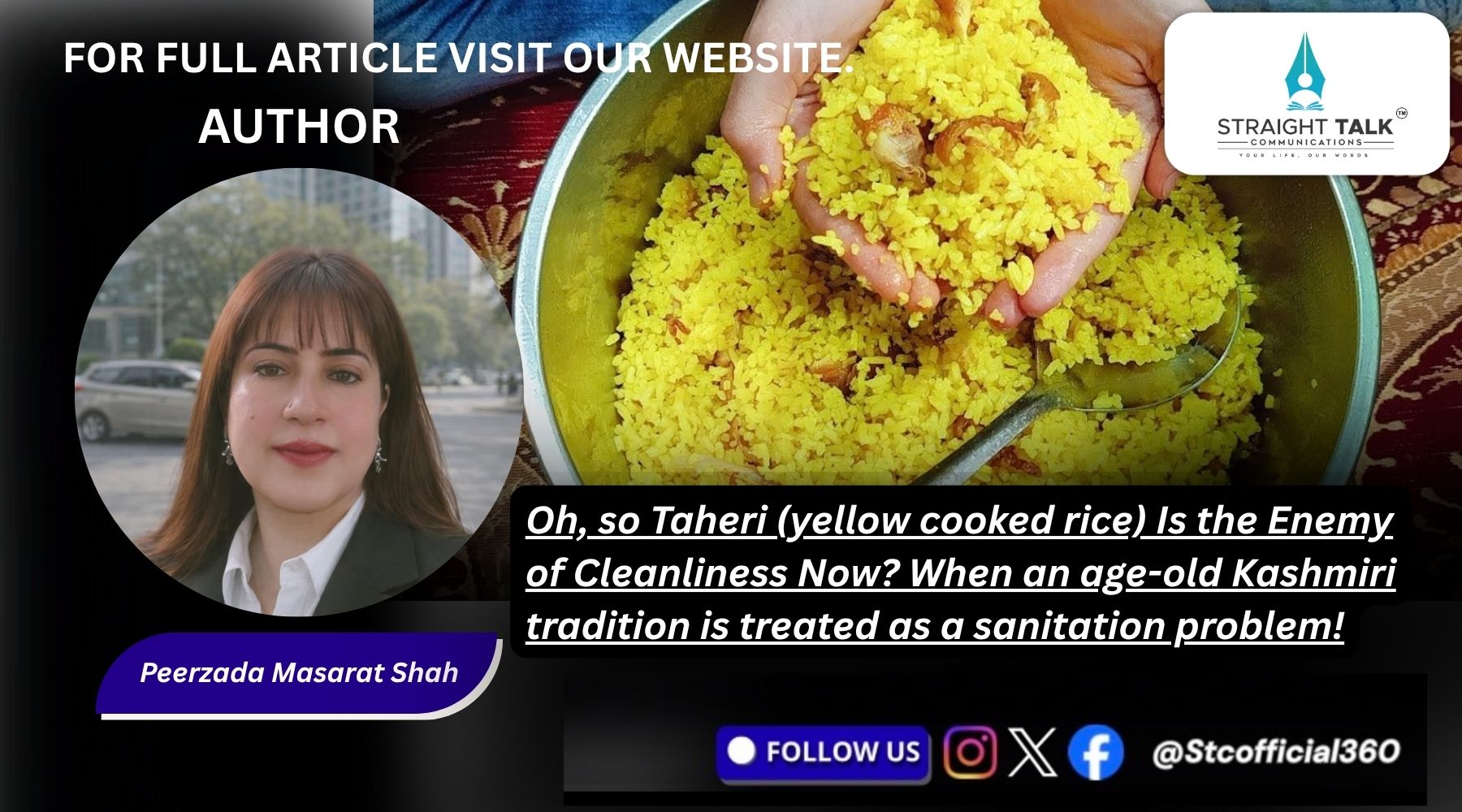
Oh, so Taheri (yellow cooked rice) Is the Enemy of Cleanliness Now? When an age-old Kashmiri tradition is treated as a sanitation problem!
Peerzada Masarat Shah
Kashmir’s history is not merely a story of kings, wars, rulers and political movements. It is also the story of countless small traditions that have quietly held society together for generations. Taheri—the distribution of yellow cooked rice at shrines, Khanqahs and religious gatherings—is one such tradition.
The exact origin of Taheri in Kashmir is difficult to establish with certainty. However, rice has been an integral part of Kashmiri food culture for centuries, and yellow rice prepared with turmeric has long been associated with religious, social and ceremonial occasions. Over time, the practice of preparing and sharing Taheri became woven into Kashmir’s cultural fabric.
Importantly, Taheri cannot simply be reduced to a Muslim religious practice. Yellow rice and similar preparations have also existed in Kashmiri Pandit households as part of traditional meals, rituals and celebrations. Around Muslim shrines and Khanqahs, its distribution acquired another dimension—as nazr-o-niyaz, charity, thanksgiving and the sharing of رزق (sustenance).
That is what makes the tradition particularly Kashmiri.
At a shrine, the person receiving Taheri could be a man or woman, young or old, rich or poor, local or traveller. For a moment, social distinctions disappeared. A simple handful of rice became an expression of faith, gratitude, compassion and community.
And now comes the rather extraordinary question:
Has Taheri suddenly become Kashmir’s greatest threat to cleanliness?
If the problem is hygiene, improve hygiene.
If the problem is overcrowding, improve crowd management.
If the problem is waste, provide proper waste-disposal systems.
If the problem is animals entering shrine premises, secure the boundaries and install proper gates.
If the problem is disorderly distribution, create designated spaces where food can be distributed with dignity and cleanliness.
In other words, manage the tradition – do not erase it.
The same principle applies to feeding birds around shrines and mosques. Feeding a creation of Allah has traditionally been viewed by many devotees as an act of compassion and blessing. If feeding birds creates litter or congestion, the obvious answer is regulation: designated areas, controlled quantities, cleanliness and regular removal of waste.
No one is arguing against discipline or sanitation. Quite the opposite. Religious places deserve to be cleaner, safer and better managed.
But there is a fundamental difference between regulating a tradition and abolishing it.
The Waqf Board’s responsibility should be to protect the shrine, preserve its sanctity, improve facilities, ensure cleanliness and security, and make it easier for devotees to practise their traditions responsibly. The answer to an untidy tradition should be better management—not the disappearance of the tradition itself.
Kashmir’s shrines and Khanqahs are not merely buildings. They are repositories of memory, faith and culture. Their courtyards have witnessed generations of Kashmiris praying, feeding the poor, sharing food and expressing gratitude.
If Taheri is being distributed in an unhygienic manner, then by all means establish rules.
But please do not confuse cleanliness with cultural erasure.
There is an irony here worth pointing out. Kashmir has far greater examples of wasteful expenditure and extravagant consumption—particularly at weddings and social functions. Yet somehow, the humble distribution of a plate of rice to a devotee or a hungry person becomes the pressing administrative emergency.
Perhaps the priorities deserve another look.
Build the boundary walls. Keep dogs and other animals out. Improve sanitation. Create designated spaces for Taheri and bird-feeding. Maintain discipline. Ensure that food is handled hygienically.
But let the people continue a tradition that has survived generations.
Because Taheri is not merely rice coloured yellow with turmeric.
It is رزق being shared. It is gratitude being expressed. It is charity without a receipt. It is memory being passed from one generation to another.
Kashmir has already lost too many of its old traditions to time, politics and changing lifestyles.
We should not allow poor management to become another reason to lose them.
Do not ban the tradition. Manage it with dignity.
Because a clean shrine without its living traditions may be orderly—but it risks becoming merely a building.
(STRAIGHT TALK COMMUNICATIONS EXCLUSIVE)
(Disclaimer: The views are of the author and not of the Straight Talk Communications)