



PERSONALITY: The Man Who Shared in the Sorrows of Others
Maulvi Abdul Samad Akhoon — A Life of Grace, Compassion and Quiet Service
Khurshid Ahmad Akhoon
It was past 10 on a quiet August night. Chowgan in Kishtwar was filled with people who had gathered, as people do when a familiar life comes to an end and a beloved presence is no more. There was a solemn stillness in the air, broken only by the subdued murmur of prayers and grief. I stood before those rows of mourners with the profound responsibility of leading the funeral prayer of my father, Maulvi Abdul Samad Akhoon. In that moment, beneath the open night sky, the imam, the teacher, the father, and the man whose life had touched so many stood before me not merely as memories, but as a lifetime suddenly gathered into a single, deeply moving moment.
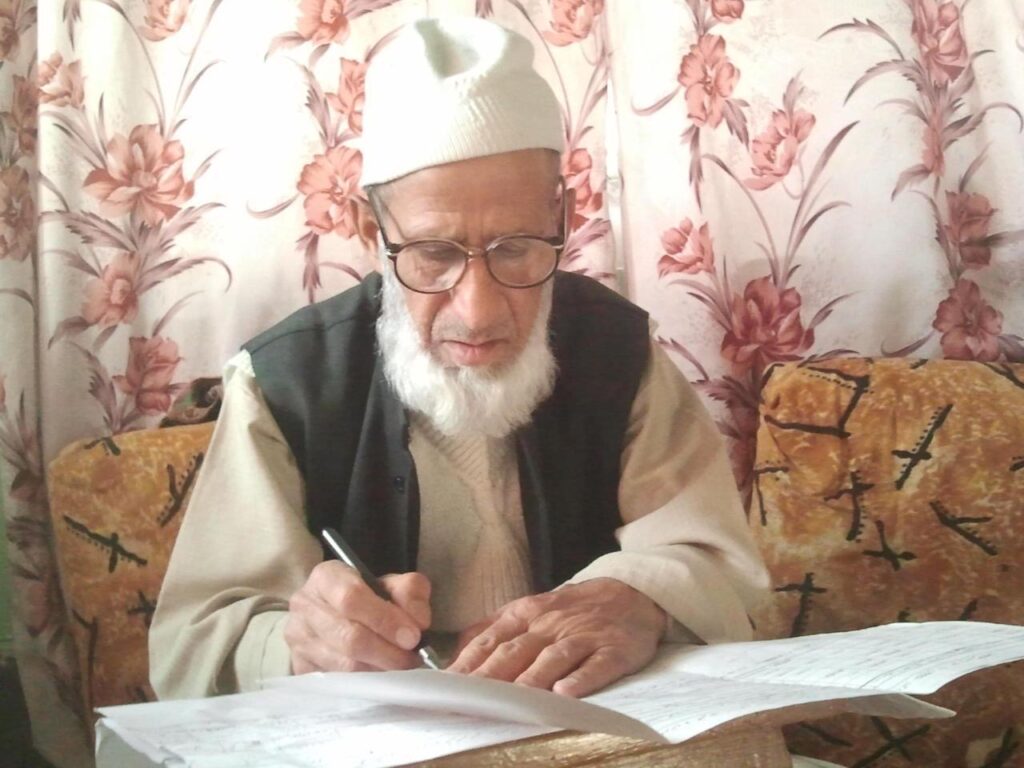
My father was born on 13 April 1932 in Kishtwar, the eldest son of Maulvi Sanaullah Akhoon. My grandfather belonged to a generation when formal madrasas were rare in the villages. He therefore travelled from village to village and from house to house, teaching the Qur’an and the fundamentals of faith to children and adults, asking for nothing in return. He would sometimes stay for days in a village, teaching wherever he was needed. As a young boy, Abdul Samad often accompanied him. Perhaps that was where the first foundations of his life were quietly laid—not in an institution, but on the road, in humble homes, with the Qur’an as his companion and service as his inheritance.
He grew into a man of intelligence, simplicity and deep spiritual discipline. From childhood, prayer and fasting became the rhythm of his life. After the passing of his father, Maulvi Saadullah Akhoon assumed the responsibility of the imamate, while Abdul Samad served as his deputy. When Saadullah Akhoon later suffered paralysis, my father took upon himself the responsibility of leading prayers at Jamia Masjid Israriya in Kishtwar. For nearly thirty-five years, he remained associated with the mosque as its imam.
His relationship with the mosque, however, went far beyond leading prayers. He worked tirelessly for the construction of Jamia Masjid Israriya, seeing it as an amanah—a trust entrusted to the community. For him, a mosque was not merely a building; it was a place where the Qur’an was taught, prayer offered, knowledge shared and people brought together.
He taught the Qur’an to thousands during his lifetime. Many who are now fathers and grandfathers may still remember sitting before him as children, learning their first letters and verses. He taught with affection rather than fear, believing that the Qur’an should enter a child’s heart through love, patience and understanding.
He also believed that religion was not merely about hearing words; understanding was equally essential. Before delivering the Arabic Friday sermon, he would explain its meaning in Urdu so that ordinary people could understand its message. His reading extended deeply into Islamic scholarship, including Tafsir Ibn Kathir, Durr al-Mukhtar, Fatawa Alamgiri and Tafhim al-Bukhari, alongside the major collections of Hadith—Sahih Bukhari, Sahih Muslim, Sunan Abi Dawood, Jami’ al-Tirmidhi, Sunan al-Nasa’i and Sunan Ibn Majah.
His devotion to worship was equally profound. He would often rise around two in the morning, recite the Qur’an and offer Tahajjud. Fasting and prayer remained integral to his life. Looking at the simplicity of those nights, one might describe his world in a single sentence: there was a man, a Qur’an, and his Lord.
Yet if one remembers him only as an imam or a religious scholar, one would remember only a part of the man he was. His deeper legacy lay in the way he treated people—with warmth, dignity and quiet compassion. He respected his elders, loved children, cared for his neighbours and remained especially tender towards orphans, the poor and the helpless. A hand placed gently upon the head of an orphan was, for him, more than a gesture; it was a silent expression of love and responsibility. Much of his kindness was offered quietly, without seeking recognition. He believed that differences of opinion need not become differences of heart, and that true faith reveals itself most beautifully in the way we treat one another.
People also came to him with illnesses, family difficulties and personal anxieties. He would listen patiently, offer Qur’anic verses, prayers and wazaaif, and, according to his practice, Qur’anic taweez. Many remembered not only what he recited, but the reassurance they found in his presence. Whatever their circumstances, they often left feeling that someone had listened to them without making them feel like a burden.
He lived through periods when differences of school and sect could easily become walls between people. Yet his personality often became a bridge. When disputes arose around the mosque, people listened to him. His credibility came not merely from his position as an imam, but from the trust he had earned over decades. He believed that people could differ in opinion without allowing their hearts to become divided.
His life also carried the responsibilities of ordinary work. He was among the first in our family to enter government service, joining the Agriculture Department of Jammu and Kashmir. He was known for his honesty, diligence and sense of duty. He continued his professional responsibilities while simultaneously carrying the demanding responsibility of the imamate—treating both as trusts to be honoured.
He performed Hajj twice and also undertook Umrah. But the measure of his religious life was never simply the journeys he made to the holy places; it was the manner in which faith shaped the life he lived among people.
In the final two or three years of his life, dementia gradually took away many of the faculties through which he had once expressed himself. The man who had spent decades teaching the Qur’an, leading prayers and listening to people’s troubles became increasingly confined to a room. It was a difficult reversal of life, yet those who had known him continued to carry the memory of the man he had been.
He passed away on 19 August 2026.
That night at Chowgan, after 10, I stood before his bier and led his funeral prayer. As I looked at the gathered faces, I found myself thinking that a person’s life is rarely contained in the dates of his birth and death. Between those two dates lies an invisible history—the people one helped, the children one taught, the neighbours one stood beside, the prayers one offered, and the hearts one quietly comforted.
My father leaves behind three sons: Nisar Ahmad Akhoon, Dr. Ishtiaq Ahmad Akhoon and myself, Khurshid Ahmad Akhoon. But the true inheritance of a person is not always something that can be divided among his children. Sometimes it survives in the habits of goodness he leaves behind—in the way we speak to an elder, hold a child’s hand, care for a neighbour, remember an orphan, help someone in difficulty, or listen to a troubled heart without making it feel like a burden.
A person eventually leaves this world. Wealth fades, positions change, and names slowly disappear from the pages of time. But a kind word, a prayer offered for someone, a lesson from the Qur’an, dignity shown to a poor man, or a few moments spent listening to a troubled heart—these are gifts that can outlive the person who gave them.
Perhaps this is what remains when a good man departs.
Not the position he held.
Not the title he carried.
But the warmth he left in other people’s lives.
My father lived his faith not only in the mihrab, but in his dealings with people. He taught the Qur’an, but he also taught—through his conduct—something about compassion. He led prayers, but he also taught people how to stand beside one another.
Some voices do not disappear with death. They become memories, and memories become inheritance.
My father’s voice is now silent.
But perhaps, in the quiet mornings of Kishtwar, in the pages of the Qur’an he taught, in the prayers of those who knew him, and in the lives he touched, something of that voice will continue to live.
(STRAIGHT TALK COMMUNICATIONS EXCLUSIVE)