





BOOK REVIEW: Mayani Vachuk Kotur – The Pigeon That Memory Keeps Alive…..

Bashir Aarif’s Mayani Vachuk Kotur does not ask us merely to remember the past. It asks us to consider what, within ourselves, we have chosen not to forget.
Sanjay Pandita
What survives when a familiar world begins to disappear? Houses may change hands, neighbourhoods may lose their old faces, relationships may loosen, and words once common may gradually fall silent. Yet something remains—held in the private chambers of memory, beyond the reach of time. Bashir Aarif’s Mayani Vachuk Kotur, literally The Pigeon of My Heart, enters this intimate territory. Its eleven stories are not simply narratives about people and their circumstances; together, they constitute an act of remembering—a writer gathering fragments of a changing Kashmir and giving them another life through fiction.
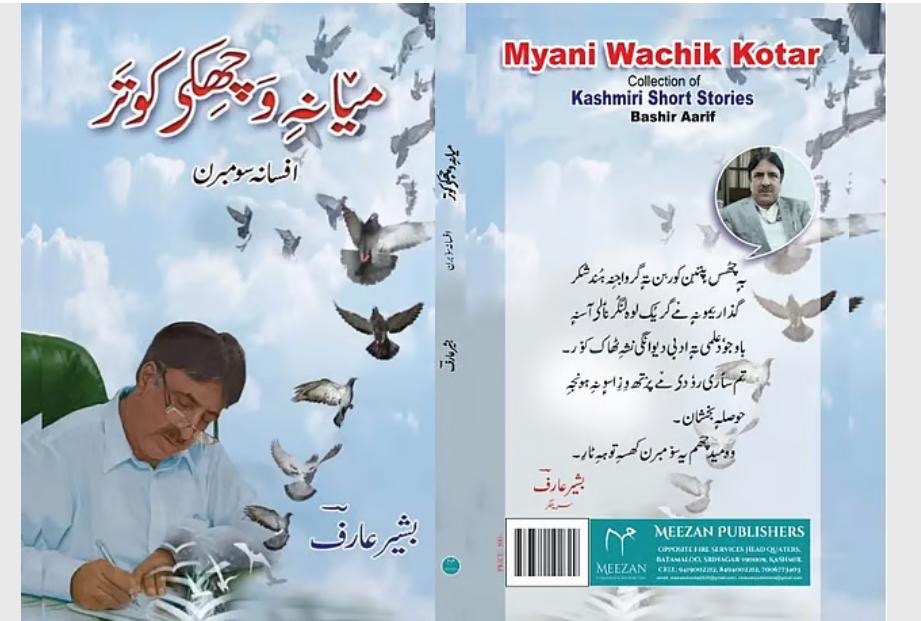
The title provides the key to understanding the collection. The pigeon is a bird of return, a creature that may cross distances yet retains an instinct for its place of belonging. In Aarif’s imaginative world, the pigeon becomes a metaphor for what the heart refuses to lose. The stories are the memories he has sheltered within himself: people encountered, relationships observed, wounds witnessed, values remembered and a social world that has altered beyond recognition in many respects. When these memories take the form of stories, they leave the privacy of the heart and enter the shared space of literature.
That movement—from the inward to the outward—is what gives Mayani Vachuk Kotur its distinctive character.
This 110-page collection brings together eleven short stories written in an accessible and natural Kashmiri idiom. Aarif does not burden his narratives with elaborate literary ornament. His strength lies elsewhere: in observation, restraint and an ability to discover significance in seemingly ordinary situations. A conversation, a family relationship, a social judgement or a small act of cruelty becomes, in his hands, a point from which a larger human reality begins to emerge.
The stories are rooted firmly in Kashmir, but they are not confined by it. Aarif’s characters inhabit recognisable streets and social settings, yet the emotions that shape their lives—loneliness, affection, jealousy, shame, compassion, prejudice, longing and loss—belong to no single geography. Kashmir provides the soil from which these stories grow; human nature gives them their wider reach.
This distinction is important because Mayani Vachuk Kotur is not a collection of picturesque memories of an older Valley. Its interest in the past is neither decorative nor sentimental. Aarif is concerned with what happens to human beings when the social environment around them changes. Old relationships are tested, inherited values encounter new attitudes, and the familiarity of one generation becomes the strangeness of another. His stories consequently become observations of a society in transition.
The author is particularly attentive to the small details through which a culture lives. Professions, names, neighbourhood relationships, habits and patterns of behaviour carry traces of a social order that is gradually fading. He does not document these things as a historian might. He allows them to remain embedded in the lives of his characters. This is where the collection acquires an archival quality without becoming documentary fiction. Aarif preserves not merely what people did, but something of how they once related to one another.
His characters are therefore more than vehicles for plots. They possess the awkwardness and ambiguity of real human beings. They can be loving and selfish, generous and judgemental, courageous and vulnerable. Aarif does not turn them into moral categories. He places them within circumstances and allows their contradictions to surface.
Tuel-Kul, for instance, is attentive to a truth that society often overlooks: the need for affection does not retire with age. The longing to be noticed, understood or loved remains part of the human condition. Through Tara Chand and the emotional world surrounding him, Aarif refuses to treat old age merely as a period of decline. There remains within the ageing human being the same hunger for warmth and companionship that exists at every stage of life. The story’s quiet power lies precisely in recognising a desire that others may find inconvenient or even embarrassing.
If Tuel-Kul explores emotional hunger, Brasht examines the violence of social judgement. Its elderly Pandit character becomes the subject of assumptions that reveal how easily a community can mistake appearances for truth. The story’s deeper concern is not confined to the individual caught within its circumstances. It asks a more uncomfortable question: how often do human beings condemn what they have never taken the trouble to understand?
That question gives Aarif’s fiction an ethical force. He is interested in the distance between what people profess and how they actually behave. Schooch makes this contradiction particularly visible. The fate of a puppy considered impure becomes the means through which the author exposes an unsettling moral inconsistency. The story asks, without preaching, what meaning outward notions of purity can have when compassion towards a helpless creature is absent.
Here the collection begins to acquire a quiet spiritual undertone. Not a spirituality of sermons or theological declarations, but one rooted in conscience. Aarif’s moral universe seems to suggest that the measure of a human being is revealed in conduct—in the ability to recognise another’s suffering, resist hasty judgement and extend compassion beyond the boundaries of convenience or identity. The spiritual dimension of the stories is therefore inseparable from their humanity.
This inward quality makes the word heart in the title especially significant. The heart becomes a repository—not simply of affection, but of conscience, memory and unresolved experience. What the external world discards, the inner world may continue to preserve. The kotur sheltered there can consequently stand for anything that remains alive within us after its physical presence has disappeared.
Few experiences make this more poignant than displacement.
In Yeth Makanas Manz and Brasht, the exodus of Kashmiri Pandits enters the collection not as an abstract historical proposition but as an experience of separation and loss. The abandoned home, the absent neighbour and the transformation of belonging into distance carry a weight that requires no rhetoric. Aarif understands that displacement is not completed when a person crosses a geographical boundary. A part of the displaced person’s inner life continues to inhabit the place left behind.
This is where the title acquires another resonance. The pigeon knows its home, but human beings separated from their homes may not always have the freedom to return to them. What remains possible is the return of memory. The heart becomes a place of habitation when geography can no longer provide one. The lost house survives as recollection; the absent neighbour survives as a remembered presence; the old landscape survives within language and story.
Aarif’s treatment of this painful history is significant because he allows the human rather than the polemical to occupy the foreground. The stories do not need to argue in order to communicate loss. They show what historical rupture does to ordinary lives. The result is more intimate than an argument and, precisely for that reason, often more affecting.
The memory of an older inter-community relationship also runs through Atur. The story involving Farooq, Anjali and her father Mohan Ji brings affection, family honour, communal identity and tragedy into the same emotional space. Mohan Ji’s attempt to protect Farooq by claiming that the two are siblings reveals the complicated moral pressures within which individuals sometimes find themselves. The tragedy that follows does not simplify the past into an idealised picture. Instead, it reminds us of a time when relationships between people could carry a depth that exceeded the boundaries of formal identity.
Aarif’s recollection of that social intimacy is therefore less an exercise in nostalgia than a question directed at the present: what happens when the invisible threads connecting human beings become weaker than the identities separating them?
That question gives the collection contemporary relevance.
The Valley that appears in these stories is changing, and the author is alert to the costs as well as the inevitability of change. He does not suggest that everything belonging to the past was perfect. Nor does he portray everything new as corrupt. Rather, he observes the tensions produced when one social order gives way to another. In doing so, he avoids the easy comfort of nostalgia while retaining the emotional truth of remembrance.
This is also why the brevity of the stories works in their favour. Aarif does not attempt to inflate small incidents into grand literary statements. He allows them to remain compact. Their significance accumulates through implication. The reader may finish a story quickly, but its moral or emotional question can remain considerably longer.
The language contributes to this effect. Its accessibility brings the reader close to the characters, while its restraint leaves room for interpretation. Aarif does not constantly explain what a character should mean or how an incident should be judged. His narratives often depend upon the reader’s willingness to pause, reconsider and look beneath the surface.
That quality is particularly valuable in short fiction. A successful short story does not merely compress a novel into fewer pages; it creates an afterlife beyond the final sentence. Several of Aarif’s stories possess that quality. Their incidents end, but their questions remain.
Taken together, the eleven stories—Tuel-Kul, Brasht, Shooch, Atur, Gopa, Aav Ha Aav Ha, Kanz, Sakh Dod Chum, Yeth Makanas Manz, Manz Saraai and Mayani Vachuk Kotur—form a mosaic rather than a single continuous narrative. Each piece illuminates a different corner of social life, but the fragments gradually assemble into a larger picture of human relationships under pressure from time, memory and change.
The title story ultimately gathers these concerns into one symbolic image. The pigeons sheltered in the heart can be understood as all that Aarif has seen and refused to let vanish completely. They are people, memories, emotions, places and moral questions. They have remained alive within him long enough to become literature.
And literature, in this collection, becomes a form of return.
The pigeon leaves the heart when the story is written, travels into another person’s consciousness and perhaps finds another place to rest. The author’s private memory becomes a reader’s shared memory. What belonged to one life becomes part of a larger cultural remembrance.
That may be the most enduring contribution of Mayani Vachuk Kotur. Aarif does not simply tell us that Kashmir has changed; he shows us how change enters human lives. He does not merely remember people who have disappeared from familiar surroundings; he restores their presence, however briefly, through narrative. He does not preach about compassion; he places human contradictions before us and allows conscience to do the rest.
In the end, the pigeon of the heart becomes more than a title. It becomes the governing metaphor of the book—a symbol of memory that travels, of belonging that survives distance, and of experiences that refuse to be completely erased by time. The stories fly out from Aarif’s inner world carrying fragments of a lived Kashmir, but they do not lose their way. They return, ultimately, to the place from which all meaningful literature begins: the human heart.
And perhaps that is why Mayani Vachuk Kotur lingers after its final page. It does not ask us merely to remember the past. It asks us to consider what, within ourselves, we have chosen not to forget.
(The Author is Poet, Columnist, and critical Analyst)