


SUNDAY BYTES: The Untold Story OF Chair and Ego
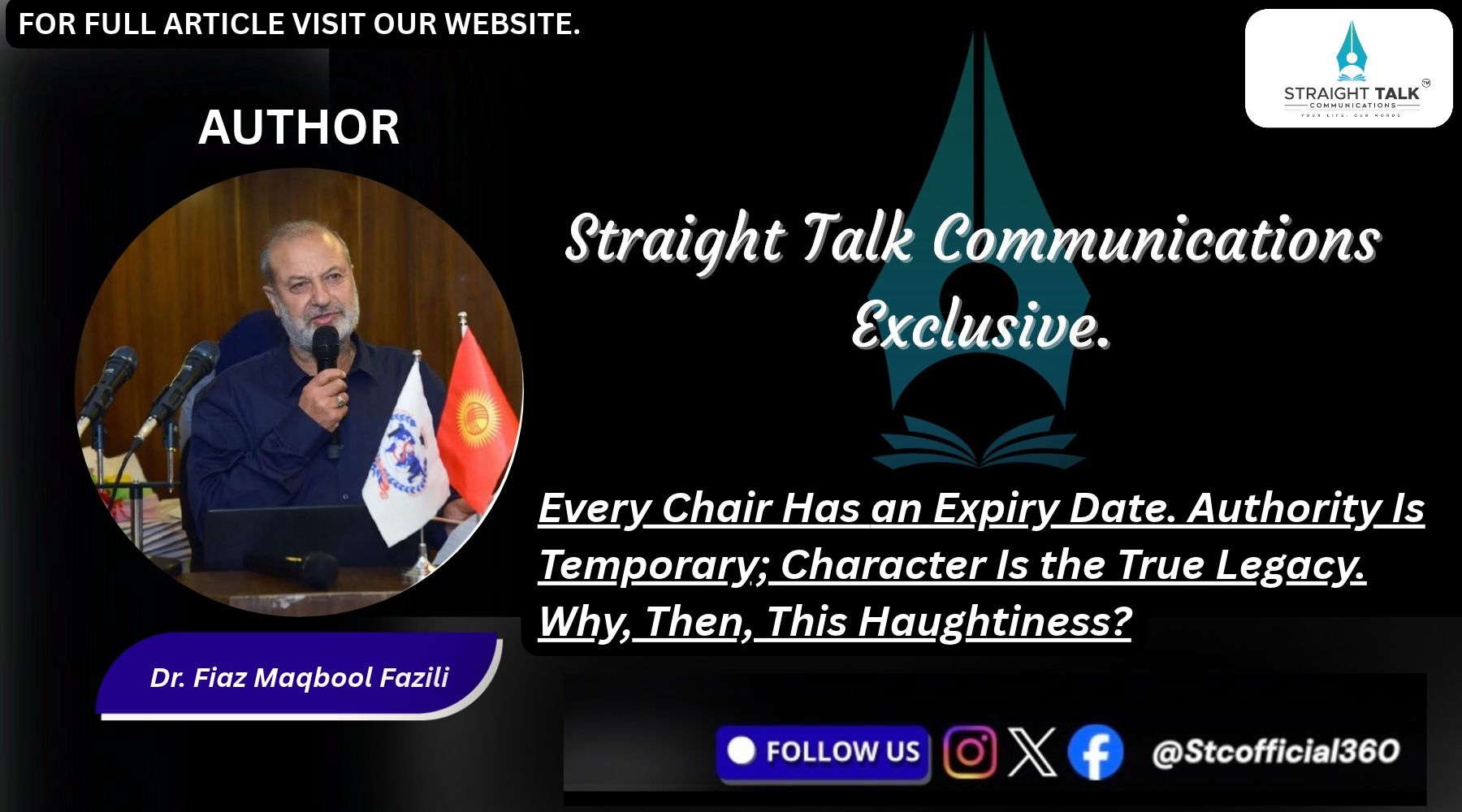
Every Chair Has an Expiry Date. Authority Is Temporary; Character Is the True Legacy. Why, Then, This Haughtiness?
Dr. Fiaz Maqbool Fazili
After more than five decades in medicine, one question continues to trouble me.
Why do some doctors, upon reaching positions of authority and prominence, gradually lose the very qualities that once made them admirable? Why does humility sometimes give way to arrogance, civility to impatience, and empathy to indifference? Why does the chair seem to change the person who occupies it?
Medicine is often described as a noble profession, but its nobility does not arise from knowledge alone. Technical competence may earn a degree, a promotion, or a title, but the essence of medicine lies in qualities that cannot be measured by certificates or designations: humility, compassion, patience, respect, and the ability to listen.
Yet, throughout my career, I have witnessed an uncomfortable reality. Some individuals become larger than their offices, while others allow their offices to become larger than themselves.
A leadership position should broaden perspective and deepen responsibility. Instead, it sometimes narrows vision. A doctor who once worked comfortably among colleagues begins to expect deference. Constructive disagreement is viewed as disloyalty. Suggestions are treated as challenges. Gradually, respect is confused with obedience, authority with superiority, and silence with approval.
Perhaps power does not always change people. Perhaps it merely reveals what success had previously concealed.
The paradox of leadership is that the higher a person rises, the more humility he requires. Responsibility should cultivate patience, not pride. Seniority should produce wisdom, not self-importance. Experience should make us more approachable, not more distant.
The finest leaders I have encountered never needed to remind others of their status. Their confidence came from competence, not from titles. They corrected without humiliating, disagreed without insulting, and guided without intimidating. Their presence inspired trust rather than fear.
One of the most important lessons I have learned is that leadership is not measured by how many people stand when you enter the room. It is measured by how freely people can speak when you are in it.
Young care providers (doctors, nurses, technicians, and students trainee )often observe their seniors far more carefully than seniors realise. They may forget lectures and presentations, but they rarely forget how they were treated. A harsh remark can remain in memory for years. Equally, a kind word of encouragement can influence an entire career.This is why character matters so profoundly in positions of authority.
In Moral culture and more so in Islamic tradition, authority is regarded as an amānah – a sacred trust. It is never a personal possession. Leadership is not an entitlement; it is a responsibility for which one will be held accountable. The Moral science and even our holy book Qur’an repeatedly links authority with justice, responsibility, and humility, while warning against arrogance and contempt for others. These teachings are not confined to speeches, sermons, memorial lectures podcasts, mosques and religious gatherings. They belong equally in hospitals, universities, boardrooms, and public institutions. Their real measure lies in how faithfully we apply them in our hospitals, institutions, and positions of responsibility.
A person may possess extraordinary qualifications yet fail the moral test of leadership if he uses authority to elevate himself rather than serve others. One reality should keep every leader grounded, sadly often ignored or forgotten, every chair has an expiry date. No title is permanent. No office belongs to us forever. Today’s department head, director, dean, chairman, or chief executive will eventually become yesterday’s office-bearer. Another individual will inherit the same room, the same desk, and the same authority.
What remains is not the title but the legacy beyond the tenure: how your leadership, decisions and contributions and time in Office.
People rarely remember farewell of their predecessors, the exact wording of administrative orders or institutional policies. They remember dignity, fairness, kindness, and respect. They remember who listened, who encouraged, and who cared. Long after professional achievements fade into history, personal conduct survives in the memories of others.I have been fortunate to encounter examples of leadership that strengthened this conviction.
Among them is my dear brother, Dr. Abdullah Allam, FRCS (Edinburgh), a distinguished thoracic surgeon at KFH Medina Munawarah KSA, Hafiz-e-Qur’an, and teacher at Masjid an-Nabawi in Madinah. Since my arrival at King Fahd Hospital in 1992, we shared the challenge of establishing thoracic surgery services and introducing video-assisted thoracic surgery. Our professional journey was rewarding, but what endured beyond professional accomplishments was something far more valuable: friendship, humility, scholarship, faith, and mutual respect. Over the years, positions changed and responsibilities evolved, but those human qualities remained constant. His example reinforced a lesson often forgotten in modern professional culture: a person’s worth is determined not by the chair he occupies but by the character he retains while occupying it.
As I reflect on a lifetime in medicine, I believe every professional should pause from time to time and ask a few uncomfortable questions. Has success made me more grateful or more entitled? Has authority strengthened my commitment to service or weakened my empathy? Do people remember my designation, or do they remember how I treated them? These questions matter because professional success alone is not enough. A brilliant surgeon may save thousands of lives. A capable administrator may transform an institution. Both achievements deserve recognition. Yet neither excuses arrogance, discourtesy, or the mistreatment of others.
Excellence and humility are not opposites. The greatest professionals combine both.
Ultimately, every one of us will surrender the chair. The office will belong to another. The title will pass. The authority will end.What will remain is a far more enduring record: the impact we had on human lives.
Let the chair increase our sense of duty, not our sense of self-importance. Let authority deepen our compassion rather than diminish it. Let leadership make us more humane, not more distant.For in the final reckoning, people will remember less the position we held and more the humanity we preserved while holding it.
(STRAIGHT TALK COMMUNICATIONS EXCLUSIVE)