
FRIDAY SERMON: Foresight And Prediction
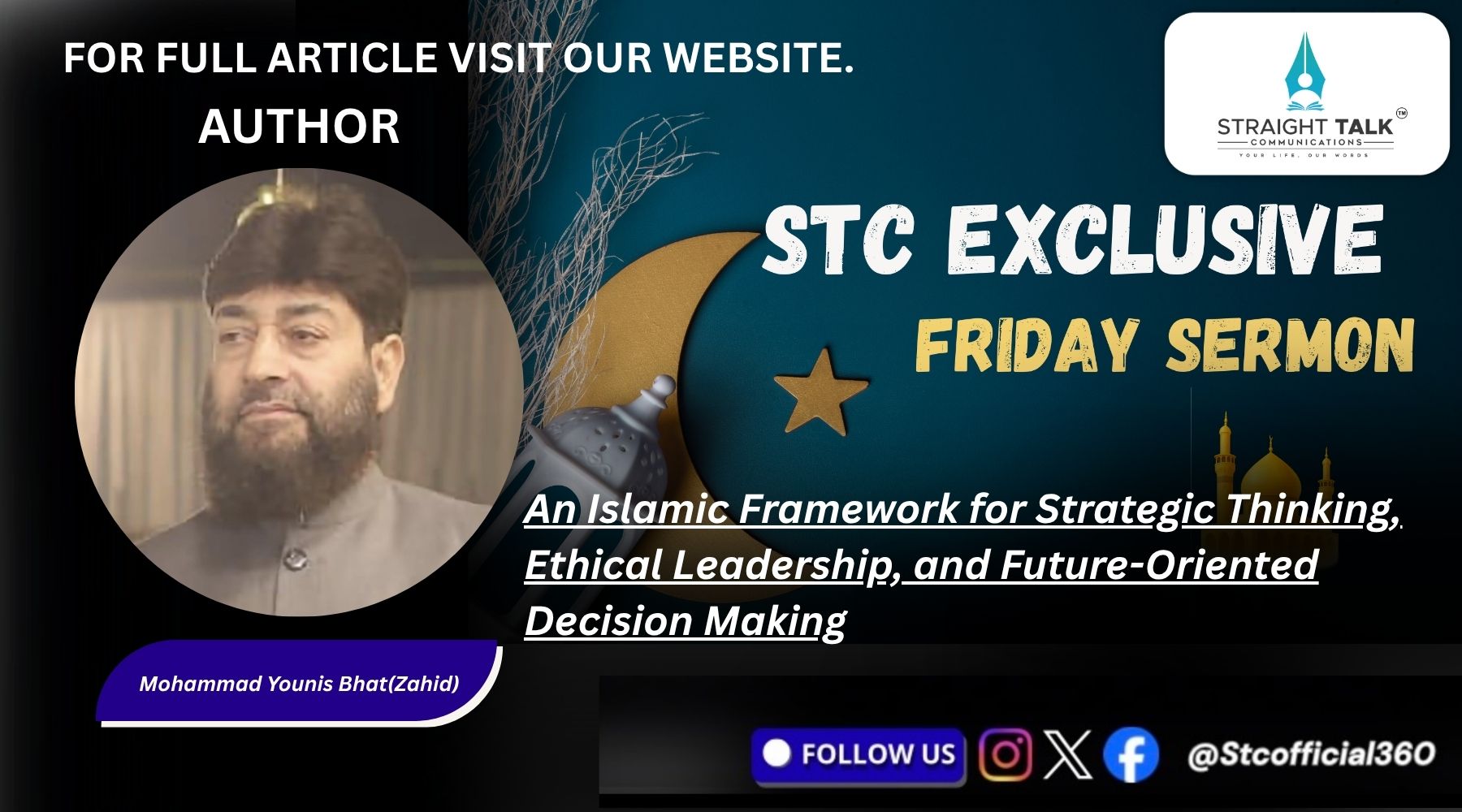
An Islamic Framework for Strategic Thinking, Ethical Leadership, and Future-Oriented Decision Making
Mohammad Younis Bhat (Zahid)
A Comparative Study in the Light of the Qur’an, Sunnah, Reason, and Practical Life
“True foresight is not the ability to know the future; it is the wisdom to prepare for the future in accordance with the guidance and pleasure of Allah.”
In today’s world, terms such as Forecasting, Prediction, Projection, Strategic Planning, Risk Assessment, Scenario Analysis, and Future Studies are widely used in business, economics, healthcare, education, governance, military strategy, and public policy.
Although these concepts are valuable, many people mistakenly assume that foresight and prediction are the same. From an Islamic perspective, they are fundamentally different.
Understanding this distinction is essential because it protects a believer from two extremes:
Claiming knowledge of the unseen, which belongs to Allah alone.
Neglecting planning and preparation under the false assumption that trust in Allah eliminates the need for responsible action.
Islam teaches a balanced approach that combines wisdom, preparation, and reliance upon Allah.
WHAT IS FORESIGHT?
Foresight is the ability to make responsible decisions today by carefully considering their possible consequences tomorrow.
It is founded upon:
■Knowledge
■Wisdom
■Experience
■Observation
■Consultation
■Ethical responsibility
■Taqwa (God-consciousness)
■Trust in Allah
A person with foresight does not claim certainty about the future.
Instead, such a person says:
“I have used the knowledge, intellect, and lawful means that Allah has granted me to prepare as responsibly as possible, while leaving the final outcome to Him.”
This is the Islamic understanding of foresight.
WHAT IS PREDICTION?
Prediction is an estimate or forecast concerning a future event.
Predictions may be based upon:
●Scientific research
●Statistical analysis
●Economic indicators
●Weather observations
●Medical evidence
●Historical trends
When supported by reliable evidence, predictions can be useful tools for planning.
However, they remain probabilistic rather than certain.
A prediction may prove correct or it may not.
Islam therefore distinguishes between informed estimation and certainty about the unseen.
The Qur’anic Principle
Allah Almighty says:
“Say, ‘None in the heavens and the earth knows the unseen except Allah.'”
(Qur’an 27:65)
This verse establishes a foundational principle of Islamic belief.
Only Allah possesses complete and perfect knowledge of the unseen.
Human beings may analyze evidence, identify trends, and prepare wisely, but they must never claim independent knowledge of the future.
THE ISLAMIC BALANCE
Islam neither encourages passivity nor reckless optimism.
Instead, it teaches believers to:
▪︎Think carefully.
▪︎Seek knowledge.
▪︎Consult trustworthy people.
▪︎Make sound plans.
▪︎Prepare responsibly.
▪︎Utilize lawful means.
▪︎Place complete trust in Allah.
This balanced approach defines Islamic foresight.
Foresight versus Prediction
Although the two concepts are related, they differ significantly.
Foresight Prediction
•Focuses on preparation •Focuses on estimating outcomes
•Encourages responsible action
•Estimates future possibilities
•Guided by ethics and values Guided primarily by available evidence
Leads to strategic planning Produces forecasts or projections
Strengthened through consultation Strengthened through data analysis
Ends with trust in Allah May prove accurate or inaccurate
In simple terms:
Prediction asks:
“What is likely to happen?”
Foresight asks:
“How should I prepare if it happens?”
This distinction transforms planning into a moral responsibility rather than merely an intellectual exercise.
Prophet Yusuf (Joseph) عليه السلام
A Timeless Model of Strategic Foresight
One of the greatest examples of foresight in the Qur’an is found in the story of Prophet Yusuf (Joseph) عليه السلام.
After interpreting the king’s dream by Allah’s permission, Prophet Yusuf did not stop at explaining the dream.
He proposed a comprehensive national strategy:
Maximize agricultural production during seven years of abundance.
Store surplus grain carefully.
Avoid unnecessary consumption.
Prepare systematically for seven years of famine.
Manage public resources responsibly.
This was not merely dream interpretation.
It was an outstanding example of long-term strategic planning rooted in divine guidance, wisdom, and responsible governance.
The lesson is clear:
Faith does not replace planning.
Rather, faith guides planning.
The Prophet Muhammad ﷺ
The Perfect Example of Foresight
The life of Prophet Muhammad ﷺ offers countless examples of practical foresight.
The Migration (Hijrah)
During the migration from Makkah to Madinah, the Prophet ﷺ:
♡Selected trustworthy companions.
♡Chose an unexpected route.
♡Stayed temporarily in the Cave of Thawr.
♡Appointed a skilled guide.
♡Arranged food and logistical support.
♡Protected sensitive information.
These actions demonstrate careful planning and responsible preparation.
Yet throughout the journey, his heart remained completely dependent upon Allah.
This illustrates the perfect harmony between planning and trust in Allah.
THE TREATY OF HUDAYBIYYAH
When the Treaty of Hudaybiyyah was signed, many Companions initially found its terms difficult to accept.
However, the Prophet ﷺ recognized its long-term benefits.
History later proved that this agreement became one of the greatest strategic victories in Islamic history.
“A wise decision is not always immediately popular.”
Sometimes true foresight becomes visible only with time.
Foresight in Contemporary Society
Today, governments, universities, businesses, hospitals, and international organizations all engage in long-term planning.
They conduct:
Strategic planning
Risk management
Scenario analysis
Forecasting
Policy development
Islam encourages all such efforts, provided they remain within the limits of justice, honesty, and obedience to Allah.
A financially profitable plan that violates Islamic ethics cannot be regarded as successful from an Islamic perspective.
“Material success without moral integrity is incomplete success.”
Questions Every Farsighted Muslim Should Ask
Before making an important decision, every believer should reflect:
Will this decision please Allah?
Does it comply with the Qur’an and Sunnah?
Could it harm another person?
Have I sought sincere consultation?
Have I considered both worldly and eternal consequences?
Have I prayed for Allah’s guidance?
These questions distinguish Islamic foresight from ordinary planning.
Common Misconceptions
Misconception One
Foresight means knowing the future.
Reality:
Foresight means preparing responsibly for possible futures.
Misconception Two
Trust in Allah means planning is unnecessary.
Reality:
Islam teaches planning first, then trust in Allah.
Misconception Three
Only highly intelligent people possess foresight.
Reality:
Foresight requires character, wisdom, humility, consultation, and God-consciousnes—not merely intelligence.
Precisely: Islamic foresight is:
◇Faith in action.
◇Responsible thinking.
◇Wise planning.
◇Ethical leadership.
◇Careful preparation.
Strategic decision-making.
Trust in Allah after employing lawful means.
Prediction, by contrast, is an informed estimate that may or may not prove correct.
The believer does not seek certainty about the unseen.
Rather, the believer seeks excellence in preparation while remaining humble before Allah, Who alone possesses perfect knowledge of the future.
Key Lessons
This chapter teaches five essential principles:
- Only Allah knows the unseen.
- Careful planning is encouraged in Islam.
- Taking lawful means is part of faith.
- Trust in Allah never justifies negligence.
- True foresight prepares for success in both this life and the Hereafter.
Closing Prayer
“O Allah, grant us beneficial knowledge, sound judgment, sincere intentions, righteous character, and the wisdom to make decisions that earn Your pleasure. Guide our planning, bless our efforts, strengthen our trust in You, and grant us success in this world and in the Hereafter. Ameen.”
Practical case studies demonstrating how Islamic foresight can guide modern leadership, governance, business ethics, education, and family life.
And Allah knows best
(TO BE CONTINUED)
(STRAIGHT TALK COMMUNICATIONS EXCLUSIVE. The author can be reached at makahmadina11@gmail.com)