


FRIDAY FOCUS: Fiqh Is Not Everyone’s Cup of Tea
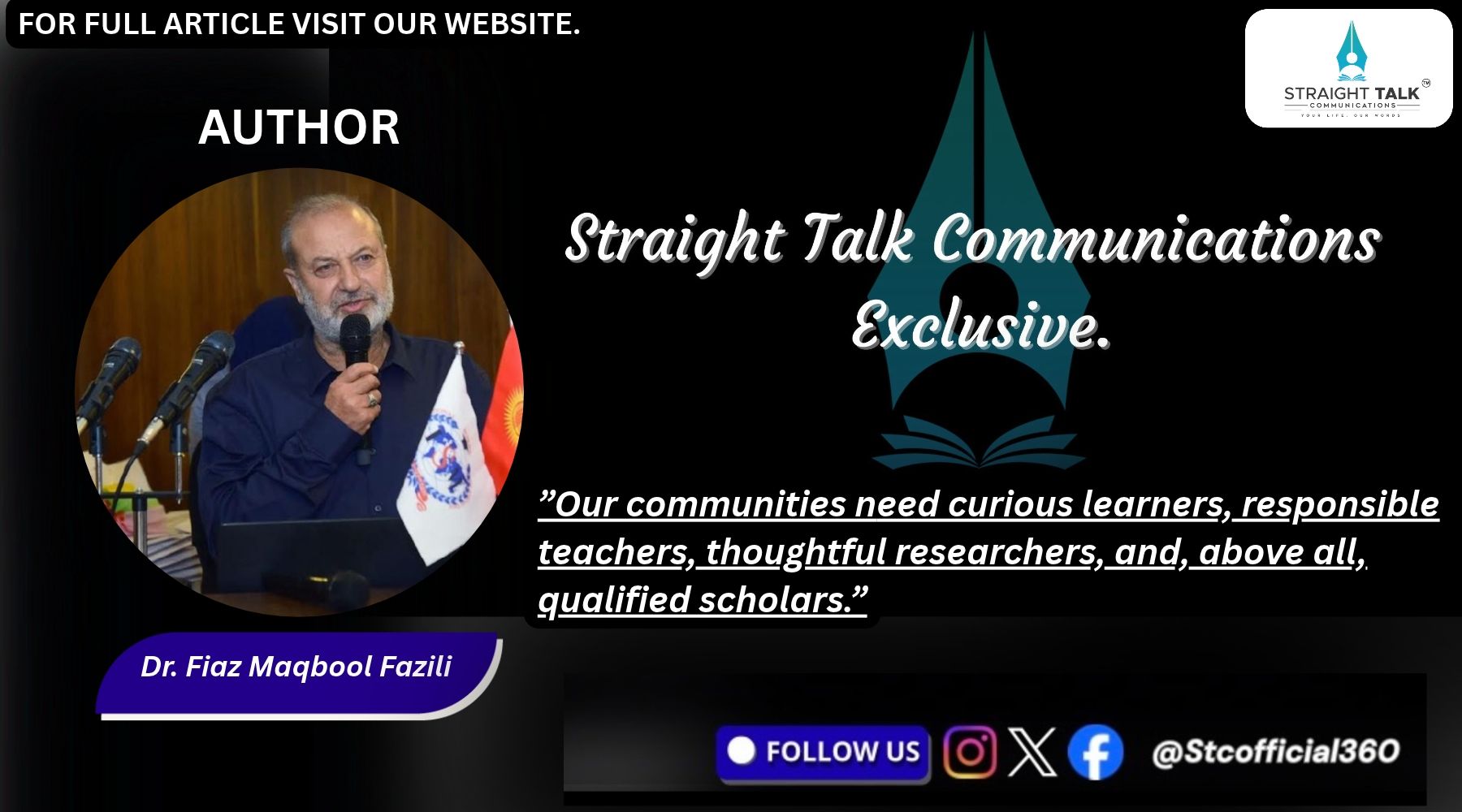
”Our communities need curious learners, responsible teachers, thoughtful researchers, and, above all, qualified scholars.”
Dr. Fiaz Maqbool Fazili (Islamic Researcher
One of the subjects I studied during my Postgraduate Diploma in Islamic Sciences was Fiqh, particularly contemporary controversies in Islamic practice. Today, that subject feels more relevant than ever. In an age of Google searches, social media platforms, and artificial intelligence, religious information is available to almost everyone. Yet access to information does not automatically confer the authority to interpret it.
Perhaps nowhere is this more visible than on social media. Religious debates unfold daily, often involving people with little or no formal grounding in Islamic sciences. A verse is cited without context, a Hadith is quoted without examining its authenticity or application, and personal opinions are presented as unquestionable religious truths.
The problem is not discussion itself. Islam encourages reflection, learning, and the pursuit of knowledge. Every Muslim has the right and responsibility to understand his or her faith. The problem begins when the boundary between learning religion and issuing religious judgments disappears. Everyone may discuss Islam. Not everyone is qualified to interpret every text, derive legal rulings, or issue fatwas. That distinction is both intellectually honest and firmly rooted in the Islamic scholarly tradition.
What Exactly Is Fiqh? Many people either ignore or misinterpret the essence while arguing or commenting. Fiqh is not simply a collection of religious opinions. It is the disciplined understanding and derivation of practical Islamic rulings from the Qur’an and Sunnah through recognised principles and methodologies. The field demands knowledge of Qur’anic sciences, Hadith sciences, Arabic language, legal theory, principles of interpretation, and centuries of accumulated scholarship. It requires understanding not only texts but also context, circumstances, objectives, and precedent.
The great scholars (ulemmas) of Islam devoted their lives to mastering these disciplines. Their conclusions did not emerge from isolated readings, emotional reactions, or personal preferences. They were the result of rigorous intellectual effort.
The recognised schools of Islamic jurisprudence demonstrate that legitimate differences of opinion have always existed within scholarship. Yet there is a profound difference between disagreement grounded in expertise and disagreement based on superficial reading. Not every disagreement reflects ignorance, but not every opinion deserves scholarly authority.
FAQ during debates is, Who Is Qualified to Interpret? Whenever religious controversies arise, one question inevitably follows: who has the authority to interpret religious matters? Islam does not discourage independent thinking. It encourages inquiry and reflection. However, understanding a clear religious teaching is different from interpreting a complex Qur’anic passage, reconciling apparently conflicting Hadith reports, or issuing a legal verdict affecting the lives of others.Responsible scholarship demands specialised training. It requires mastery of language, context, methodology, legal principles, and scholarly precedent. These are not skills acquired through a few online lectures, social-media posts, or AI-generated summaries.The Qur’an provides a simple principle: “Ask the people of knowledge if you do not know.” (16:43)
The verse is not merely guidance for the uninformed. It is a reminder that recognising the limits of our knowledge is itself a form of knowledge.
The Problem With “I Think and My view on Deen and Fiqah. One trend that has become increasingly common in religious discussions is the use of phrases such as “I think,” “in my opinion,” or “my view is.” In ordinary conversation, there is nothing wrong with expressing a personal opinion. Matters of faith, however, carry a greater responsibility.
There is an important difference between saying, “This is my understanding, though I may be mistaken,” and declaring, “Islam unquestionably says this,” without the necessary qualifications. Attaching the words “in my opinion” to an uninformed interpretation does not make it reliable.The Qur’an repeatedly warns against speaking about Allah without knowledge and cautions believers against pursuing claims for which they possess no evidence.
Religious statements are not casual remarks. They influence how people worship, think, and act. A careless comment online may be repeated hundreds of times and accepted as authentic guidance simply because it sounds convincing. Before speaking in the name of religion, a believer should ask not merely whether something can be said, but whether it should be said. The unregulated access to social media, AI and the emerging digital religious marketplace has made religious commentary accessible to everyone, but not necessarily responsible. The resulting risks of misinterpretation, misrepresentation and misguidance are deeply concerning.Digital platforms have transformed the way religious information is consumed and shared. They have opened valuable opportunities for learning, research, and engagement. Yet they have also made religious misinformation easier to spread.
A verse may be quoted while ignoring the surrounding passage. A ruling from one school may be presented as the only Islamic position. A Hadith may circulate without context. An AI-generated answer may sound authoritative while containing serious errors.
The central lesson is simple: information is not authority. The ability to publish does not confer the authority to interpret. Searching is not scholarship. Artificial intelligence is a tool, not a mufti. Every religious claim should therefore be approached with caution. Its source should be verified, its context understood, and its interpretation examined in light of recognised scholarship. Confidence is not evidence. Popularity is not proof.
Islamic discussion should be a search for truth rather than a contest of egos must follow the etiquette and or ethics of religious debate. Too often debates become exercises in scoring points, displaying knowledge, or winning arguments. A healthier approach requires humility. It requires recognising the difference between established teachings, scholarly interpretations, and personal reflections. It requires accepting that sincere scholars may disagree while remaining within the bounds of legitimate scholarship.This is particularly important in complex matters involving marriage, divorce, inheritance, finance, medical ethics, and contemporary social issues. Such questions often involve multiple texts, legal principles, and scholarly precedents. Casual verdicts can create confusion and cause harm. The Qur’an instructs believers to invite others with wisdom and to debate in the best manner. Wisdom includes knowing when to speak and when to remain silent.
The Courage to Say “I Do Not Know” is both virtuous and safe not to incur sins. Perhaps the most neglected virtue in contemporary discourse is the willingness to admit ignorance.Throughout Islamic history, great scholars never considered the phrase “I do not know” a source of embarrassment. They understood that knowledge carries responsibility and that speculation is no substitute for certainty.A university degree in another discipline, social-media popularity, personal enthusiasm, or access to online information does not automatically qualify a person to issue religious judgments.
Our communities need curious learners, responsible teachers, thoughtful researchers, and, above all, qualified scholars. We also need people who understand the limits of their own expertise.
Before offering a religious opinion, we should ask ourselves: Have I verified the source? Do I understand the context? Am I presenting a personal reflection as an established ruling? Am I qualified to make this judgment?
Everyone should be encouraged to seek knowledge and participate in respectful discussions. But authoritative interpretation, deriving rulings, and issuing fatwas must remain within the competence of those trained for that responsibility.
Let us learn before lecturing, verify before sharing, understand before arguing, and remain humble before knowledge.Sometimes the most responsible religious answer is not, “I think,” but simply:“I do not know. Let me ask someone who does.”
May Allah grant us beneficial knowledge, sound understanding, wisdom, and the humility to recognise the limits of our knowledge. Ameen.
(STRAIGHT TALK COMMUNICATIONS EXCLUSIVE)