



DIWALI: Beyond Celebration, a Message of Light, Humanity and Harmony
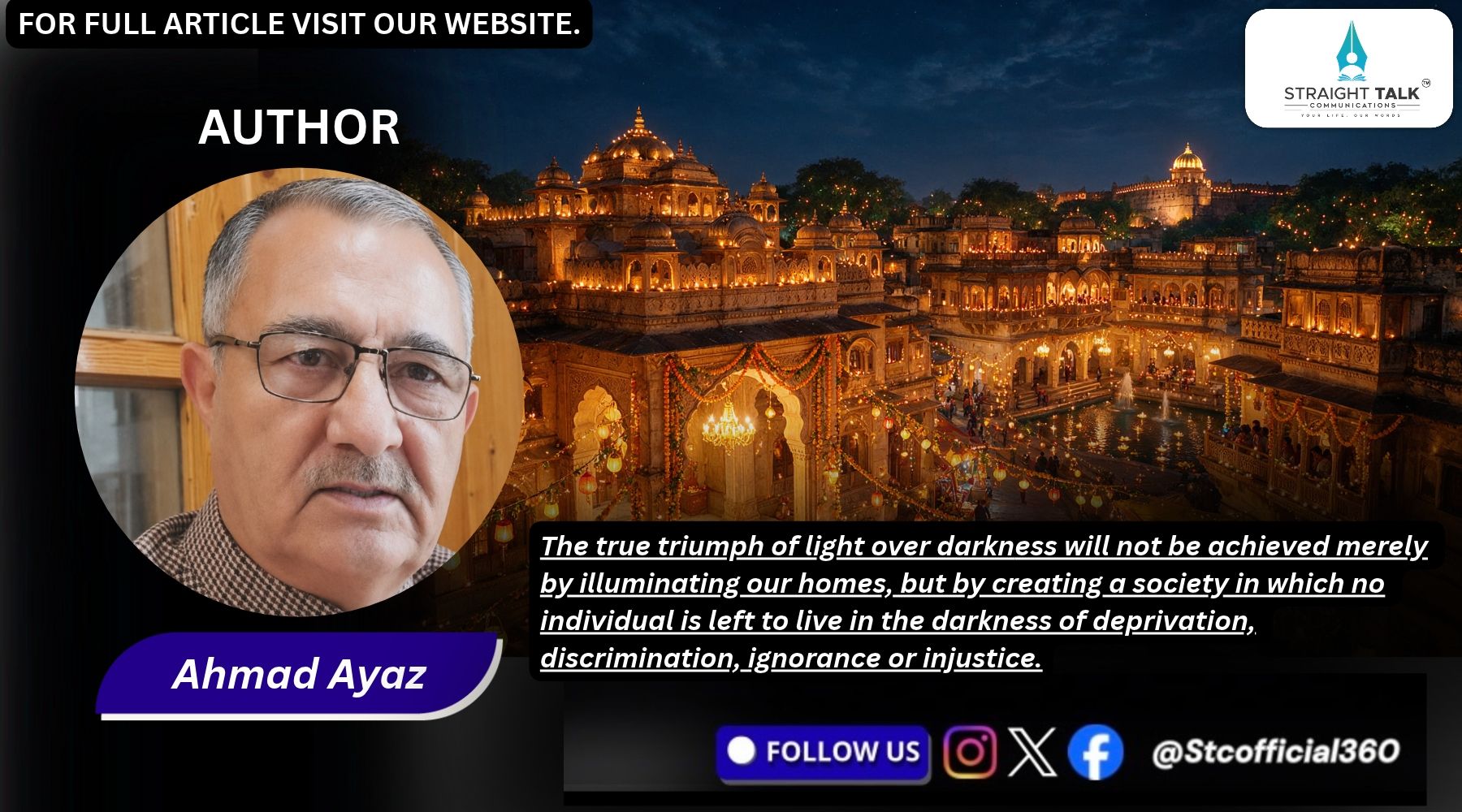
The true triumph of light over darkness will not be achieved merely by illuminating our homes, but by creating a society in which no individual is left to live in the darkness of deprivation, discrimination, ignorance or injustice.
Ahmad Ayaz
Diwali, popularly known as the Festival of Lights, occupies a special place in India’s cultural and spiritual heritage. Celebrated with traditional lamps, illuminated homes, sweets, family gatherings and expressions of goodwill, it is one of the most widely observed festivals in the country. Yet, the significance of Diwali extends far beyond its outward celebrations. At its heart lies a timeless message: the triumph of light over darkness, knowledge over ignorance, truth over falsehood and goodness over evil.
Diwali is traditionally celebrated over five days during the Hindu lunar month of Kartik, with the principal festival falling on Amavasya, the new moon day, generally in October or November. Its religious and cultural significance is reflected in different traditions, making it an important part of India’s diverse civilisational heritage.
In a country as diverse as India, festivals are not merely occasions of religious observance. They also provide opportunities to strengthen social relationships, promote mutual understanding and reaffirm the values that hold society together. The message of Diwali, when understood in its wider humanitarian sense, belongs not to one community alone but to humanity as a whole.
The Historical and Spiritual Significance
Diwali has several religious and cultural associations. In Hindu tradition, it is particularly associated with the return of Lord Rama to Ayodhya after fourteen years of exile and his victory over Ravana. According to the Ramayana, the people of Ayodhya welcomed Rama, Sita and Lakshmana by lighting earthen lamps throughout the city. This tradition came to symbolise the restoration of righteousness and the victory of good over evil.
For many Hindus, Diwali is also associated with Goddess Lakshmi, who represents prosperity, wealth and well-being. The occasion is marked by prayers, gratitude and hopes for happiness and abundance.
The festival has special significance for other religious communities as well. For Jains, Diwali commemorates the attainment of nirvana by Lord Mahavira, the twenty-fourth Tirthankara. For Sikhs, the occasion coincides with Bandi Chhor Divas, commemorating the release of Guru Hargobind Sahib from imprisonment at Gwalior Fort, along with other prisoners.
These different associations reflect the richness of India’s religious and cultural traditions. Although the historical narratives and forms of observance differ, the broader values of freedom, righteousness, enlightenment and the triumph of good over evil resonate across communities.
The Real Meaning of Light
In modern times, Diwali has increasingly become associated with shopping, elaborate decorations, gifts and commercial celebrations. These activities contribute to the festive atmosphere and generate economic opportunities for traders, artisans and small businesses. There is nothing wrong with celebrating prosperity and sharing happiness. However, the material aspects of the festival should not overshadow its deeper spiritual and moral significance.
A lamp is a small source of light, yet it has the power to dispel darkness around it. Similarly, an individual act of honesty, compassion or kindness can make a meaningful difference in another person’s life.
The darkness that society confronts is not always physical. It may exist in the form of ignorance, corruption, prejudice, discrimination, intolerance, injustice and indifference towards human suffering. A city may be illuminated with thousands of lamps, yet remain socially dark if its people are deprived of dignity, justice, education and equal opportunities.
The true significance of Diwali, therefore, lies in the willingness of individuals and institutions to remove these forms of darkness from society. Lighting a lamp should also inspire us to examine our own conduct, overcome personal prejudices and become more sensitive towards the difficulties faced by others.
A Celebration of India’s Pluralism and Social Harmony
Perhaps one of the most important messages of Diwali in contemporary India is the need to preserve social harmony and respect religious diversity.
India’s civilisational strength has always been reflected in its ability to accommodate different faiths, languages, cultures and traditions. Its unity does not depend upon religious or cultural uniformity but upon the mutual respect and coexistence of its people.
The Constitution of India guarantees freedom of conscience and the right to profess, practise and propagate religion, subject to its constitutional limitations. These are not merely legal provisions; they represent the democratic and secular foundations upon which the nation is built.
However, constitutional values become meaningful only when they are reflected in everyday conduct. Respecting another person’s faith, acknowledging the sentiments of different communities and participating in one another’s happiness are essential expressions of a mature and inclusive society.
Festivals provide a natural opportunity for such interaction. Extending greetings, sharing sweets, visiting neighbours and exchanging goodwill may appear to be simple gestures, but they help build relationships that transcend religious boundaries.
The happiness of one community should never be viewed with indifference or suspicion by another. Equally, no festival should become an instrument for creating divisions or questioning the belonging of people who follow different faiths.
The spirit of Diwali should remind us that humanity is a bond stronger than religious differences and that mutual respect is essential for peaceful coexistence.
Remembering Those Who Cannot Celebrate
While millions of families celebrate Diwali with enthusiasm, there are many others for whom even basic necessities remain a daily struggle. Poverty, unemployment, illness, displacement and social disadvantage prevent countless people from experiencing the happiness associated with festivals.
There are elderly people living alone, children deprived of educational opportunities, daily-wage workers uncertain about their next day’s earnings and families struggling to meet healthcare and household expenses.
Their circumstances should remind us that the true spirit of a festival is reflected not merely in what we receive but also in what we are willing to share.
Helping a disadvantaged family, providing educational materials to a child, supporting a small artisan, sharing food with someone in need or spending time with an elderly person living alone may be more meaningful than expensive gifts and extravagant celebrations.
Compassion should not be restricted to a particular day or occasion. It must become a continuing part of our social behaviour.
There is also a wider responsibility on governments and public institutions. Access to quality education, affordable healthcare, employment, social security and timely justice should not be treated as occasional welfare concerns. They are fundamental requirements of a society committed to human dignity and inclusive development.
The real illumination of society begins when its most disadvantaged members are not left behind.
Environmental Responsibility Must Accompany Celebration
Another important aspect of responsible Diwali celebrations is environmental protection. Excessive use of firecrackers, smoke, noise and the resulting waste have raised serious concerns about air quality, public health and ecological sustainability.
Children, elderly people, patients suffering from respiratory illnesses and animals are particularly vulnerable to excessive noise and pollution.
In cities already experiencing environmental stress from vehicular emissions, construction dust and industrial pollution, additional pollution during festivals can further aggravate public-health concerns.
The answer is not to discourage celebrations but to promote a more responsible approach. Traditional earthen lamps, energy-efficient lighting, environmentally conscious decorations and restraint in the use of firecrackers can help preserve the festive spirit without imposing unnecessary harm on others.
Environmental protection is a shared responsibility. Citizens must demonstrate awareness and restraint, while administrative authorities must ensure that applicable environmental regulations are implemented consistently and fairly.
A celebration becomes more meaningful when it brings happiness without causing suffering to others.
The Economic Importance of Diwali
Diwali is also an important occasion for economic activity. It generates business for retailers, manufacturers, transporters, artisans, small shopkeepers and numerous other sections of the economy.
The demand for traditional decorations, earthen lamps, textiles, sweets, household goods and gifts provides seasonal income to thousands of families.
Particular attention should be given to local artisans and small producers whose traditional skills form an important part of India’s cultural heritage. Purchasing locally manufactured products, including earthen lamps made by potters, can help sustain traditional occupations and support economically weaker sections.
The festival also offers an opportunity to promote ethical consumer behaviour. Honest transactions, fair prices, quality products and responsible commercial practices should remain important considerations.
Prosperity has greater meaning when it is generated honestly and its benefits reach beyond a privileged section of society.
The Message of Diwali in a Troubled World
The relevance of Diwali extends beyond national boundaries. The contemporary world is witnessing wars, political conflicts, displacement, economic uncertainty, religious intolerance and growing social divisions. Millions of people continue to live under conditions of fear, insecurity and deprivation.
In such circumstances, the symbolism of light carries a deeper meaning. It represents hope in difficult times, courage in the face of adversity and the belief that humanity can overcome hatred and conflict through wisdom, compassion and collective effort.
India, with its long experience of religious and cultural diversity, has an important responsibility to demonstrate that differences need not become sources of hostility.
National unity cannot be sustained merely through slogans or ceremonial expressions. It requires mutual trust, equal treatment, constitutional safeguards and respect for the dignity of every citizen.
The strength of a democracy is reflected in how it treats its minorities, protects the vulnerable, responds to dissent and ensures that justice is accessible to all.
Diwali should therefore inspire reflection not only among ordinary citizens but also among those entrusted with public responsibilities. For political leaders and public servants, the triumph of light should translate into transparency, accountability, integrity and service to the people. For citizens, it should mean rejecting hatred, standing against injustice and contributing constructively to society.
From Celebration to Commitment
The real worth of any festival should ultimately be measured by the values it inspires and the positive changes it encourages in society.
If the message of Diwali disappears once the lamps are extinguished and the decorations are removed, its deeper purpose remains incomplete. Its values must continue to guide our actions throughout the year.
A teacher who educates a disadvantaged child, a public servant who performs duties honestly, a citizen who raises a voice against injustice, a neighbour who helps someone in distress and a family that shares its resources with those in need are all contributing to the larger illumination of society.
These acts may not attract public attention, but they represent the highest expression of humanity.
The challenge before us is to move beyond symbolic celebrations and translate the message of light into everyday conduct. This requires greater sensitivity towards others, respect for differences, commitment to justice and a willingness to stand against wrongdoing irrespective of who is responsible.
Conclusion
Diwali is much more than a festival of lights. It is a celebration of hope, renewal, righteousness and the enduring human aspiration to overcome darkness. Its spiritual traditions may have different interpretations across communities, but its broader message of goodness, compassion, enlightenment and harmony has universal relevance.
At a time when societies are increasingly confronted with intolerance, inequality and uncertainty, Diwali offers an opportunity to reaffirm our faith in humanity and our commitment to peaceful coexistence.
The most meaningful celebration would be one in which prosperity is shared, the disadvantaged are supported, diversity is respected, the environment is protected and every individual is treated with dignity.
Let the lamps we light illuminate not only our homes but also our thoughts and actions. Let their brightness inspire us to replace hatred with understanding, indifference with compassion and injustice with fairness.
The true triumph of light over darkness will not be achieved merely by illuminating our homes, but by creating a society in which no individual is left to live in the darkness of deprivation, discrimination, ignorance or injustice.
(STRAIGHT TALK COMMUNICATIONS EXCLUSIVE. The author is a Columnist and National tv Debater. He can becreached at ahnadayaz08@gmailcom)