

BY THE WAY: BRICS – An Opportunity or a Political Challenge
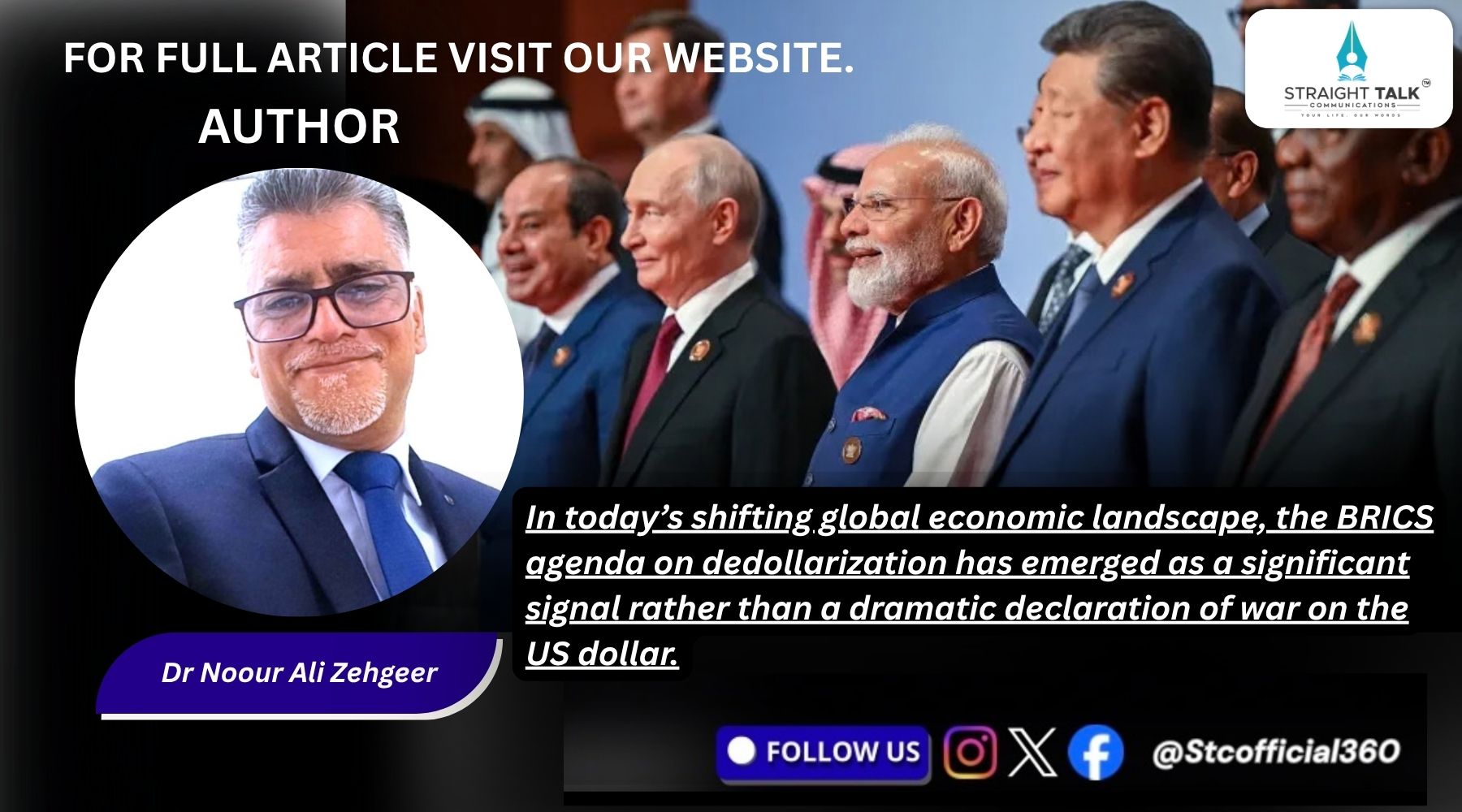
In today’s shifting global economic landscape, the BRICS agenda on dedollarization has emerged as a significant signal rather than a dramatic declaration of war on the US dollar.
Dr Noour Ali Zehgeer
India’s role in BRICS has grown significantly, especially at the 18th BRICS Summit (September 2026 in New Delhi), where India positioned itself as a bridge between the Global South and major powers, advancing trade, digital infrastructure, and UN reforms. The summit also highlighted India’s independent foreign policy, with PM Modi stressing strategic autonomy in talks with China. In today’s shifting global economic landscape, the BRICS agenda on dedollarization has emerged as a significant signal rather than a dramatic declaration of war on the US dollar. The central question is not whether a single BRICS currency will suddenly replace the greenback, but whether a more practical, gradual reduction in the dollar’s necessity for trade, energy purchases, investment and cross-border payments is already under way. While the economic interests of India, Russia, China, Brazil, South Africa and newer partners such as Iran are not identical, a shared desire to lessen over-dependence on the dollar provides common ground. The message is not that the dollar will vanish tomorrow, but that the world should possess credible alternatives.
“India’s role in BRICS is now central to shaping multipolar global governance.”
I want to see how China and India will keep their border issues at bay to address the global agenda for trade opportunities across the world. India is going to benefit more as they are yet to catch up with China’s economy pace. India has to have robust Industrial growth and imports in local currency to avoid the inflation due to exchange rates.
Creating a common BRICS currency remains an extraordinarily complex undertaking. It would demand close coordination on monetary policy, exchange-rate regimes, foreign-exchange reserves, central-banking arrangements, fiscal discipline and political consensus—conditions that do not yet exist. Far more realistic is the quiet expansion of local-currency trade, bilateral payment arrangements and alternative cross-border financial systems.
Dedollarization, properly understood, does not require abolishing the dollar; it means reducing its indispensability wherever feasible. When India and Russia settle a larger share of energy trade in national currencies, when BRICS members increase the use of alternative payment mechanisms, and when new financial architectures take shape for investment and settlements, the dollar’s role can shrink in specific sectors even without a shared currency. This approach is less confrontational and more operationally sound.
The strategic hallmark of the BRICS effort is its preference for expanding options without direct challenge. No formal announcement of the dollar’s demise is required. Incremental steps—wider use of national currencies, local payment networks and parallel mechanisms—gradually enlarge the space for multipolar finance. Member states need not abruptly sever ties with the American financial system; the dollar remains central to global trade, reserves and markets. The practical path is therefore the construction of a system in which the dollar is no longer the sole indispensable medium. Political friction is minimised while economic choices are widened.
Donald Trump’s threat of heavy tariffs against any serious attempt to erode the dollar’s global role has clarified the stakes. BRICS faces a choice between open economic confrontation and the quieter reinforcement of alternatives without anti-dollar rhetoric. The latter is politically more cautious and economically more viable. By insisting that the goal is greater use of local currencies and alternative instruments rather than the dollar’s destruction, BRICS sends a different signal—one that is harder for Washington to meet with proportional retaliation. Real power lies less in slogans than in building systems that prove reliable, cheaper, faster and efficient. When such mechanisms work, firms and governments will adopt them naturally.
President Putin’s visit to India carried a clear economic message beyond traditional diplomacy. Energy, defence, trade, investment and payment systems form the broader canvas. India’s substantial energy purchases from Russia and the strategic partnership between the two countries mean that more efficient national-currency settlements affect not only bilateral ties but the wider financial architecture. Large economies can pursue their interests through alternative routes even amid tariff pressure or dollar strength. As Russia deepens Asian market linkages and other BRICS economies conduct more transactions in local currencies, global trade can become gradually more multipolar. This is not an immediate dollar crisis, yet over time it raises the question whether dollar primacy rests solely on American economic power or also on the previous absence of workable alternatives.
Russia and China have long advocated greater diversity in the international monetary system. China’s trade scale, Russia’s energy leverage and India’s large consumer market, if combined with broader BRICS financial cooperation, can create structures that limit the dollar’s reach in certain domains without offering an immediate substitute. Important caveats remain: strategic rivalry between China and India, payment frictions between Russia and India, and uneven currency stability all constrain cohesion. Claims that BRICS will abolish the dollar are therefore exaggerated. A more accurate assessment is that BRICS is developing parallel options. Success in energy, commodities, investment and cross-border payments would reduce the relative inevitability of the dollar without eliminating it.
The masterstroke is to enhance the capacity to operate without the dollar while refraining from declaring its end—“kill the snake and preserve the stick.” The United States may assert that the dollar remains secure; BRICS may maintain that abolition is not the objective.
Meanwhile, a portion of trade migrating to national currencies, strengthened alternative payment systems and deeper financial cooperation can quietly alter economic behaviour. In the years ahead, the decisive contest may not be which currency is declared number one, but how many viable alternatives the world can use. Dollar dominance will not disappear by announcement, nor will a common BRICS currency transform the system overnight. Yet if BRICS steadily constructs networks that lessen the need for the dollar in key sectors, long-term pressure on American monetary primacy is inevitable.
I am curious to see how Trumph administration will react to all this, the tarriff weapon he has already used and it has back fired with some countries like china and few like India has adjusted with this new Diktat of USA. The Challenge for India is that it has pledged $500Billion trade commitment to USA till 2030, on other hand it is trying to have a larger pie from BRICS, that too when China has larger domestic consumption and wider global reach in last 30 years. The amount of investment China has done in ASEAN, AFRICA and PACIFIC region cannot be ignored, this was done to keep in mind another 50 years to come and China surpasses every nation who is challenging his supremacy.
(STRAIGHT TALK COMMUNICATIONS EXCLUSIVE )
(Disclaimer: The views are of the author and not of the Straight Talk Communications)