


CHILDREN’s DAY: Celebrating Childhood, Protecting Innocence and Securing Future of Nation
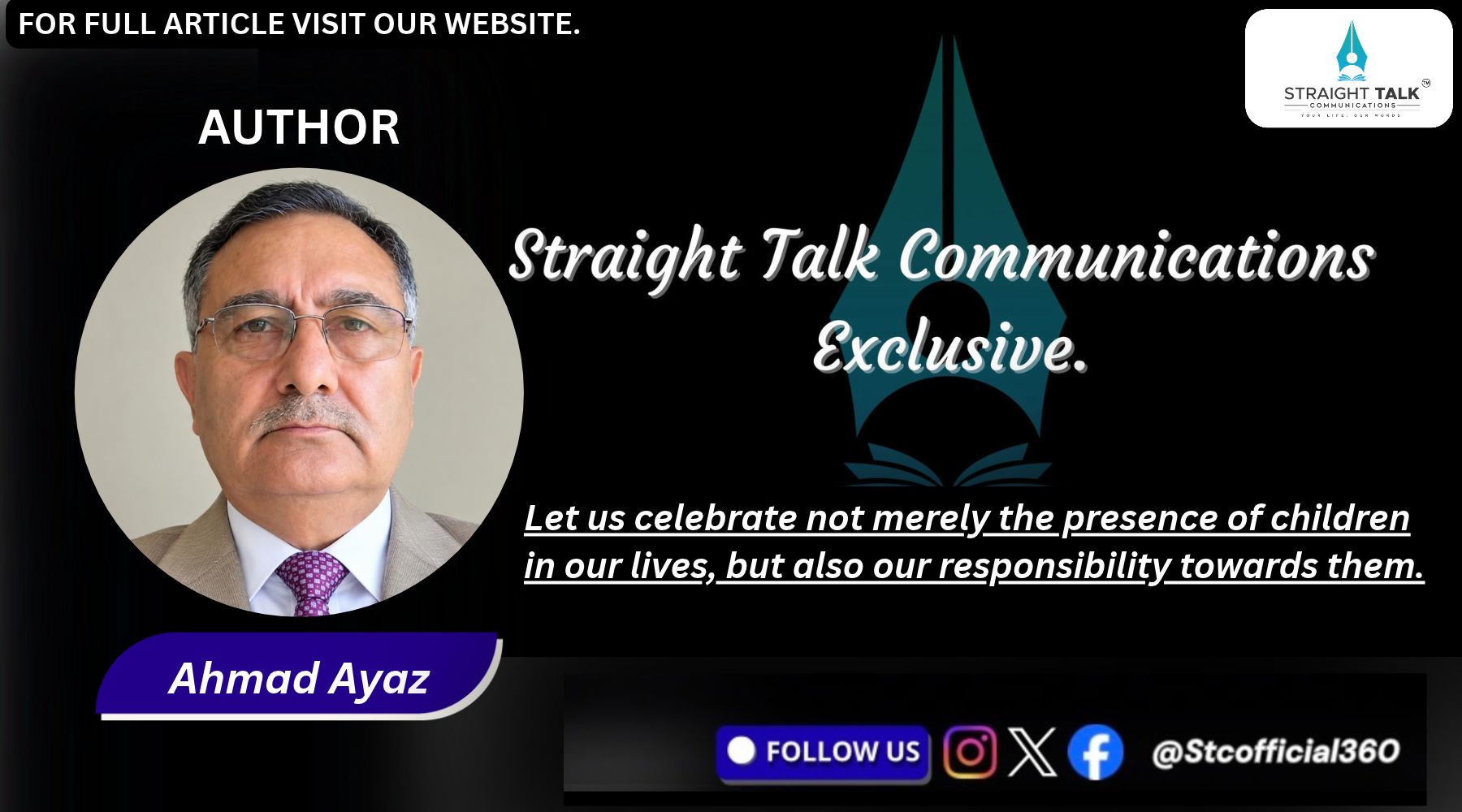
Let us celebrate not merely the presence of children in our lives, but also our responsibility towards them.
Ahmad Ayaz
Every year, 14th November is celebrated across India as Children’s Day, commemorating the birth anniversary of Pandit Jawaharlal Nehru, the first Prime Minister of independent India, fondly remembered by children as Chacha Nehru. His affection for children and his belief that they represented the future of the country gave this day a special place in India’s national calendar.
However, Children’s Day should not merely be an annual occasion marked by celebrations, speeches, cultural programmes and the distribution of sweets. It should serve as an opportunity for serious reflection on the condition of children, the challenges confronting them and our collective responsibility to ensure their well-being, protection, education and overall development.
Children are not merely the future citizens of a country; they are an integral and valuable part of society today. Their happiness, safety, health, education and emotional development are important indicators of how responsibly a society functions. The manner in which we treat our children reflects our social values, the priorities of our institutions and the vision we have for generations to come.
Childhood is perhaps the most precious phase of human life. It is a period of innocence, curiosity, imagination, discovery and learning. Every child enters the world with dreams, abilities and unlimited possibilities. It is the responsibility of parents, families, educational institutions, communities and the government to create an environment in which these possibilities can flourish without fear, discrimination, exploitation or neglect.
Unfortunately, the experience of childhood is not the same for every child. While some grow up surrounded by love, comfort, quality education and opportunities, millions of others continue to struggle for basic necessities. Poverty, unemployment, malnutrition, inadequate healthcare, child labour, school dropouts, domestic violence and social discrimination remain serious concerns. These realities remind us that celebrating Children’s Day has little meaning unless we also acknowledge and address the circumstances in which many children are compelled to live.
Education: The Foundation of a Better Future
Education is one of the most powerful instruments for transforming individual lives and building a progressive society. It gives children knowledge, confidence, awareness and the ability to distinguish between right and wrong. More importantly, it equips them to participate meaningfully in society and contribute to national development.
Every child, irrespective of economic background, gender, religion, geographical location or social circumstances, must have access to quality education. The constitutional guarantee of free and compulsory education for children between six and fourteen years of age under Article 21-A reflects the importance attached to this fundamental right.
However, providing admission to a school cannot be the sole measure of educational progress. We must also examine the quality of education being delivered, the availability of qualified teachers, classroom infrastructure, sanitation facilities, libraries, laboratories, digital resources and the overall learning environment.
In many rural, remote and economically disadvantaged areas, children continue to face educational limitations. Some schools lack adequate infrastructure, while others struggle with shortages of teachers and essential facilities. Children living in difficult geographical conditions often have to travel considerable distances to reach educational institutions.
The government must ensure that educational facilities are strengthened at every level, with particular attention to disadvantaged and underserved areas. Equally important is the need to improve government schools so that children from economically weaker families are not deprived of quality education.
Education must never become a privilege available only to those who can afford expensive private institutions. It is a fundamental instrument of equality and social justice.
The Growing Importance of Values and Character
While academic achievement is important, education should not be restricted to examinations, marks, degrees and competition. A truly educated individual must also possess integrity, compassion, discipline, tolerance, respect for others and a sense of responsibility towards society.
Unfortunately, the increasing emphasis on academic performance and competitive examinations sometimes overshadows the importance of character-building. Children are often judged by their marks rather than their creativity, individual abilities, practical understanding and personal development.
Schools and families must work together to nurture values that enable children to become responsible, sensitive and socially conscious individuals.
Respect for elders, kindness towards the vulnerable, honesty, gender equality, respect for differing opinions and concern for the environment should form an essential part of their upbringing.
Children must also be encouraged to question, think independently, express their opinions and develop a scientific temperament. Blind obedience and memorisation cannot replace curiosity, reasoning and critical thinking.
A society that produces academically qualified individuals without nurturing moral values may achieve material progress, but it will struggle to establish a culture of trust, accountability and social harmony.
Mental Health: An Issue That Cannot Be Ignored
One of the most pressing concerns in contemporary childhood is the growing pressure on children to perform academically and meet expectations imposed by families, schools and society.
The competition for admission to reputed institutions, professional courses and, eventually, employment opportunities often begins at a very young age. Children are increasingly exposed to expectations that may exceed their emotional and psychological capacity.
Parents sometimes unknowingly compare their children with others, while schools may place excessive emphasis on academic rankings and examination results. Such pressures can adversely affect a child’s confidence, emotional stability and willingness to learn.
Every child has a different personality, aptitude, interest and pace of development. Some may excel academically, while others may demonstrate exceptional abilities in sports, music, art, literature, technology or other creative pursuits.
Parents and teachers must recognise these differences rather than impose a uniform definition of success.
Mental health deserves the same attention as physical health. Children should have access to appropriate counselling, emotional support and a safe environment in which they can communicate their concerns without fear of ridicule or punishment.
Parents must learn to listen to their children, understand their anxieties and encourage them to discuss their difficulties openly. A supportive family environment can make an enormous difference to a child’s emotional development.
Protecting Children from Abuse, Exploitation and Neglect
The protection of children must remain among the highest priorities of any civilised society.
Despite legal safeguards and institutional mechanisms, child labour, trafficking, sexual abuse, physical violence and exploitation continue to threaten the safety and dignity of children.
It is particularly disturbing that children who should be attending school and enjoying their childhood are sometimes compelled to work in hazardous conditions to support their families. Others become victims of exploitation because of poverty, vulnerability or the absence of adequate parental care.
Such situations demand firm and sustained action from the government and society.
The Protection of Children from Sexual Offences (POCSO) Act, the Juvenile Justice (Care and Protection of Children) Act and other child-protection mechanisms provide an important legal framework. However, legislation alone cannot eliminate these problems unless enforcement is effective and institutions discharge their responsibilities with sensitivity and accountability.
There must be greater public awareness about child protection, stronger monitoring mechanisms and timely action against those involved in exploiting or abusing children.
Schools, neighbourhoods and families must remain alert to warning signs. Children should be educated, in an age-appropriate manner, about personal safety, inappropriate behaviour, trusted adults and the importance of reporting abuse.
Above all, every child must feel safe, heard and protected.
Digital Technology: Opportunities and Emerging Risks
Children today are growing up in a world very different from the one experienced by previous generations. Smartphones, the internet, social media, online gaming and artificial intelligence have transformed the way children communicate, learn and access information.
Technology has opened up extraordinary opportunities. Children can explore knowledge beyond textbooks, develop new skills, access educational resources and connect with the wider world.
However, uncontrolled exposure to digital platforms also carries significant risks.
Excessive screen time, online bullying, inappropriate content, cybercrime, gaming addiction and exposure to misleading information can adversely affect children’s development.
Parents and teachers must therefore help children develop digital awareness and responsible online habits. Merely restricting access to technology may not be sufficient. Children must be taught how to use digital platforms safely, recognise misinformation, protect personal information and maintain a healthy balance between online and offline activities.
Artificial intelligence is also transforming the educational landscape. It can support learning and creativity, but it should not replace independent thinking, reading habits, practical understanding or human interaction.
The objective must be to prepare children to use technology intelligently rather than become excessively dependent on it.
Nutrition, Healthcare and Equal Opportunities
A healthy childhood requires adequate nutrition, timely medical attention, clean drinking water, sanitation and a safe living environment.
Malnutrition, anaemia, preventable diseases and inadequate healthcare continue to affect children, particularly those belonging to economically weaker families.
The first few years of a child’s life are especially important for physical growth and brain development. Proper maternal healthcare, breastfeeding support, immunisation, balanced nutrition and regular health monitoring are essential during this period.
Government programmes such as the Integrated Child Development Services (ICDS), Mission Saksham Anganwadi and POSHAN 2.0 have an important role in improving nutritional outcomes and providing early childhood care.
However, the effectiveness of these programmes must be regularly monitored. The availability of funds and the announcement of schemes cannot substitute for their actual delivery at the grassroots level.
Anganwadi centres, schools, healthcare institutions and local administrative bodies must work in coordination to identify children requiring additional support.
Special attention must also be given to children with disabilities and those facing social or economic disadvantages. They deserve equal opportunities, accessible educational institutions, appropriate healthcare and an environment that respects their dignity.
No child should ever be made to feel inferior because of circumstances beyond their control.
The Importance of Sports, Creativity and Outdoor Activities
Childhood should not become a continuous struggle involving school assignments, tuition classes, examinations and competitive preparation.
Sports, physical activities, cultural programmes, reading, music, art and outdoor recreation are equally important for a child’s overall development.
Participation in sports teaches discipline, teamwork, leadership, patience and the ability to accept both success and failure. Cultural and creative activities encourage imagination, confidence and self-expression.
Unfortunately, many educational institutions lack adequate playgrounds, sports equipment and recreational facilities. In urban areas, the shrinking availability of open spaces has further restricted children’s opportunities to play outdoors.
Urban planning must recognise the needs of children. Parks, playgrounds, libraries, community spaces and safe pedestrian areas should be treated as essential public infrastructure rather than optional amenities.
Local authorities, municipal corporations and development agencies must ensure that public spaces are accessible, safe and child-friendly.
A child who grows up with opportunities to play, explore and participate in creative activities is more likely to develop a balanced personality.
The Responsibility of Parents and Society
Although governments have a central responsibility in framing policies and providing facilities, the upbringing and protection of children cannot be left to public institutions alone.
Parents are the first teachers and role models in a child’s life. Their behaviour, language, attitudes and values influence the way children understand the world.
Parents must provide love, attention, guidance and emotional security. They should encourage children to express themselves, respect their individuality and develop confidence in their abilities.
Equally important is the need to protect children from discrimination within their own homes. Girls must receive the same affection, education, encouragement and opportunities as boys.
Society must also become more sensitive towards children belonging to poor, orphaned, abandoned and vulnerable families. Community organisations, civil society groups and responsible individuals can contribute by supporting education, healthcare and rehabilitation initiatives.
A society cannot claim to be progressive if it remains indifferent to the suffering of its most vulnerable members.
Special Responsibility Towards Children in Jammu and Kashmir
In Jammu and Kashmir, Children’s Day carries additional significance because generations of children have grown up amid prolonged uncertainty, disruption and difficult circumstances.
Children in several areas have experienced interruptions in education, limited recreational opportunities and emotional challenges arising from the broader social environment.
The government and educational institutions must make concerted efforts to ensure continuity in education, improve school infrastructure, strengthen healthcare facilities and expand opportunities for sports and cultural activities.
Particular attention is required in remote and border areas, where children may face geographical and infrastructural disadvantages.
There is also a need to strengthen counselling facilities in schools and provide children with appropriate emotional support. Educational institutions should create environments where students can discuss their concerns freely and receive proper guidance.
The region possesses immense talent among its younger generation. Children from Jammu and Kashmir have demonstrated excellence in academics, sports, arts, literature and other fields despite difficult circumstances.
Their potential must be encouraged through better facilities, transparent selection processes, scholarships, professional guidance and exposure to wider opportunities.
Our children should not be defined by the difficulties surrounding them. They must be empowered to define their own future.
Revisiting the Vision of Pandit Jawaharlal Nehru
Pandit Jawaharlal Nehru’s association with Children’s Day reminds us of his belief that children were central to India’s future.
He recognised the importance of education, scientific development and the creation of institutions that could contribute to a modern and progressive India.
His affection for children was not merely symbolic. It reflected an understanding that the future strength of a nation depends substantially on how it nurtures its younger generations.
On this occasion, it is appropriate to revisit that broader vision. India aspires to become a developed nation, but this ambition cannot be achieved merely through economic growth, technological advancement or infrastructure development.
The real measure of national progress must also include the quality of childhood enjoyed by its citizens.
A country that invests in the education, health, safety and character of its children is investing in its own long-term stability, prosperity and social harmony.
Moving Beyond Ceremonial Celebrations
Children’s Day should not remain confined to school functions, speeches, competitions and entertainment programmes organised for a single day.
Such celebrations have their place, but the occasion must also encourage meaningful and sustained action.
Schools should review the quality of education and the safety of their campuses. Government departments should assess the implementation of child welfare programmes. Local authorities should identify gaps in playgrounds, sanitation and recreational facilities. Civil society organisations should strengthen their efforts to support disadvantaged children.
Parents must reflect on whether they are giving their children sufficient time, understanding and emotional support.
We must also ask some difficult questions: Are all children receiving equal educational opportunities? Are vulnerable children adequately protected? Are our schools nurturing creativity and independent thinking? Are we providing sufficient opportunities for children to participate in sports and cultural activities? Are our institutions sensitive to the mental and emotional needs of young people?
These questions deserve attention not merely on 14th November but throughout the year.
Conclusion: A Better Childhood, A Better Tomorrow
Children are the hope, strength and promise of every nation. Their dreams should inspire us, their questions should challenge us and their potential should motivate us to build a better society.
Every child deserves a childhood free from fear, exploitation, discrimination and deprivation. Every child deserves quality education, adequate nutrition, healthcare, love, dignity and opportunities to discover and develop their abilities.
We must remember that children do not need merely promises about a brighter future. They need responsible action in the present.
The responsibility for shaping their future rests not only with governments but also with parents, teachers, institutions and society as a whole.
Let this Children’s Day be an occasion to renew our commitment to protecting childhood, strengthening educational institutions, promoting equality and ensuring that no child is left behind.
A nation that takes care of its children secures its future. A society that protects their innocence, nurtures their dreams and gives them equal opportunities lays the foundation for a more humane, progressive and prosperous tomorrow.
Let us celebrate not merely the presence of children in our lives, but also our responsibility towards them.
Happy Children’s Day!
(STRAIGHT TALK COMMUNICATIONS EXCLUSIVE. The author is a Columnist. He can be reached at ahmadayaz08@gmail.com.)