



FRIDAY SERMON: Fitnah in Light of Sayings of the Prophet ﷺ
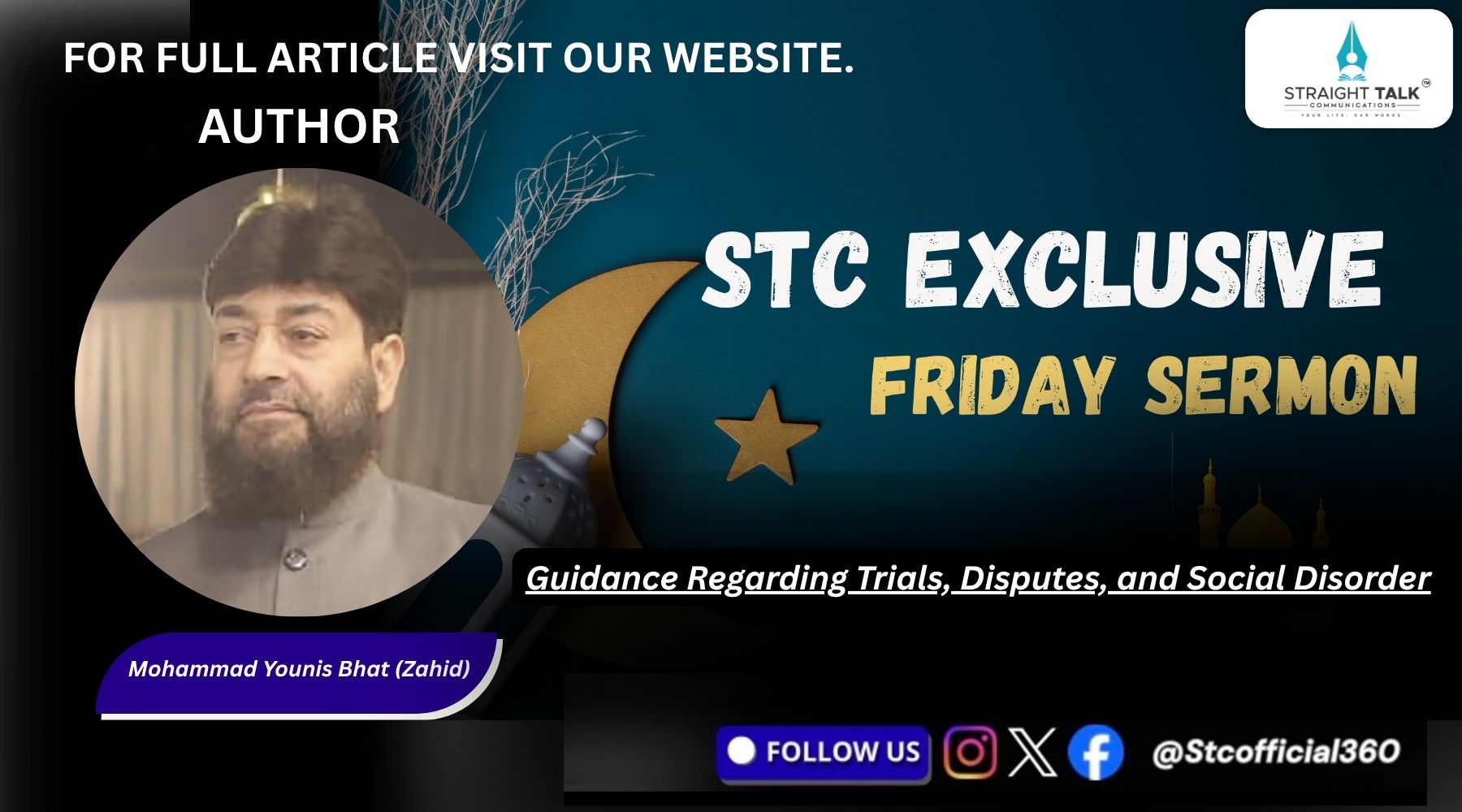
Mohammad Younis Bhat (Zahid)
Guidance Regarding Trials, Disputes, and Social Disorder
The Qur’an gives us principles for recognizing and avoiding fitnah, while the Sunnah of the Prophet Muhammad ﷺ provides practical guidance for dealing with it.
The teachings of the Prophet ﷺ show us that fitnah may begin with something very small a careless statement, suspicion, rumor, argument, or false accusation and may eventually develop into hatred, division, and social disorder.
Therefore, a Muslim should not only avoid creating fitnah but should also try to stop it, verify information, reconcile people, and promote reform (Islah).
- The Prophet ﷺ Warned the Ummah About Fitnah
The Companions of the Prophet ﷺ were deeply concerned about fitnah. Hudhayfah ibn al-Yaman رضي الله عنه was particularly concerned about recognizing evil so that he could protect himself from it.
This teaches us an important principle:
A believer should learn about the causes and signs of fitnah so that he does not unknowingly become part of it.
Understanding fitnah is not an invitation to become suspicious of everyone. Rather, it is a means of protecting our faith, character, family, and society.
Hastening Towards Good Deeds Before Fitnah
The Prophet ﷺ warned that there would be trials in which a person could lose his faith and become confused.
In Sahih Muslim, the Prophet ﷺ described severe trials as being like dark portions of the night.
This teaches us that when confusion and disorder spread, a person should strengthen his relationship with Allah, hold firmly to the Qur’an and Sunnah, perform good deeds, and avoid becoming involved in unnecessary disputes.
The Tongue Can Become a Source of Fitnah
One of the greatest causes of social problems is the human tongue.
The Prophet ﷺ said:
“Whoever believes in Allah and the Last Day should speak good or remain silent.”
This simple teaching has enormous importance.
Many disputes begin because someone says something unnecessary, exaggerates a matter, insults another person, reveals a private matter, or repeats something without checking whether it is true.
Therefore:
Think before speaking.
Verify before repeating.
Remain silent when speech may cause harm.
A Muslim Must Protect Others From His Tongue and Hands
The Prophet ﷺ taught that a true Muslim is one from whose tongue and hand other Muslims are safe.
This means that Islam does not only concern our personal worship. It also concerns how we treat other people.
A person may pray, fast, and perform many acts of worship, but if he constantly insults people, spreads accusations, creates disputes, or harms others, he must seriously examine his conduct.
A Muslim should be a source of peace, safety, and goodness not fear and conflict.
Tale-Bearing (Namimah) Can Create Fitnah
Namimah means carrying statements from one person to another in a manner that causes disagreement or hostility.
For example, someone may say:
“Do you know what he said about you?”
Then he carries another person’s words to someone else, adds his own interpretation, and creates anger between them.
Such behavior can destroy friendships, marriages, families, and communities.
The Prophet ﷺ strongly warned against namimah.
Therefore, we should not become messengers of conflict. If a statement will only create hatred and has no legitimate benefit, it should not be carried from one person to another.
Backbiting is Another Door to Fitnah
Allah says in the Qur’an:
“And do not backbite one another.”
(Qur’an 49:12)
Allah then gives a powerful example by comparing backbiting to eating the flesh of one’s dead brother.
Backbiting may appear to be an ordinary conversation, but it can have serious consequences.
A person may say:
“I am only telling the truth.”
“Everyone already knows this.”
“I am just explaining what happened.”
But if a person’s absence is used to discuss something he would dislike, it can become backbiting.
When backbiting spreads, it creates suspicion and damages relationships. It can therefore become a doorway to larger social problems.
Avoid Suspicion
The Prophet ﷺ warned Muslims against excessive suspicion.
Suspicion can develop like this:
A small doubt → negative thinking → assumption → accusation → argument → hatred.
Sometimes a person does not even know the facts, yet he creates a complete story in his mind.
Islam teaches us to verify matters rather than build conclusions upon assumptions.
Before judging someone, ask:
Do I actually know the facts?
Have I heard the matter from a reliable source?
Could there be another explanation?
This attitude can prevent many conflicts.
Reconciliation is Better Than Increasing Conflict
Islam strongly encourages reconciliation between people.
When two Muslims have a disagreement, our responsibility should not be to make the dispute bigger.
Instead, we should try to bring people together through wisdom, fairness, patience, and sincere advice.
The Prophet ﷺ emphasized the great virtue of reconciling people.
Therefore, if we can reduce hatred and restore peace, we should consider that an important act of goodness.
Reform, Not Escalation
When a dispute begins, there are two possible directions:
Escalation:
Argument → anger → insults → accusations → revenge → further conflict.
Reform:
Understanding → verification → patience → dialogue → forgiveness → reconciliation.
A believer should try to choose the second path.
Our purpose should not be to prove that we are stronger or that the other person is wrong. Our purpose should be to find the truth and prevent harm.
Patience During Times of Fitnah
During difficult times, emotions can become very strong.
People may become angry quickly, share information without checking it, and make decisions that they later regret.
Patience is therefore essential.
A person should pause before reacting and ask:
“Will my response solve the problem, or will it make the problem worse?”
Sometimes remaining silent for a short time prevents a conflict that could otherwise continue for years.
Social Media and Modern Fitnah
Today, fitnah can spread much faster than in the past.
A message can reach thousands of people within minutes.
Examples include:
False WhatsApp messages
Unverified news
Edited videos
Old photographs presented as new
Incomplete quotations
False religious statements
Accusations against individuals
Emotionally charged posts
Statements taken out of context
The fact that something appears on a mobile phone does not mean that it is true.
Before forwarding anything, ask three questions:
- Is this information true?
- What is the reliable source?
- Will forwarding it create benefit or harm?
If you cannot answer these questions, it is safer not to forward it.
Religious Disagreement Should Be Handled With Wisdom
Not every disagreement is fitnah.
There can be legitimate differences of scholarly opinion in matters where recognized scholars have differed.
The problem begins when disagreement turns into:
Insults
Hatred
False accusations
Personal attacks
Mockery
Unverified claims
Encouragement of hostility
Breaking family and community relationships
A Muslim should therefore learn to distinguish between difference of opinion and destructive conflict.
Where a religious question is complex, it is better to consult qualified and trustworthy scholars rather than relying on social media arguments.
Five Steps When You Receive Potentially Harmful Information
When you receive information that may create conflict:
Step 1 STOP.
Do not immediately forward or publish it.
Step 2 VERIFY.
Check whether it is actually TRUE.
Step 3 THINK.
Consider the possible consequences.
Step 4 CONSULT.
If the matter is religious, legal, or complicated, ask a qualified person.
Step 5 CHOOSES ISLAH.
Always prefer the path that brings truth, justice, peace, and reconciliation.
Our Intention Must Be Correct
Sometimes people enter arguments with the intention of defeating another person.
A believer should instead seek the truth.
The correct attitude is:
“I want to know what is right, even if I have made a mistake.”
This attitude protects a person from arrogance and unnecessary conflict.
The goal of Islamic knowledge should be guidance and reform, not winning arguments or humiliating others.
True Success During Fitnah
During times of fitnah, true success is not simply being the loudest person or having the largest audience.
True success is to:
Protect one’s faith.
Avoid injustice.
Protect people’s honor.
Avoid spreading false information.
Control the tongue.
Avoid unnecessary arguments.
Seek reliable knowledge.
Reconcile people where possible.
Promote goodness.
Remember accountability before Allah.
Every person should ask himself:
“Am I becoming a cause of fitnah, or am I becoming a means of ending it?”
The teachings of the Prophet Muhammad ﷺ give us a clear path for protecting ourselves and society from fitnah.
We should control our speech, avoid backbiting and tale-bearing, stay away from unnecessary suspicion, verify information, use social media responsibly, seek knowledge from reliable sources, and work toward reconciliation.
The greatest achievement is not to spread a problem further. The greater achievement is to stop the problem and bring people toward truth and peace.
Let us therefore make a personal commitment:
“I will not become a source of fitnah. I will verify before forwarding, think before speaking, seek truth before judging, and choose Islah whenever possible.”
Fitnah should not be our mission.
Reform, peace, truth, and righteousness should be our mission.
How Does Fitnah Begin? Its Causes, Stages, and Early Signs
Fitnah usually does not appear suddenly in a large form. In many cases, it begins with something very small—a misunderstanding, an assumption, an unnecessary statement, or an unverified piece of information.
If that small matter is not handled wisely, it can gradually become a serious conflict.
A common pattern is:
Suspicion → Rumor → Backbiting → Tale-bearing → Disagreement → Hostility → Division → Fasad
Therefore, understanding the beginning and early signs of fitnah is extremely important. If we stop the problem at its first stage, we may prevent a much greater problem later.
Fitnah Often Begins With Suspicion
One of the first doors through which fitnah enters a person’s heart is suspicion.
For example, someone sees two people talking privately and immediately thinks:
“They must be talking about me.”
But he does not actually know what they were discussing.
Another person may see a family member behaving differently and immediately assume:
“He must be angry with me.”
Instead of asking or verifying, he begins creating explanations in his mind.
This is dangerous because an assumption can gradually be treated as if it were a fact.
A simple principle:
Do not turn a suspicion into a conclusion without evidence.
Rumors Give Strength to Suspicion
When suspicion is shared with another person, it can become a rumor.
For example:
“I think something is wrong between them.”
Another person may repeat:
“I heard there is a problem between them.”
A third person may say:
“There is definitely a serious problem between them.”
In this way, something that began as a person’s assumption can eventually be presented as established truth.
This is why Muslims must be extremely careful about repeating information.
Unverified News Can Become a Major Cause of Fitnah
Allah gives a very important principle in the Qur’an:
“If a wicked person brings you news, verify it.”
— Qur’an 49:6
This principle is particularly important in today’s world.
A message may arrive on WhatsApp.
A video may appear on Facebook.
A voice recording may be forwarded.
Someone may send a screenshot.
But none of these things automatically proves that the information is true.
Before believing or forwarding information, ask:
Who said it?
What is the source?
Is the information complete?
Has it been verified?
Could the information be misleading?
Verification can prevent a small misunderstanding from becoming a major fitnah.
Backbiting Opens Another Door
Once people begin discussing another person behind his back, the situation can become more dangerous.
Someone may say:
“I don’t want to say anything bad about him, but…”
And then continue discussing his personal matters.
Another person may add something else.
Soon the conversation becomes a collection of criticism, assumptions, and negative statements.
This can damage the reputation of the person being discussed and can also create hatred between people.
Therefore, controlling our conversations is an important way of closing the doors of fitnah.
Tale-Bearing Can Turn Words Into Conflict
Namimah—carrying words from one person to another with the potential to create conflict—is particularly dangerous.
Consider this example:
Person A says something ordinary.
Person B takes those words to Person C and says:
“Do you know what Person A said about you?”
Perhaps Person B leaves out the context or adds his own interpretation.
Person C becomes angry.
He confronts Person A.
Person A becomes angry because the statement was misunderstood.
The result may be:
Words → misunderstanding → anger → argument → broken relationship.
One person’s careless behavior may therefore create conflict between many people.
Emotional Reactions Make Fitnah Bigger
Another major cause is reacting before thinking.
When people become angry, they may:
Speak harshly.
Send angry messages.
Make accusations.
Post on social media.
Reveal private information.
Involve other people unnecessarily.
Refuse to listen to the other side.
After the anger disappears, they may regret what they have done.
Therefore, when emotions are high, delay can be wisdom.
Take a moment.
Remain silent.
Pray.
Think.
Verify the matter.
Then respond appropriately.
Social Media Can Accelerate Fitnah
In the past, a rumor might take days to travel from one place to another.
Today, a person can forward one message to hundreds of people within seconds.
This makes personal responsibility even more important.
A person should remember:
“I am responsible not only for what I create, but also for what I choose to spread.”
Before sharing a message, ask:
Is it true?
Is it necessary?
Is it beneficial?
Could it harm someone’s honor?
Could it create fear or hatred?
If the answer is uncertain, do not forward it.
Religious Matters Require Even Greater Care
Fitnah becomes particularly serious when false or incomplete information is attributed to Islam.
For example, someone may say:
“Islam says this…”
without knowing whether the statement is actually supported by the Qur’an or authentic Sunnah.
Another person may forward a quotation attributed to the Prophet ﷺ without checking its authenticity.
Religious information should therefore be handled with responsibility.
When we do not know, it is better to say:
“Allah knows best. I need to verify this.”
There is no shame in admitting that we do not know.
From Disagreement to Hostility
Disagreement itself does not necessarily constitute fitnah.
People can have different opinions and still respect one another.
The problem begins when disagreement changes into:
“I disagree with you” → “You are my enemy” → “I must defeat you” → “I will insult you” → “I will encourage others to hate you.”
At this stage, the disagreement is no longer simply about an issue. It has become personal.
Islam teaches us to maintain justice and good manners even when we disagree.
When Fitnah Becomes Fasad
If fitnah continues without correction, it may produce actual damage.
Relationships may break.
Families may become divided.
Friendships may end.
Communities may become hostile.
People may be falsely accused.
Rights may be violated.
This is where fasad—corruption, disorder, and harmful wrongdoing—can emerge as a practical consequence.
Therefore, stopping fitnah early is much easier than repairing the damage after it has become widespread.
The Early Warning Signs
We should recognize the warning signs before a situation becomes serious.
Some important signs are:
- People are repeatedly discussing someone who is absent.
- Unverified information is being circulated.
- Suspicion is being treated as fact.
- People are becoming angry without knowing the complete truth.
- Private conversations are being exposed.
- Insults are replacing discussion.
- People are being encouraged to take sides.
- Social media is being used to attack individuals.
- Religious statements are being shared without verification.
- Reconciliation is being rejected in favor of continued conflict.
When these signs appear, a wise person should try to stop the process rather than become another participant in it.
How Can We Stop Fitnah at the Beginning?
The solution begins with every individual.
First: Verify
Do not believe every statement immediately.
Second: Control the Tongue
Do not repeat everything you hear.
Third: Avoid Suspicion
Do not create conclusions without evidence.
Fourth: Protect People’s Honor
Do not expose someone’s private matters unnecessarily.
Fifth: Reconcile
When possible, bring people toward understanding rather than division.
Sixth: Seek Knowledge
When a religious matter is complicated, consult reliable and qualified scholars.
Seventh: Choose Silence When Necessary
Silence is sometimes better than a statement that may create greater harm.
Conclusion
Fitnah often begins with something that appears small.
A single suspicion may become a rumor.
A rumor may become backbiting.
Backbiting may become tale-bearing.
Tale-bearing may produce anger.
Anger may produce hostility.
Hostility may lead to division and fasad.
Therefore, the best time to stop fitnah is at its beginning.
Every Muslim should ask:
“Am I helping to solve this problem, or am I helping to spread it?”
If we learn to verify information, control our speech, avoid suspicion, protect people’s honor, and promote reconciliation, we can prevent many forms of fitnah from entering our families and communities.
The person who stops fitnah at its beginning may prevent a much greater harm.
(STRAIGHT TALK COMMUNICATIONS EXCLUSIVE)