


From Awards to Accountability: Jammu’s Real Cleanliness Test
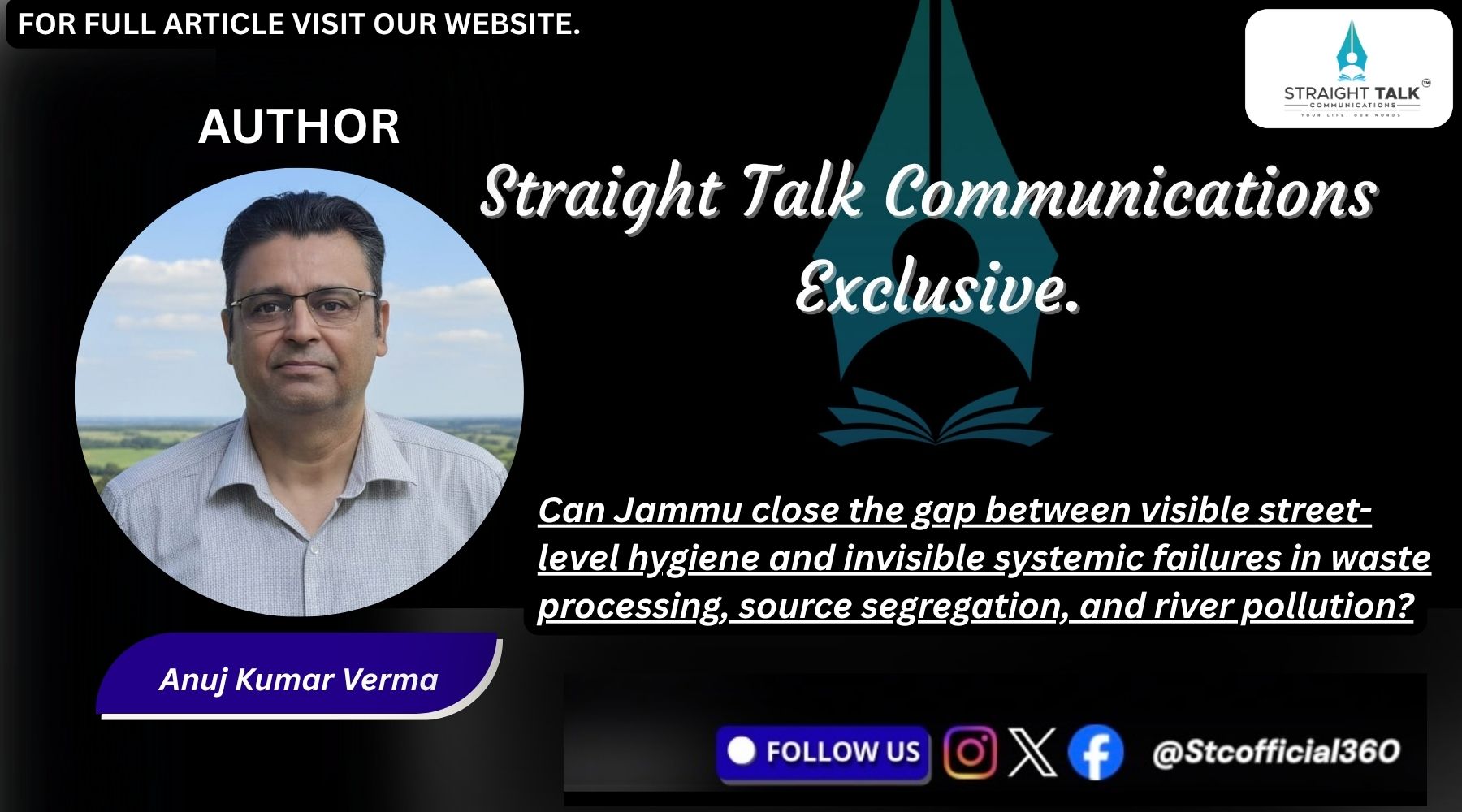
Can Jammu close the gap between visible street-level hygiene and invisible systemic failures in waste processing, source segregation, and river pollution?
Anuj Kumar Verma
There is no denying that cleanliness in Jammu city has improved markedly over the past couple of years. Better waste logistics, GPS-tracked garbage vehicles, biometric attendance for sanitation staff, ward-level air-quality initiatives, and new composting and bio-CNG facilities reflect determined civic action. In Swachh Survekshan 2024–25, Jammu leapt from 248th to 42nd among Indian cities in the 3–10 lakh population category and was named the cleanest city in Jammu and Kashmir.
Yet the real test lies beyond awards: Can Jammu close the gap between visible street-level hygiene and invisible systemic failures in waste processing, source segregation, and river pollution?
Progress, but a widening gap
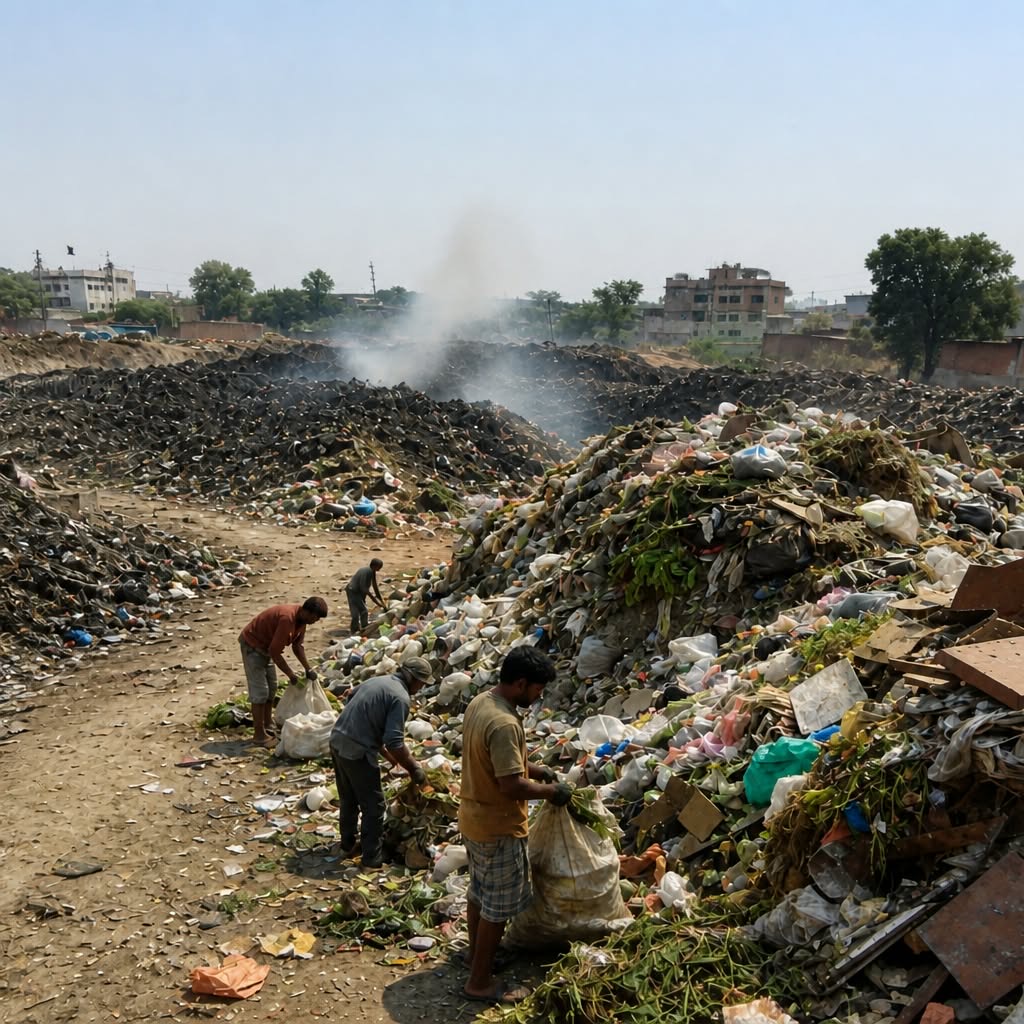
Jammu generates about 374–380 tonnes of municipal solid waste (MSW) daily, according to government Monthly Progress Reports to the National Mission for Clean Ganga. While the Municipal Corporation claims near-complete door-to-door collection and substantial scientific processing, official data and audit findings point to a persistent shortfall. About 164 tonnes of wet waste and roughly 130–160 tonnes of dry waste are reported processed daily, leaving a gap of around 50–80 tonnes that may remain untreated or unaccounted for.
This gap could have been largely eliminated had bulk waste generators complied with the Solid Waste Management Rules, 2016 (and the 2026 update). The rules are clear: households and bulk generators—large housing societies, gated colonies, hotels, hospitals, and commercial establishments—must segregate wet, dry and hazardous waste and, wherever possible, compost wet waste on site. According to data confirmed by the Health Officer, JMC, there are 163 bulk waste generators within JMC limits; of these, only about 20 are fully compliant, while the rest are at various stages of notices, penalties or corrective action. Most have not constructed segregation sheds or halls; only a few have purchased composting machines, and even these remain ineffective where wet and dry waste arrive mixed.
The JMC must move beyond routine notices: impose penalties transparently within fixed timelines, publish ward-wise compliance data, and compel bulk generators to construct segregation facilities and operate composting units immediately.
A division-wide leakage of waste and money
The problem is not confined to Jammu. Official data indicate that hundreds of tonnes of urban waste remain unprocessed daily across Jammu and Kashmir. The Comptroller and Auditor General’s audit (period ended March 2022) found that source segregation was not being carried out in 17 sampled urban local bodies during 2017–22, while more than ₹103 crore in user charges remained uncollected. As of March 2022, 18.35 lakh metric tonnes of unprocessed waste lay in the open at dumping sites in eight sampled ULBs, including Jammu and Srinagar.
Kot Bhalwal remains the centre of Jammu’s waste crisis, but the absence of an operational authorised engineered landfill in the Jammu Division increases the risk of continued unscientific dumping. Bioremediation work has been awarded for a major share of the legacy waste at Kot Bhalwal and seven other ULBs, but detailed, publicly available data on legacy clearance, fresh-waste inflow, compost output, bio-CNG production and residual disposal are still lacking. This could make Kot Bhalwal a genuine resource-recovery hub—but only if these flows are measured and published regularly.
Composting without data is not accountability
Composting of wet waste is reported at three sites—Kot Bhalwal, Narwal Mandi and Bandurakh—but the system runs without public data. There is a need maintain transparent data about daily waste composted at all three locations, the quantity of manure produced, and how that manure is disposed of or used alongwith quantities and locations, where sold or despatched. Without these basic numbers, composting remains a claim, not a verifiable public service.
Cutting single-use plastics at source
The three principles of waste management—Recycle, Reuse and Reduce—must be adhered to completely. Packaged drinking-water bottles and plastic milk pouches are major contributors to municipal waste; waste characterisation studies in Indian cities suggest they can account for roughly a quarter of the total stream. The Housing and Urban Development Department should consider proposing a ban on packaged drinking-water plastic bottles up to two litres and require milk suppliers to shift to biodegradable pouches, for which commercially viable alternatives exist elsewhere in India. Many regions in India and abroad have successfully implemented bans on packaged water bottles up to 500 ml or 1 litre. Purified water fountains need to be installed at short intervals, with regular water testing and public awareness campaigns encouraging people to carry steel, glass or earthen water bottles.
Strong enforcement is also needed against polythene bags below 120 microns, especially in fruit and vegetable markets, rural areas and semi-urban markets. The government should also ban covering of sweet boxes by sweet vendors by polythene films. These steps would reduce single-use plastics and prevent waste from entering drains, open spaces and the Tawi.
Biomedical waste: enforcement must match risk
Biomedical waste disposal needs urgent review. One private-sector startup at Swankha Morh, Samba, has operated as a Common Bio-Medical Waste Treatment Facility (CBWTF) for about a decade; a second is under construction. Biomedical waste from other cities is ferried to this facility, a difficult process with risks of leakage and non-compliance by some private hospitals, clinics, nursing homes, pathological laboratories and dialysis centres.
According to the JKPCC’s Annual Report on Biomedical Waste Management for 2025, healthcare facilities in Jammu and Kashmir recorded 6,725 violations in 2025 (3,587 in Jammu; 3,138 in Kashmir). During the year, 730 show-cause notices/directions were issued to healthcare facilities (595 in Jammu; 135 in Kashmir), one direction was issued to a CBWTF in Jammu, and 206 closure orders were issued in Jammu (23 in Kashmir). These figures show that enforcement action is being taken, but dependence on a single private facility must be reduced by creating additional facilities across Jammu province, in either the private or public sector. The JMC Commissioner and Chairman of the Jammu and Kashmir Pollution Control Committee should personally lead and monitor verification of machinery, capacity and compliance.
The Tawi contradiction
The most serious contradiction lies in the Tawi. Official monitoring records under the National Green Tribunal process identify most of the 26 drains carrying untreated sewage and other waste into the river. A city may keep its streets visually clean while its river absorbs the waste moved out of public view. The Tawi is not a drain; it is Jammu’s ecological, cultural and hydrological lifeline.
All 26 Tawi-bound drains must be intercepted and treated, with clear timelines and public monitoring. Jammu’s progress is real, but so are its gaps. The awards are on the wall; the waste is still in the Tawi. Plugging the loopholes in the system and closing all gaps is Jammu’s next and most important cleanliness test.
(STRAIGHT TALK COMMUNICATIONS EXCLUSIVE. The author is a Jammu-based Environment Advocate and Policy Writer. He is convenor of We The Humans Forum for Nature and Mankind, a public charitable trust. Email: verma.anujjk@gmail.com)