


JKPCC Chief Sajad Lone says statehood no favour, rejects 2019 as reference point
STC NEWS DESK
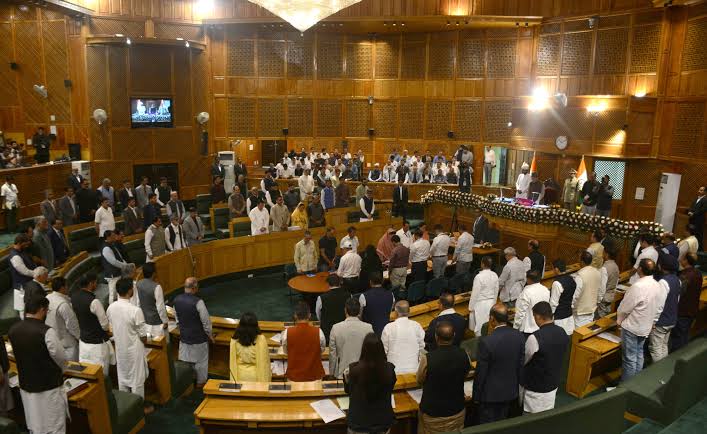
SRINAGAR, SEPTEMBER 28 (STC): J&K Peoples Conference president and MLA Sajad Lone on Monday supported the statehood resolution in the Jammu and Kashmir Assembly, but used his time on the floor to challenge how the debate has been framed.
Statehood, he argued, is not a promise made by the Prime Minister or the Supreme Court. It is a commitment owed to the people of J&K since 1947.
“If we are here today, it is not because of Modi ji’s promise or because of the Supreme Court,” Lone told the House. “We are here in this country because of the promises made to the people of J&K in 1947.” He said he had “full respect” for both the Prime Minister and the apex court, but objected to speakers repeatedly citing their assurances as the basis of the House’s claim.
His remarks drew sharp interjections from the treasury benches as he invoked 1947 and the role of Kashmiris in bringing J&K into India. “We fought, you did not fight,” Lone shot back, telling BJP members to hear him out first and reply afterwards if they had an argument.
Lone said the promise of 1947 was of an exalted status within a federal structure. “The people of J&K will have an exalted status. That they will have autonomy, that they will have the power to make their own decisions,” he said. But the erosion, he added, began almost immediately. “’52 happened, ’56 happened, ’58 happened, and ’65 happened. One by one, they took everything away.” The process ended in 2019, he said, when J&K lost both its statehood and its special standing.
Lone said Union Territory status has two dimensions now, one is the power that was “snatched away” and second what he called the “UT lottery,” the shift of real authority to unelected officials. Bureaucrats, he said, now hold sway while elected representatives are sidelined. “The IAS officers today do not even pick up the phones of elected representatives here,” he said.
Drawing on the common law tradition India inherited from Britain, Lone said the downgrading of a state has no parallel. “Wherever common law is followed, nowhere has such relegation occurred,” he said. “This is the first place on the entire earth where a state has been relegated to a UT. This is the only one.”
Turning to the Supreme Court, Lone said petitioners had approached it with a single question: whether the Union Government’s relegation of a state to a UT is within the ambit of the law.
“The honorable Supreme Court gave no answer. They just gave a date stating that at the appropriate time, you will be given statehood,” he said. A ruling either way, he argued, would have resolved the matter. “If they had said that this is illegal, we would have gotten statehood.” As it stands, he said, a larger question remains open: “Even today, we don’t know whether this is a precedent, whether the Union Government can relegate any state in India to a UT.”
Lone also took issue with the language of benevolence used by some members. “They will give statehood! He is saying it as if he will give it from his own pocket! We will take everything from here!” he said.
Returning to his central argument, Lone urged the House not to let the starting point of the conversation shift. “We should stop talking about the promises made by the Supreme Court in 2019. Our promise is the promise of 1947. That should be the reference point of this Assembly,” he said. “We cannot change the context of history. The context of history will remain what it was in 1947.”
He closed with a reminder of the transience of power, one he said applied to every side of the House. “How many governments came and how many went. They too will go one day, you too will go, everyone has gone. Just as they are a phase, we too are a phase,” Lone said, reiterating that the reference point must remain 1947 in any discussion of statehood or the autonomous powers promised to J&K.
(Straight Talk Communications I Inputs KNS)