



SUNDAY BYTES; When Kinship Was Chosen, Not Inherited
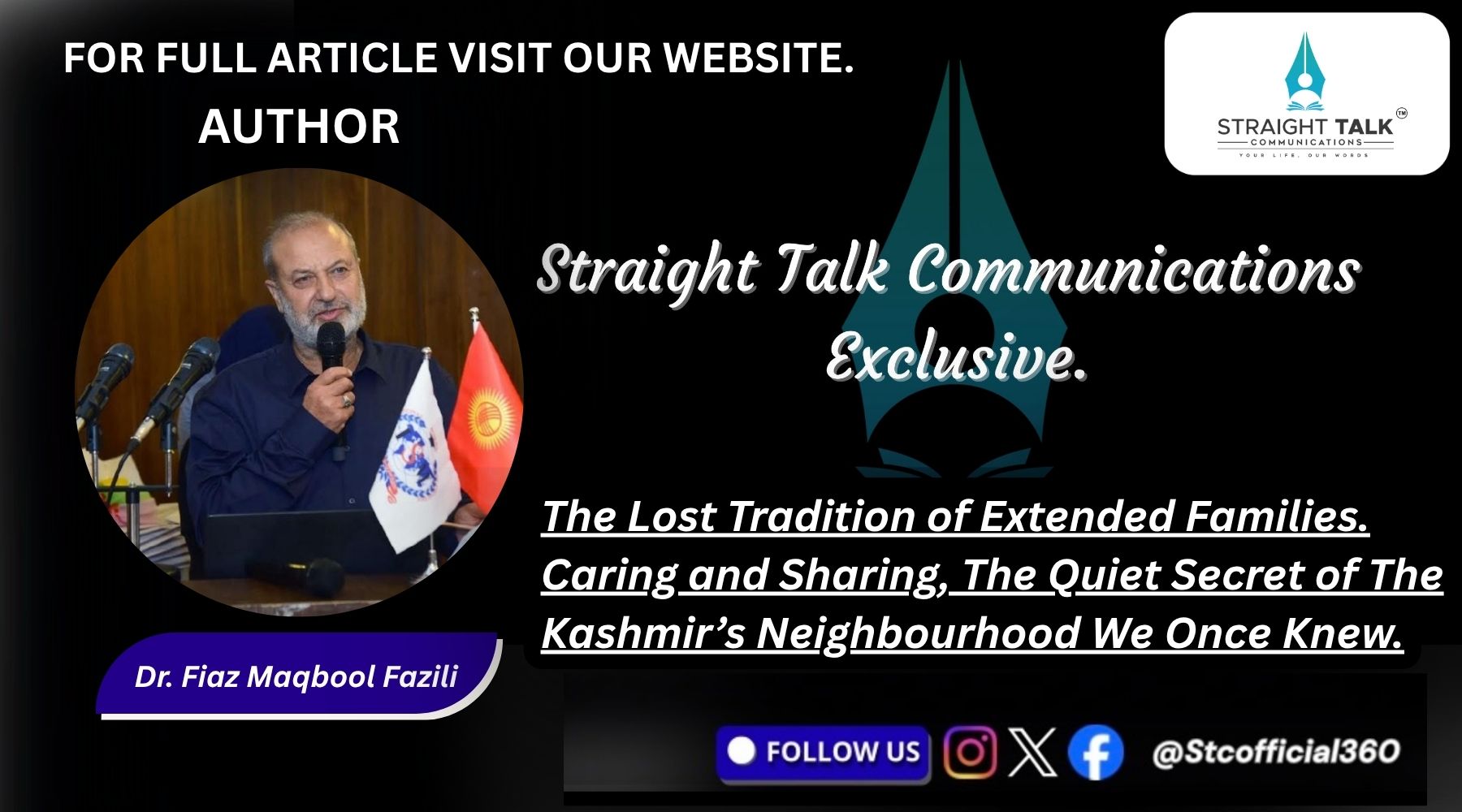
The Lost Tradition of Extended Families. Caring and Sharing, The Quiet Secret of The Kashmir’s Neighbourhood We Once Knew.
Dr. Fiaz Maqbool Fazili
There are some truths that arrive late in life. They do not alter the present; they simply cast a different light on everything we thought we knew about the past.
A few days ago, Nasir Shah, a scientist, began sharing profiles of educationists, mostly his father Prof. G. R. Shah’s colleagues. Among these, one profile particularly touched me – that of Prof. Moti Lal Kaul, a Chemistry teacher, popularly known as “Sharabi.” The name was, however, a family alias rather than a reflection of his character or habits a misnomer, as he never drank, but acquired this label due to the proximity of his residence to a liquor store.
It occurred to me very late in middle school that the man we had always called Uncle, was not, in truth, my father’s younger sibling. The revelation was so gentle, yet so unsettling, that for a while I simply sat in silence. For more than six decades, I had never paused to ask how exactly we were related. The question itself had never occurred to me. In our home, he needed no introduction. He arrived without ceremony, laughed without restraint, blessed us like an elder, scolded us like family, and left behind the warmth that only one’s own people can leave. Then I realised something far more profound than the fact itself. He was never related to us by blood. He had simply been related to us by love.
Perhaps only those who grew up in the Kashmir of another time will understand why this discovery felt so extraordinary. We belonged to a generation where relationships were not always inherited through birth; many were quietly woven through compassion, loyalty and shared lives. Affection dissolved the boundaries that genealogy drew. One did not ask whether someone was a cousin, a neighbour or a family friend. The heart had already decided.
My earliest memory of Uncle takes me back to Sopore. I was too young to understand illness or sacrifice. He had suffered a severe bout of black motion and his condition deteriorated rapidly during the night. Hospitals were far away, transport uncertain, and emergencies depended less on institutions than on people. Without hesitation, my father lifted him, almost carrying him on his back towards the hospital. Looking back today, I realise that night achieved far more than saving a life. It created another family. No document recorded that relationship. No elder announced it. No ceremony acknowledged it. Yet from that day onwards, the two households drifted so naturally into one another’s lives that the distinction quietly disappeared. We celebrated together, mourned together, worried about one another, and rejoiced in each other’s successes with the ease of those who had forgotten where one family ended and the other began. That was the Kashmir I inherited.
A Kashmir where kinship was often chosen before it was inherited. The Kashmir of my childhood was rich in relationships, even when material possessions were few. Every neighbourhood had its own moral compass. Every elder watched over every child. We addressed neighbours as uncles and aunts, not because etiquette demanded it, but because affection had already bestowed those titles upon them. No one felt embarrassed to correct another person’s child, and parents rarely took offence. Instead, they expressed gratitude because someone else had cared enough to guide their son or daughter.
Homes were open in every sense of the word. A visitor rarely announced his arrival. A cup of noon chai was never measured. Meals expanded effortlessly to accommodate unexpected guests. Weddings were community events, not carefully choreographed spectacles. During harvest, neighbours worked shoulder to shoulder. During illness, relatives and friends shared responsibilities without waiting to be asked. Relationships were never maintained through calendars or reminders. They were sustained through presence.
Looking back, I realise that these seemingly ordinary gestures formed the invisible architecture of Kashmiri society. We often speak of our magnificent chinars, our lakes, our poetry and our crafts, but perhaps our greatest cultural inheritance was something less visible—the remarkable ability to make strangers feel like family. To Gen Z, often distanced from stories of our rich cultural traditions and social fabric, such narratives may seem like mere ptcha kath—a fairy tale from another time.
The language of affection was deeply embedded in our everyday lives. Children instinctively touched the hands of elders in respect. Shopkeepers knew three generations of the same family. Teachers remained mentors long after classrooms were left behind. A family doctor often knew not only a patient’s illness but also the joys and sorrows that surrounded it. Relationships were never confined to professional boundaries. They carried emotional responsibility.
Life was not without hardship. Poverty existed. Winters were harsh. Medical care was limited. Communication was slow. Yet loneliness was uncommon because people belonged to one another. One family never carried its burden alone. When grief entered a home, neighbours arrived before relatives. When happiness knocked, the entire locality celebrated.
Today our lives are undeniably more comfortable. We possess smartphones, instant communication, digital payments and social media platforms connecting us across continents. Yet somewhere in this remarkable progress, many of us have quietly misplaced something precious. Our contact lists have grown. Our circles of trust have shrunk. We know hundreds online but often remain strangers to those living next door. Children recognise usernames more readily than neighbours. We remember birthdays through automated notifications while forgetting to ask about an elderly neighbour who has not stepped outside for days. Technology has connected our devices. It has not always connected our hearts.
Modern life has also introduced a subtle form of individualism. We increasingly measure people by what they own, what they earn or what they can offer us. Networking has replaced friendship. Utility has begun to overshadow loyalty. Even our conversations have changed. Instead of asking, “How is your family?” we often ask, “What do you do?” Identity has become professional before it remains personal. Perhaps this is the quiet price of modernity.
What worries me even more is that we have become less tolerant on dissent. Our forefather’s, earlier generations disagreed on politics, ideology and social customs, yet those disagreements rarely dissolved lifelong friendships. One could argue passionately during the day, without touching the “faith part ,” and still share a meal in the evening. Affection was stronger than opinion.
Today, disagreement often ends dialogue. We are quick to judge, quick to block and quick to distance ourselves. Relationships that once took years to nurture now disappear with a single message or misunderstanding. As I reflect upon Moti Lal Uncle, I realise he symbolises something much larger than one affectionate family friend. He represents an entire civilisation of relationships.
A civilisation where people earned the privilege of becoming family through character rather than chromosomes; where compassion carried greater weight than genealogy; where kindness quietly erased the lines that blood alone could never cross. Perhaps that is why the recent discovery of affection exhibited in post and comments surprised me so deeply. Biology had one story. Life had another. And life had been far more convincing. I do not believe that this inheritance has vanished completely. It survives in small pockets of Kashmir, in villages where neighbours still gather without invitation, in homes where elders remain the centre of family life, and in countless anonymous acts of kindness that never find their way onto social media. But such traditions survive only when they are practised, not merely remembered.
We preserve heritage not only by restoring monuments, protecting shrines or planting chinars. We preserve it every time we knock on a neighbour’s door without an occasion, visit an elderly person without waiting for Eid or a wedding, comfort a grieving family before being called, or treat another person’s child with the same concern we reserve for our own. These are not small gestures. They are the foundations upon which compassionate societies are built. Today, when I remember not only Uncle, Aunty, Baisahaib, Bhabhi culture or other interpersonal relationship, the caring and sharing within neighbourhood I no longer think of whether he or she belonged to our family tree. Trees are concerned with roots and branches. Human lives are measured differently. They are remembered by the shade they offer others. Perhaps that is why the recent discovery did not diminish him in my memory. It enlarged him.
If Kashmir’s Veth and Vitasta, Reshivar has given us anything worth preserving beyond its lakes, mountains, walnut wood and pashmina, it is this extraordinary ability to enlarge the meaning of family. For, in the end, the people who leave the deepest footprints on our hearts are not always those who share our surname. They are those who share our journey. And perhaps that was the quiet secret of the Kashmir we once knew.
It was a land where family was not merely inherited. It was lovingly created.
(STRAIGHT TALK COMMUNICATIONS EXCLUSIVE)

Kashmir ki rooh yahin bashti hai — rishton ko bada karne mein.
Beautifully said. Family isn’t just in our surname, it’s in the shade we give each other. Kashmir taught us that best.
The conflict took a heavy toll of our relations, peace and family values.
It started in 1979,the day Zulfiqar Ali Bhutto was hanged and became an armed movement called millitancy in 1988.
People,education and social ethos got into a quagmire and we are deep in it.