




The Soft Edge: Why Kindness Might be Hardest Skill in Modern World
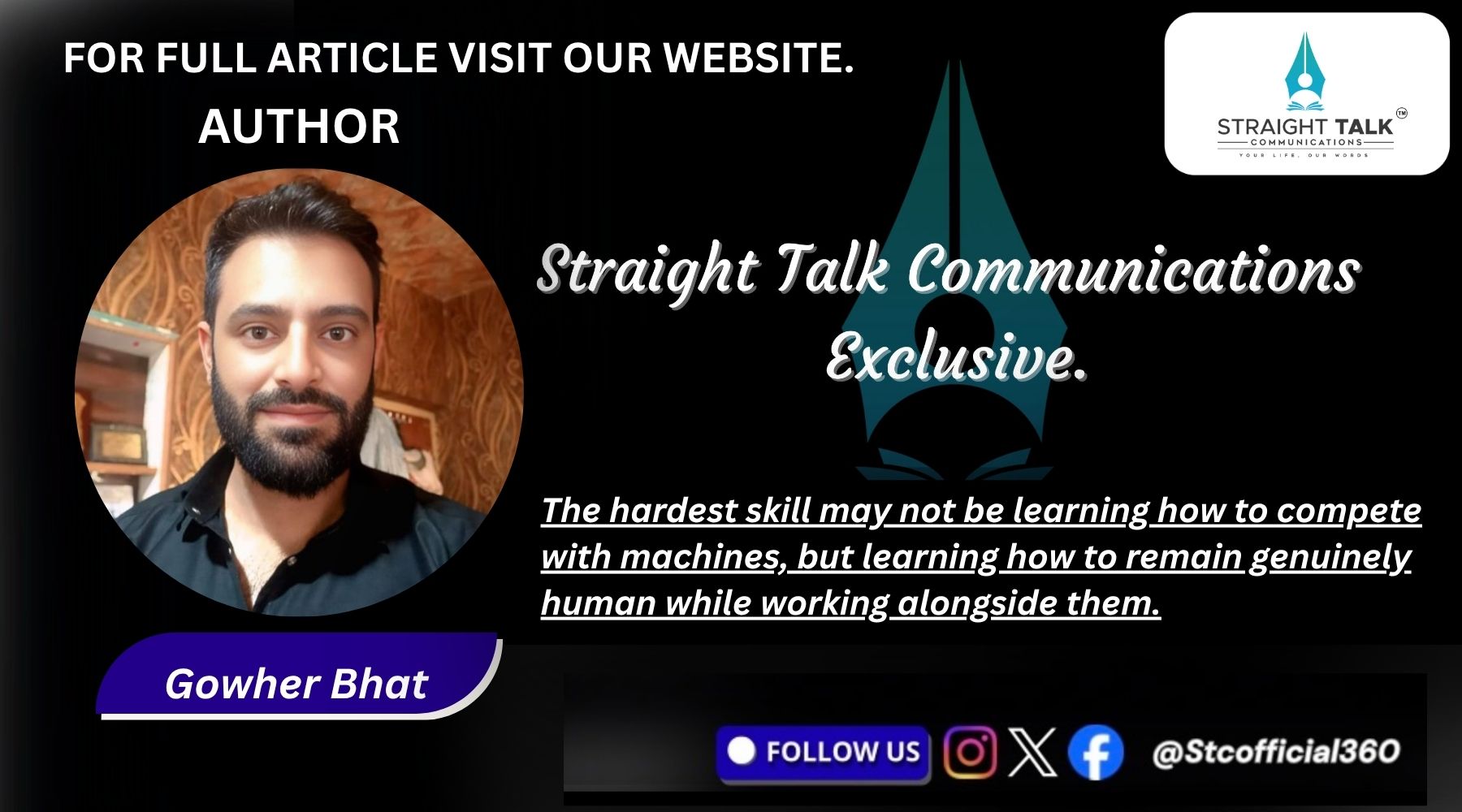
The hardest skill may not be learning how to compete with machines, but learning how to remain genuinely human while working alongside them.
Gowher Bhat
It was just after dawn at the airport, and the air smelled of coffee and metal. Behind the counter stood a young woman with her sleeves rolled up and a calm smile on her face, while a long line of tired passengers waited in front of her. One man began arguing about his baggage weight, but she did not raise her voice or respond with irritation. She listened carefully, explained the rules, and remained patient until his frustration began to fade. When she handed him his boarding pass, his tone had changed, and he thanked her before moving away.
She turned towards the next passenger with the same calm voice and steady manner. Watching her, one could see that she possessed something that no degree or certificate could fully teach. Communication, patience, empathy, adaptability, and kindness are often described as soft skills, yet developing them requires self-control, awareness, and emotional strength.
A few hours later, in a private parking lot across the city, another customer was arguing about an overcharge. The person in charge barely looked up and processed the payment without making much effort to understand the customer’s frustration. The customer eventually left dissatisfied, carrying the feeling that the payment had been processed but the person had not really been heard.
These two situations illustrate how differently people can respond to the same basic challenge, which is dealing with another human being. One interaction reduced tension and created understanding, while the other allowed frustration to remain unresolved.
For decades, society has placed great emphasis on degrees, marks, certificates, technical knowledge, and professional qualifications. These achievements remain important, but qualifications alone cannot determine how effectively a person communicates, responds to pressure, works with colleagues, manages disagreement, or understands other people.
This is where human skills become important. Communication, teamwork, problem solving, adaptability, leadership, empathy, and active listening influence how people cooperate and respond to difficult situations. They can affect whether disagreements become larger conflicts, whether teams communicate openly, and whether people can adjust when circumstances change.
The World Economic Forum’s Future of Jobs Report 2025 provides evidence that employers value a combination of technological and human abilities. The report draws on the views of more than 1,000 employers representing more than 14 million workers across 55 economies and examines the skills employers expect to become important between 2025 and 2030. Its findings place resilience, flexibility and agility, leadership and social influence, creative thinking, and empathy and active listening alongside technological literacy and analytical thinking.
One of the clearest examples of the economic value of these abilities comes from India. Researchers from MIT Sloan, the University of Michigan, and Boston College conducted a randomised controlled trial involving five garment factories in Bangalore. Workers participated in a structured 12-month programme covering communication, problem solving and decision making, time and stress management, financial literacy, legal literacy and social entitlements, and execution excellence.
According to MIT Sloan’s account of the research, the training generated roughly a 250 percent return on investment within eight months of the programme’s conclusion. Increased worker productivity accounted for much of the gain, while improvements in areas such as the ability to perform complex tasks more quickly, short-term attendance gains, and increased retention during the training also contributed to the result.
The study does not prove that every soft-skills programme will produce the same return, because it examined a particular workforce, industry, training programme, and setting. What it does provide is a concrete example of how communication, problem solving, decision making, and related workplace abilities can have measurable economic consequences.
The changing nature of technology makes this increasingly relevant. Artificial intelligence can process information quickly, software can automate repetitive tasks, and digital systems can analyse enormous amounts of data. Yet workplaces still depend on people who can explain ideas clearly, understand different perspectives, cooperate with colleagues, respond to changing circumstances, and make decisions when situations do not fit neatly into instructions.
This is why listening matters so much. Much of modern communication takes place through messages, emails, and video calls, where tone and immediate reactions are often missing. Misunderstandings can therefore develop easily, particularly when people respond before fully understanding what another person means.
Good listening involves paying attention, considering another person’s point of view, asking questions when something is unclear, and giving them enough space to explain their position. In a workplace, this can help a manager understand a problem before it becomes serious, help a teacher recognise when a student needs support, or help a customer-service employee understand the real reason behind a complaint.
The same principle applies to leadership. A manager may have extensive technical knowledge, but leadership also involves communicating expectations clearly, understanding employees’ concerns, responding to disagreement, and creating an environment where people can raise problems openly. A teacher may know a subject extremely well, but effective teaching also requires understanding how students respond and recognising when someone needs additional support.
These qualities are difficult to demonstrate through certificates because they are expressed through behaviour. A qualification can establish that someone completed a course, while an examination can demonstrate knowledge of a subject, but neither can fully show how a person will respond when a customer becomes angry, a colleague makes a mistake, or a team faces unexpected pressure.
This is also where kindness is often misunderstood. Kindness does not mean agreeing with everyone, avoiding difficult decisions, or ignoring poor performance. A manager can be firm while remaining respectful, a teacher can maintain discipline while showing understanding, and a leader can make an unpopular decision while communicating it honestly.
Patience can be difficult when another person is angry, while listening can be difficult when we strongly disagree. Empathy can be particularly difficult when we are already dealing with our own pressures. These qualities therefore require conscious effort, self-awareness, and practice.
The young woman at the airport demonstrated this without needing a complicated theory. She did not try to win an argument or prove that she had more authority than the passenger. She remained calm, listened to his concern, explained the situation, and treated him respectfully. The problem itself may have been ordinary, but her response changed the entire interaction.
That is the quiet power of a human skill.
The future workplace will continue to require people who understand technology and develop specialised expertise, but it will also require people who can communicate effectively, adapt to change, work with others, lead teams, and understand the human side of difficult decisions. The World Economic Forum’s employer research reflects this combination of technological, analytical, interpersonal, creative, leadership, and self-management abilities.
The lesson is not that technical skills are becoming less important. It is that technical competence works best when combined with the ability to communicate, cooperate, adapt, and understand people.
Every workplace is ultimately made up of people, and the quality of their interactions influences the environment in which everyone works. When people feel heard and respected, communication can become easier, while people who expect to be dismissed may become less willing to speak openly.
The future will require people who can combine knowledge with judgment, technical ability with communication, and professional competence with an understanding of other human beings. The Bangalore study provides a specific example of how structured training in workplace and human skills can produce measurable benefits, while the World Economic Forum’s employer research shows that these abilities remain important alongside technological skills.
Perhaps that is why kindness should not be dismissed as a soft option. When combined with judgment, confidence, and competence, it can become a practical form of strength that improves communication and helps people work together more effectively.
In a world becoming faster, more connected, and increasingly automated, the ability to communicate, listen, adapt, cooperate, and understand other people may become increasingly valuable. The hardest skill may not be learning how to compete with machines, but learning how to remain genuinely human while working alongside them.
(STRAIGHT TALK COMMUNICATIONS EXCLUSIVE)