

INSPIRING PERSONALITY: Dr. Mohammad Sultan Khuroo – A “Medical Detective” of International Repute
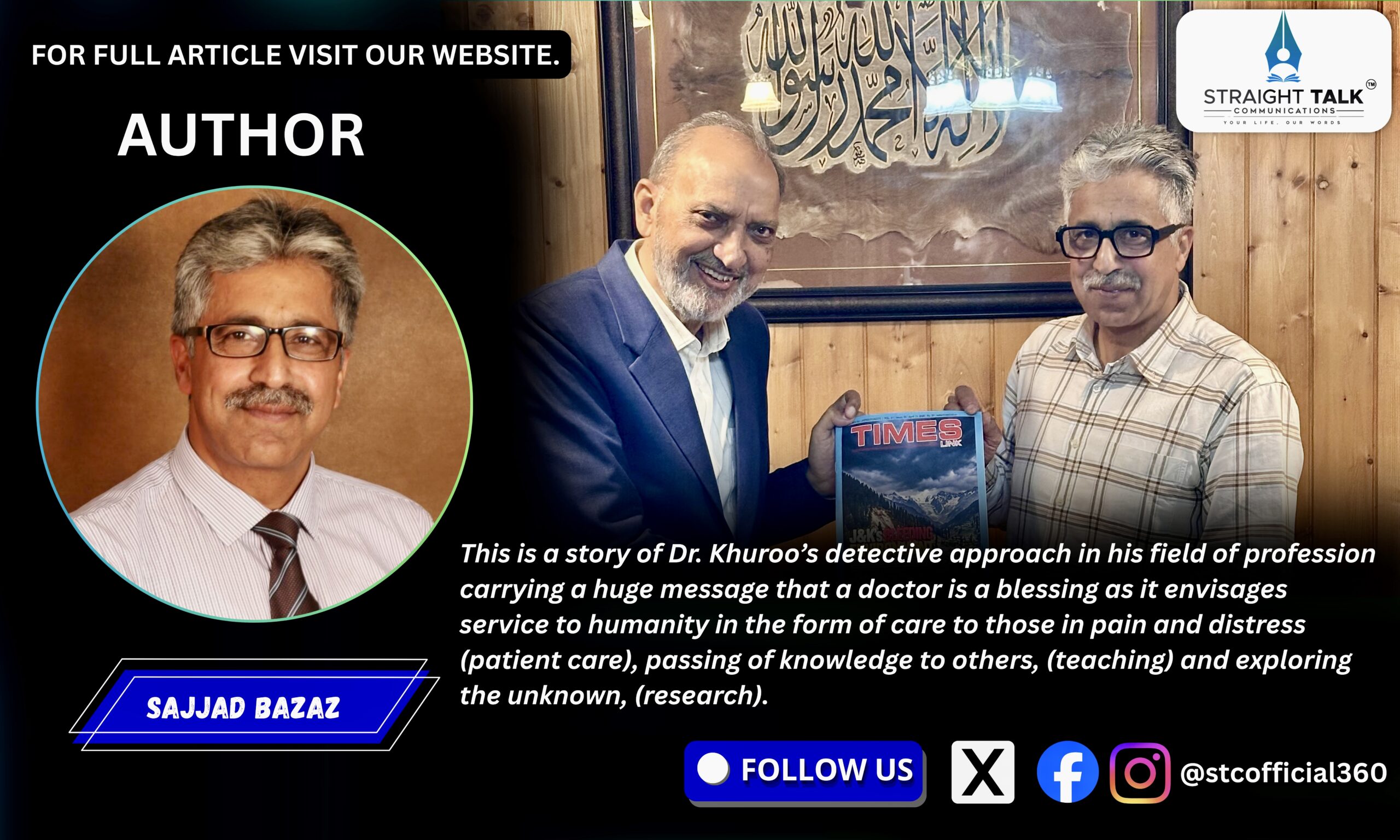
This is a story of Dr. Khuroo’s detective approach in his field of profession carrying a huge message that a doctor is a blessing as it envisages service to humanity in the form of care to those in pain and distress (patient care), passing of knowledge to others, (teaching) and exploring the unknown, (research).
Sajjad Bazaz
Incredible! But true. If you switch on the television, surf the internet or check out social media posts, you quickly come across and learn every aspect, even minutest details about the life of your favourite actor or singer. In a way, it makes sense as the top celebrities in the tinsel world or in the world of sports offer groundbreaking performances, and their work may touch the lives of many people. But when it comes to the life of medical scientists or researchers – who perform groundbreaking work that is literally lifesaving – we know very little about them and chances are that we may know nothing about them. We are quick to enjoy the benefits of the new and innovative treatments but have no idea what it takes to actually develop them.
One such inspiring story of a world renowned medical scientist/researcher who has remained unsung for the kind of invaluable discovery which has saved and continues to save millions of human lives around the globe, is very much from our region, Jammu and Kashmir. Needless to say that Jammu & Kashmir is one of the remotest geographies on the world map. Any invention or discovery in the field of medicine is undoubtedly an achievement of par excellence.
The medical scientist is none other than Dr. Muhammad Sultan Khuroo, a local (Kashmiri) medical practitioner with international recognition in the field of medical science. He has several discoveries to his credit, with the discovery of Hepatitis E virus being the most notable. The most striking thing is that his groundbreaking discovery was a voluntary activity with negligible support from the government.
When we look at Dr. Khuroo’s lifestyle, even being a medical scientist/ practitioner of repute, we find him a blend of intense intellectual pursuit, meticulous laboratory work, and a profound commitment to improving human health behind the scenes. His tireless efforts to improve the lives of humans through his groundbreaking research is enough to crown him as one of the most successful “medical detectives” in the world of medical science. His simple, focused lifestyle as a medical scientist has always remained around a “work-to-live” philosophy that prioritised (and continues to prioritise) intellectual curiosity, routine, and a purposeful, quiet contribution to not only local but also global healthcare.
Early Life
Born on March 29, 1944, at Mohalla Kraltengh in the Kashmir’s Apple town of Sopore, to a traditional trading family – Khuroos – who for centuries held the nerve of the supply chain, especially food grains from Maraz (Khanabal, Islamabad) to Kamraz (Baramulla), Dr. M. S. Khuroo was lucky enough to have sufficient financial and intellectual support from his grandparents, parents and other family members. His family has a distinction of being a seat of learning and teaching as his grandparent, Late Haji Fateh Khuroo (1885–1958) was a scholar in Persian literature. During his life, he came in touch with many scholars and Sufi saints and his residence became a seat of learning and teaching. His father, Late Haji Abdul Rahim Khuroo (1922–1995) was educated in the Persian language. Because of his wisdom, he earned special respect and status in society and was frequently approached for support, solutions and advice.
In the family atmosphere, full of wisdom, he gained tremendous confidence that is normally required for a child to dream of a successful independent life in adulthood. However, Dr. Khuroo’s early life was not without upheavals as he was born in an era when the Princely State was ruled by the last Dogra ruler Maharaja Hari Singh. During the 100‑year Dogra rule and the turnaround, there were many political upheavals along with natural calamities, which adversely affected the life of the common man and society.
A massive flood of August–September 1957, which particularly hit Sopore town, followed by drought (1958) left a large section of the Sopore community homeless and penniless resulting in massive dropouts from the schools. Khuroo’s family too got hit financially and had to struggle a lot to remain afloat financially with dignity. In his own words, Dr. Khuroo said, “My family fought this calamity with hard work and dignity. I did my part and housed myself in a makeshift room and ran a small parallel business and extended tuition facilities to other fellow students in the community to generate small profits/money to continue my education and its financial needs.”
Dr. Khuroo proudly remembers his school days. He called his educators “stalwart teachers” who taught him discipline and mannerisms. Recalling the ‘Naya Kashmir’ (New Kashmir) movement during his school days, He shares that the movement was an immensely popular public movement with a blueprint for a welfare state notable for a humanistic view of development. “Under the guidance of teachers, I extensively visited adjacent villages and towns and made public utterances on several social issues such as the value of education, rights of women and girl‑child, antenatal care, personal hygiene, etc.,” he said with nostalgic feelings visible on his face.
A Journey to Medical Scientist
Interestingly, Dr. Khuroo had a personal liking for Mathematics subject, but he was passionate about being a doctor. pursuing MBBS course aim was to become a doctor. As shared by him, he had a firm belief that to be a doctor is a blessing as it envisages service to humanity in the form of care to those in pain and distress (patient care), passing of knowledge to others, (teaching) and exploring the unknown, (research).
It was heartening to listen to Dr. Khuroo sharing his father’s words of wisdom. Here is what his father advised him when he shared his aim to become a doctor: “I wish you to serve those in pain with sincerity, hard work, and dedication and use ethics, morality, and empathy at your best. I wish that you serve your brethren as they deserve your help more than others. Lastly, I wish you to teach others what you know and explore the unknown in Medicine and Biology to establish Sadaqat Jariya (continuing charity) for you and the family.”
His passion for becoming a doctor with notable contribution started with completion of MBBS degree with Gold Medal for ‘Best Outgoing Student’ session June 1962–August 1968. Besides he earned seven Silver Medals for obtaining the first position in Anatomy (Distinction/ First Position), Physiology (Distinction/First Position), 1st MBBS (First Position), Pathology (Distinction/First Position), 2nd MBBS (First Position), Surgery (First Position), Final MBBS (First Position) and two Bronze Medals for obtaining the second position in Medicine and Forensic Medicine. He completed his post‑graduate degree (MD) in General Medicine (June 1970–June 1972). He joined the Lecturer Department of Medicine, Medical College, Srinagar, in January 1974.
However, in pursuit of knowledge, he joined the PGIMER Chandigarh, for super‑speciality (DM) in Gastroenterology. Even as he had preferred to pursue DM Cardiology, the Director of the Institute, Prof. (Late) P. N. Chhuttani, made him join Gastroenterology. “These 2 years (June 1976 to June 1978) were turning points in my career as I hardened my clinical skills, learned medicine as an art to practice and teach, and developed a research interest to explore the unknown,” says Dr. Khuroo and shared his extensive research work during the period. “I published the largest (105 patients) cohort of patients with Budd‑Chiari syndrome with critical analysis on etiologic classification, histology, hemodynamic and roentgenology studies, and amongst this cohort, recognized a new syndrome namely Budd‑Chiari syndrome following pregnancy. The article was published in the coveted Green Journal ‘the American Journal of Medicine (1980; 68:113)’, is a treat to read and has received 198 citations as of today. In addition, I highlighted the role of commonly used herbal medicines in the causation of Veno‑occlusive disease of the liver in India. For this work, I travelled extensively in villages in Punjab to collect the herbs and collaborated with Dr. Mattocks at Medical Research Council UK to have an advanced analysis of toxins present in the Indian herbs causing liver disease, Dr. Khuroo said.
Groundbreaking Discovery of Hepatitis E
After completing DM in gastroenterology, I returned to GMC, Srinagar Kashmir, India in June 1978. In 1978-79, Kashmir witnessed colossal human suffering and loss of life from an explosive epidemic of jaundice. The region affected was remote, with hard weather and primitive healthcare. He along with 500 healthcare workers took it upon himself to live in the area, strengthen healthcare, support the community and deliver care to the needy. To live and work in the area needed courage and determination to join the doorstep of death and disease. He along with several family members contracted the disease. None of his colleagues joined him and taunted him for a dangerous decision in his life. Recounting the ‘detective approach’ to combat the disease, Dr. Khuroo says: “Today I say to those wise ‘Thank you for not joining me, as I could do it alone’. No funding was forthcoming from any source for this project, so I spent a substantial part of the money generated from my practice on supporting this social and academic work. I conducted one of the unprecedented door‑to‑door intensive field studies with meticulous recording and data analysis at the inception of the epidemic, at 18 months, 14 and 30 years. Rest was history.”
The discovery of Hepatitis E brought him to the national and international scene. Notably, his discovery paper on hepatitis E was included in ‘History of Medicine’ and listed in the Book: ‘Classical Papers in Viral Hepatitis’ edited by Christine A Lee, Howard C Thomas and Dame Sheila Sherlock.
Transforming SKIMS into an Institution of Great Public Importance
During his extensive research on epidemic, he joined the Sher-i-Kashmir Institute of Medical Sciences (SKIMS). He played a yeoman’s role in transforming the Institute as a tertiary care centre earning the status of a national asset and an Institution of great public importance. As Dean of Medical Faculty at SKIMS and under the guidance of the then Director Prof. (late) B. K. Anand (an astute academician), Dr. Khuroo played a pivotal role in shaping SKIMS as an academic Institution – a deemed university.
As Professor and Head of Department Gastroenterology, SKIMS (1982–1995), he built a highly committed team and along with them worked tirelessly day and night for service, teaching and research. Department pursued many innovative, modern, humane and patient‑friendly practices. He introduced investigative and therapeutic gastroenterology at SKIMS at its best. Department became a leader in many such procedures in the country as well as in the world. Delivery of tertiary care gastrointestinal (GI) services to the Kashmiri population at the doorsteps realised the fundamental dream of conceivers of SKIMS, as such patients had not had to go out of the State for such services.
At SKIMS, he along with a highly committed team conducted breakthrough research protocols on epidemiological studies on peptic ulcers, gallstones and upper GI cancers, which identified Kashmir as a distinctive endemic zone for such diseases. He did extensive work on ascariasis and discovered the syndrome of hepatobiliary and pancreatic ascariasis, a major health problem in Kashmir.
Teaching has been his passion and his students recognise him as a ‘tough Master’, which he believes reflects his strong characteristics namely drive, energy, determination and self‑discipline. Throughout his career, he kept a superb example of giving intense formal, in‑service and practical training to his technicians, nurses, residents and younger colleagues. Many of his students have become highly reputed and skilled physicians and held positions of Directors SKIMS, Dean of Medical Faculty SKIMS, Heads of Department Gastroenterology SKIMS, and senior faculty members in medical institutions in the Middle East as well as in Western countries. His teaching skills get reflected in a story of a technologist. “One of my students who was a technologist at SKIMS did a Ph. D. degree with me. Today, he is holding the chair of viral hepatitis at the world‑famous Centre for Disease Control in Atlanta Georgia, USA,” said Dr. Khuroo.
It was in the year 1993, he was elevated to the coveted position of Director SKIMS and Ex‑Officio Secretary to Government to lead this tertiary care institute. The period was during the most trying times in Kashmir and SKIMS was faced with several threats to existence typically seen in the areas of conflict. Based on the understanding of healthcare policies, he re‑infused life and vigour in clinical and academic programmes. Manpower both faculty and technical levels were expanded, and employee service rules were improved to include quasi‑permanent pensionable status, a huge moral bonus. Innovative purchase and service contracts for high‑tech machines were introduced. Despite the tough working scenario, this period is remembered as a golden period for SKIMS by society and employees. However, Dr. Khuroo was forced to go on one year leave for security reasons as security agencies had anticipated a threat to his life.
A Decade of Excellence in Saudi Arabia
Following the advice of security agencies to leave the place Dr. Khuroo, in 1995, joined as the Head and Consultant of Gastroenterology and Liver Transplantation at the prestigious King Faisal Hospital and Research Centre (KFSH and RC), Riyadh, Saudi Arabia. The positions in this premier institution are open only to the American born and trained and he was the only Indian‑trained physician That too a Kashmiri, to find a slot on the faculty of this Institution. For 10 years, he worked as a consultant and head of gastroenterology, hepatology and liver transplantation at KFSH. He helped to set up a programme of liver transplantation in the Kingdom of Saudi Arabia. He worked and published extensively during these 10 years and found a special place in the Institution, country and among his patients. Finally, his commitment to the soil brought me back to Kashmir in January 2005.
Unrelenting Contributions
When most of his age-group medical practitioners and researchers prefer to call it a day, Dr. Khuroo’s passion for detective approach as a researcher, imparting training to build credible human resources in the field of medicine and contributing to the policy making in the health sector for better patient care facilities refuses to die. He has established a tertiary care digestive diseases Centre in Srinagar. This is a day‑care centre equipped with modern gadgets for the diagnosis and treatment of digestive disease disorders prevalent in the Valley. It also collaborates with other tertiary care centres within and outside Kashmir for advanced diagnostic and therapeutic procedures needed for complex hepatobiliary and digestive system disorders. Over the years, the centre has gained popularity amongst the public, and at present, the centre has registered and is following over 60,000 patients from all the regions of Jammu, Kashmir and Ladakh.
Dr. Khuroo’s Medical Clinic continues to indulge in research programs related to hepatitis E, hepatobiliary parasites and upper GI cancer and is collaborating with national and international organisations and has extensively reviewed and written on these topics. In addition, several new syndromes such as gastric ascariasis, Diffuse Duodenal nodular lymphoid hyperplasia and Trichuris Dysentery Syndrome have been discovered/identified in the native population at Dr. Khuroo’s Medical Clinic.
In 2008, he established a family‑sponsored Charitable Medical Trust, a non‑profit organisation that helps poor patients with medical treatment, disseminates medical education and supports academic activities. The trust conducts extensive educational courses for the medical fraternity and for this runs a very active website (www.drkhuroo.in).
Advice to Young Doctors
Let me reproduce Dr. Khuroo’s advice to young doctors verbatim. He says: “Being a doctor is God’s blessing and all budding doctors need to understand it and feel proud to become a doctor. A doctor enjoys a high social status, regard and esteem, irrespective of his underlying family, financial or religious background. This is primarily due to the quality of his job which is vital to the health of every individual and society at large. As a result, a doctor is to meet, interview, interact and counsel a wide range of society members from the downtrodden and oppressed to those who hold the highest social and administrative positions. Because of this change in social status and its consequent effects, I feel a doctor should respect his status. This can be done by maintaining a professional dress code, a perfect time schedule, a clear level of communication, decent behaviour, empathy, tolerance and decency. I have a strong belief that these leadership qualities of a doctor are essential in maintaining his respect in society.
Apart from this, a doctor has to maintain medical ethics which include confidentiality, respect and acceptance of the patient’s will and opinion and support the concept of a second opinion, to name a few. A young doctor has to remember that the practice of medicine is an art that needs to be learned from legends and teachers. Hence, they should imbibe the best from their teachers and respect the system and the teacher. To attain success in practice, travel to centres of excellence is sometimes a necessity; however, after that is done remember to serve your brethren for they deserve your help more than anybody else. Good luck.”
(STRAIGHT TALK COMMUNICATIONS EXCLUSIVE)