




The Joy of Reading: What Virginia Woolf Still Teaches Us Today
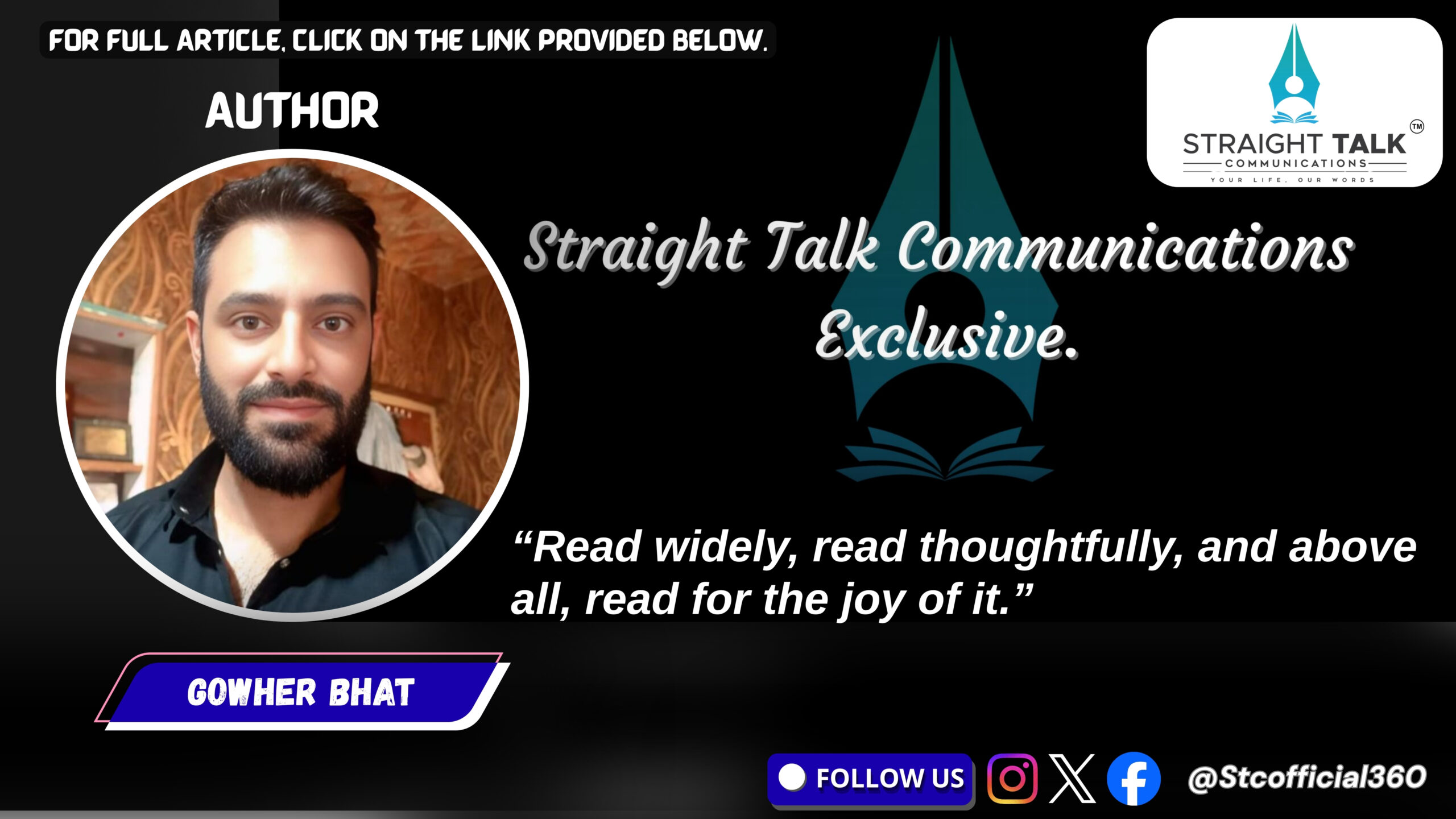
“Read widely, read thoughtfully, and above all, read for the joy of it.”
Gowher Bhat
Long before smartphones, social media, and endless digital content competed for our attention, Virginia Woolf understood something profound about books. Reading is not simply a hobby or a way to pass time. It is one of the most creative and rewarding experiences available to human beings.
In her famous 1926 essay, How Should One Read a Book?, Woolf asks a question that remains just as relevant today as it was a century ago. Surrounded by countless novels, poems, histories, biographies, and memoirs, how should we read them? What should we look for in them? Should we read for pleasure, for knowledge, for wisdom, or for something deeper?
Rather than offering strict rules, Woolf invites readers to think carefully about the act of reading itself. Her essay is not a manual but a conversation. It encourages us to reflect on our relationship with books and to consider what makes reading such an important part of human life.
At the heart of the essay lies a simple but powerful idea. There is no single correct way to read a book. Literature flourishes through curiosity, imagination, and personal discovery rather than rigid rules. While facts can be taught and memorized, great books demand something more. They ask us to be patient, thoughtful, and willing to enter another person’s vision of the world.
To explore this idea, Woolf imagines a room filled with books of every kind. There are novels, poems, histories, biographies, memoirs, dictionaries, and books written in different languages. Standing before such a collection, any reader might feel overwhelmed. Where should one begin? What kind of book should one choose? What is the true purpose of reading?
These questions lead Woolf to one of the central arguments of her essay. Different books require different approaches. A poem should not be read in the same way as a biography. A novel should not be judged by the standards of history. Every form of literature has its own purpose and its own way of revealing truth.
To make this point clearer, Woolf compares books to different animals. Just as a tiger and a tortoise cannot be judged by the same qualities, books cannot be measured by the same expectations. Problems arise when readers expect every book to do the same thing. A poem is not meant to provide historical facts, and a history book is not required to possess the imaginative beauty of poetry.
This understanding becomes even more important as Woolf discusses the relationship between readers and writers. Reading, she argues, is not a passive activity. It requires effort, imagination, and participation. The reader must meet the writer halfway.
Perhaps the most memorable line in the essay is Woolf’s suggestion that we should read a book as if we were writing it ourselves. Instead of rushing to judge, we should first try to understand. We should ask what the writer is attempting to achieve and how that goal shapes every page of the book.
To illustrate this point, Woolf imagines how three great writers, Daniel Defoe, Jane Austen, and Thomas Hardy, might describe the same simple event, meeting a beggar in the street. Each writer would approach the scene differently because each sees the world through a unique artistic lens.
Defoe would focus on facts and narrative detail. Austen would be interested in character and social relationships. Hardy would transform the event into something larger, exploring humanity’s relationship with nature, fate, and destiny. None of these approaches is superior to the others. Each represents a different way of understanding reality.
From this discussion emerges another important lesson. Great writers do not all think alike, and great readers must learn to appreciate different ways of seeing the world. This is not always easy because every reader carries personal preferences and biases.
Some readers naturally enjoy Hardy’s emotional intensity, while others prefer Austen’s wit and precision. Certain books attract us immediately, while others challenge us from the beginning. Yet Woolf encourages us not to dismiss difficult books too quickly. The works that demand the greatest effort often provide the richest rewards.
This insight leads naturally to another of Woolf’s observations. Reading, especially serious reading, can be demanding. It requires concentration, imagination, and emotional engagement. Even the finest books can become difficult when the mind is tired.
For that reason, Woolf speaks of what might be called the art of resting the mind. Readers should occasionally step away from demanding literature and spend time with biographies, memoirs, letters, and lighter works. Such books refresh the imagination and prepare us to return to more challenging reading with renewed energy.
Having discussed fiction and biography, Woolf turns her attention to poetry. Here the demands on the reader become even greater. Poetry often abandons the familiar comforts of plot and character. Instead, it relies on rhythm, imagery, sound, and metaphor.
To read poetry well, Woolf argues, we must engage not only our intellect but also our emotions and imagination. Poetry is not something to be dissected mechanically. It is something to be experienced. Its meaning often lies as much in feeling as in explanation.
Yet understanding alone is not enough. Once a book has been read, another stage begins. The reader must move from sympathy to judgment.
During the act of reading, our impressions are often incomplete. We are too close to the story to see it clearly. Only later, after some time has passed, does the book reveal its full shape and significance.
Woolf beautifully describes how this process unfolds. While walking, listening to music, gardening, or carrying out ordinary tasks, the book gradually reorganizes itself in the mind. Characters, themes, and events settle into place. What once seemed scattered begins to form a coherent whole.
Only then can we properly evaluate what we have read. And when that moment comes, Woolf advises us to trust our own judgment. Critics may guide us, but they should never think for us. Reading is ultimately a personal encounter between an individual mind and a work of literature.
This emphasis on independent thought is one of the essay’s most enduring strengths. In an age dominated by ratings, reviews, and social media recommendations, Woolf’s message remains remarkably relevant. Readers should be willing to listen to others, but they should also have the confidence to form opinions of their own.
The essay concludes with a passionate celebration of reading itself. Woolf acknowledges that reading may not always provide practical rewards. It does not necessarily make us richer or more successful. Yet it enriches life in ways that are far more meaningful.
Books expand our imagination, deepen our understanding of others, and help us see beyond the limits of our own experience. Through literature, we encounter distant places, different cultures, and unfamiliar ways of thinking. We learn not only about the world but also about ourselves.
Nearly a century after it was first published, How Should One Read a Book? continues to speak to readers across generations. Its lasting appeal lies in its celebration of curiosity, imagination, open-mindedness, and independent thought.
Virginia Woolf reminds us that reading is not simply the act of moving our eyes across a page. It is a conversation between writer and reader, a journey of discovery that continues long after the final page has been turned.
Perhaps that is why books continue to matter. In a fast-moving world filled with distractions, they still offer something rare and precious, the chance to slow down, think deeply, and connect with the richness of human experience. And nearly one hundred years after Woolf asked her famous question, her answer remains clear. Read widely, read thoughtfully, and above all, read for the joy of it.
(STRAIGHT TALK COMMUNICATIONS EXCLUSIVE)